


This article was automatically translated from the original Turkish version.
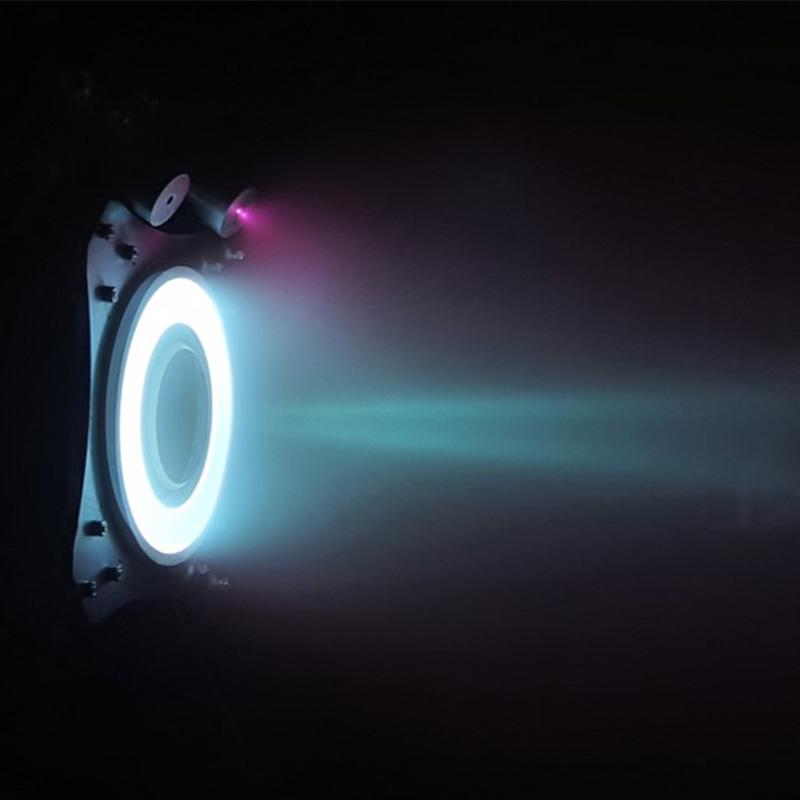
Hall Effect Thruster (HALE) Project
Executive Body | TÜBİTAK SPACE | ||||||||
|---|---|---|---|---|---|---|---|---|---|
Purpose(s) | Develop a domestic and national Hall-effect electric propulsion engine | ||||||||
Application Area(s) | Satellite orbit adjustment and stabilization in orbit positioning | ||||||||
Infrastructure Features | 300 m² R&D area, clean room (100 m²), test tanks with varying dimensions and vacuum levels, plasma, temperature and magnetic field test systems, automation infrastructure for engine lifespan and environmental condition testing | ||||||||
A Hall-effect thruster is a spacecraft propulsion system developed within the scope of electric propulsion technologies, which generates thrust by accelerating ionized gases using an electromagnetic field. In these systems, xenon—a noble gas—is commonly used; after being converted into plasma, it is expelled at high velocity through magnetic field guidance. This process imparts a thrust force on the spacecraft in accordance with Newton’s third law of motion.
Research on electric propulsion systems in Türkiye was institutionalized with the “Hall-Effect Thruster Development Infrastructure Project (HALE),” initiated in 2010 and led by TÜBİTAK UZAY.
Hall-Effect Thruster Development Infrastructure Project – HALE (TÜBİTAK)
Through this project, the necessary infrastructure for the design, manufacturing, testing, and integration of indigenous Hall-effect thrusters was established. Additionally, under the leadership of the Türkiye Space Agency (TUA), the HALE project aimed to enhance domestic production capabilities and reduce external dependency in the space sector.
Under the HALE project, the following infrastructure was established at TÜBİTAK UZAY:
Clean room, mechanical and electronic workshops, and work offices (total ~300 m², of which 100 m² is clean room).
Vacuum test facilities:
Tank with diameter 2.3 m × depth 4.5 m (pressure range 2×10⁻⁷ – 13×10⁻⁶ Torr, up to 1.5 kW power).
Tank with diameter 0.6 m × depth 1.1 m (pressure 10⁻⁸ Torr) – for low-power thrusters.
Tank with diameter 1.2 m × depth 2 m – for sub-level testing.
Test equipment: Plasma diagnostic probes (Faraday, Langmuir), magnetic field setups, thermal cameras, flow control devices, vacuum and temperature test chambers.
Automation infrastructure: Sufficient automation for thruster lifetime tests and thermal/cryogenic start-up tests (–150 °C to +125 °C) was commissioned by 2025.
The HALE infrastructure includes the following subsystems, primarily centered on two thruster types:
In addition, fuel feed units, power processing and control units (PPCU-1500, PPCU-300), and fuel tanks have also been developed.

Vacuum Tank (TÜBİTAK)
In Hall-effect thrusters, a cylindrical plasma chamber is used. A ring-shaped anode is located at the closed end, while the cathode is positioned externally. A high voltage applied between the anode and cathode ionizes the gas (typically xenon).
The magnetic field directs electrons into spiral trajectories, while positive ions are directly accelerated and expelled through the exhaust, thereby generating thrust on the spacecraft. This system is well suited for long-duration and efficient thrust production but is insufficient for launch from Earth’s surface.
Bilim Genç. "İnanılmaz Motor II: Hall İtki Sistemi." TÜBİTAK Bilim Genç, Accessed June 11, 2025. https://bilimgenc.tubitak.gov.tr/video/inanilmaz-motor-ii-hall-itki-sistemi.
TÜBİTAK UZAY. "Elektrikli İtki Motoru Geliştirme Altyapısı." uzay.tubitak.gov.tr, Accessed June 11, 2025. https://uzay.tubitak.gov.tr/elektrikli-itki-motoru-gelistirme-altyapisi/.
TÜBİTAK UZAY. "Elektrikli İtki Sistemi ve Motoru." TÜBİTAK UZAY, Accessed June 11, 2025. https://uzay.tubitak.gov.tr/uydu-alt-sistem-ve-bilesenleri/elektrikli-itki-sistemi-ve-motoru.
Türkiye Uzay Agency (TUA). "HALE – Hall Etkili İtki Motoru Geliştirme Projesi." *tua.gov.tr*, Accessed June 11, 2025. https://tua.gov.tr/tr/proje/hale.

Hall Effect Thruster (HALE) Project
Executive Body | TÜBİTAK SPACE | ||||||||
|---|---|---|---|---|---|---|---|---|---|
Purpose(s) | Develop a domestic and national Hall-effect electric propulsion engine | ||||||||
Application Area(s) | Satellite orbit adjustment and stabilization in orbit positioning | ||||||||
Infrastructure Features | 300 m² R&D area, clean room (100 m²), test tanks with varying dimensions and vacuum levels, plasma, temperature and magnetic field test systems, automation infrastructure for engine lifespan and environmental condition testing | ||||||||
No Discussion Added Yet
Start discussion for "Hall Effect Thruster (HET)" article
History and Development
HALE Project
Products and Technical Specifications
HALE-1500 Specifications
HALE-300 Specifications
Subcomponents
Technical Operating Principle