


This article was automatically translated from the original Turkish version.
+2 More
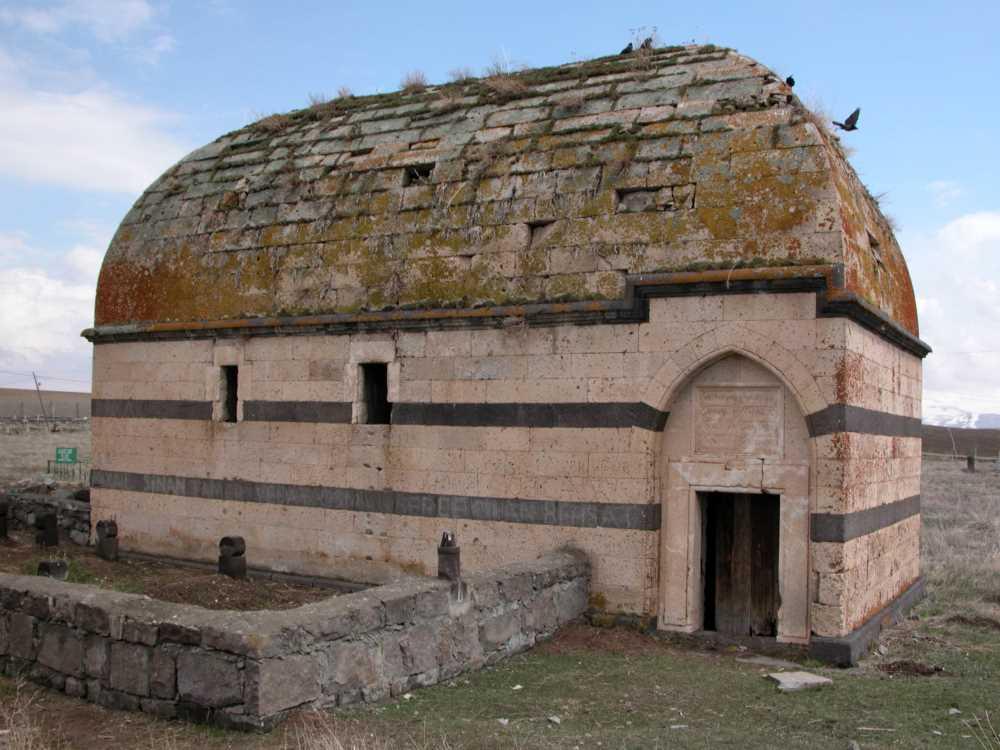
Hamur Kümbeti is a historical structure located in the Hamur district of Ağrı Province, Türkiye, and is one of the original examples of Ottoman tomb architecture. It stands in the center of an old cemetery on a high elevation in the northeastern part of the district center. Although it is not definitively known who commissioned the structure or when it was built, according to local tradition recounted by Abdullah Aziz Kaya of a prominent regional family, it was erected by Mir İbrahim Paşa, a grandson of II. İshak Paşa, builder of the İshak Paşa Palace in Bayazıt, in memory of his deceased children. The eight-line inscription above the entrance door has been damaged, but careful examination reveals the Hijri date of 1227 (Gregorian 1812–1813).

Ağrı Hamur Kümbeti- Türkiye culture portal
Hamur Kümbeti is a rectangular structure measuring 11.50 by 4.70 metres and consists of two main parts: the entrance courtyard and the main burial chamber. Access to the courtyard is through a pointed arch, eyvan-type portal located in the southwest corner. A rectangular doorway with plain stone lintels connects the courtyard to the main burial chamber. There are five mazgal windows in total: one in the courtyard and four in the burial chamber. The interiors of both sections are covered with mirrored vaults, while the exterior is crowned with a fishback-style roof. Stone projections aligned with the entrance door add an aesthetic emphasis to the structure.
The entire structure is built using precisely cut stone, with black basalt bands decorating the exterior walls and the transition to the roof. These bands, totaling four in number, are arranged as two along the main body and two at the base. It is traditionally believed that these stones were transported from Yukarı Ağadeve Village, similar to those used in the İshak Paşa Palace. These features demonstrate that Hamur Kümbeti shares material and stylistic similarities with the İshak Paşa Palace in Doğubayazıt.
Hamur Kümbeti draws attention through its refined stonework, reflecting influences from Seljuk and Ottoman architectural traditions. The stones on the exterior façade have retained their original texture over time and are adorned with geometric patterns and motifs. These decorations reveal the craftsmanship and artistic skill of artisans of the period. Particularly, star formations and abstract geometric designs lend a distinctive character to the structure’s architectural identity. The interior space is kept deliberately simple, with a spacious volume designed to accommodate visitors. The dome, the highest point of the structure, enhances the sense of openness within the interior while also serving as an aesthetic focal point.
Hamur Kümbeti holds considerable importance not only architecturally but also historically and culturally. This structure reflects the historical fabric of the region and the evolution of Ottoman architecture, standing as both a monumental tomb and a symbol of collective memory. Local tradition holds that the individuals buried here are Mir İbrahim Paşa and his brother Yusuf Bey. The four tombs inside the burial chamber are completely destroyed; only fragments of the tombstones have survived to the present day.
As an integral part of Ağrı’s historical heritage, Hamur Kümbeti is an attractive destination for both domestic and international tourists. It stands out as a key element enhancing the region’s tourism potential alongside other historical structures. The structure’s original architecture, stonework, and cultural richness attract visitors interested in history and cultural heritage.

Ağrı Hamur Kümbeti- Türkiye Culture Portal
Hamur Kümbeti is more than just a tomb structure; it is a significant cultural heritage site that reflects the cultural identity and past of the region, bearing the imprint of Ottoman architecture.
Ağrı İl Directorate of Culture and Tourism. "Hamur Kümbeti." Accessed May 18, 2025. Bağlantı
Ministry of Culture and Tourism. "Hamur Kümbeti Fotoğrafı." Kültür Portalı. Accessed May 18, 2025. Bağlantı
Ministry of Culture and Tourism. "Hamur Kümbeti Fotoğrafı." Kültür Portalı. Accessed May 18, 2025. Bağlantı
Ministry of Culture and Tourism. "Hamur Kümbeti." Kültür Portalı. Accessed May 18, 2025. Bağlantı

Architectural Features
Artistic and Cultural Values
Historical and Cultural Significance
Touristic and Cultural Contribution