


This article was automatically translated from the original Turkish version.
The Harem Aghaship was a specialized institution in the Ottoman palace responsible for the organization, security, and communication between the sultan and the harem. The harem aghas, as part of the Ottoman palace administration, were eunuch servants entrusted with managing, securing, and handling relations between the Harem-i Hümâyûn (the sultan’s private living quarters) and the outside world. Over time, this institution evolved into a powerful entity with significant political and administrative influence within the palace and state governance.
The use of eunuch officials in royal courts was not unique to the Ottoman State but rather an ancient tradition rooted in pre-Islamic civilizations. Eunuch servants were employed in the courts of ancient Mesopotamia, the Sassanids, China, Rome, and Byzantium. Similar harem-like structures also existed in the palaces of the Sumerians, Assyrians, and Achaemenids.
The Ottoman harem institution was particularly influenced by the practices of earlier Islamic states. For instance, during the reign of the Abbasid Caliph al-Muqtadir, it was recorded that the harem gained considerable influence and that state affairs were increasingly managed by women and eunuchs. In the Fatimid court, some women within the harem actively intervened in state affairs. Similar harem institutions existed in the courts of the Seljuks, Mamluks, and Timurids, resembling those of the Ottomans.
The use of eunuchs in state administration in the Ottoman Empire is believed to have begun during the reign of Sultan Mehmed Çelebi (1413–1421). The formal organization of the institution took place during the reign of Fatih Sultan Mehmed, alongside the development of the palace’s devşirme system.
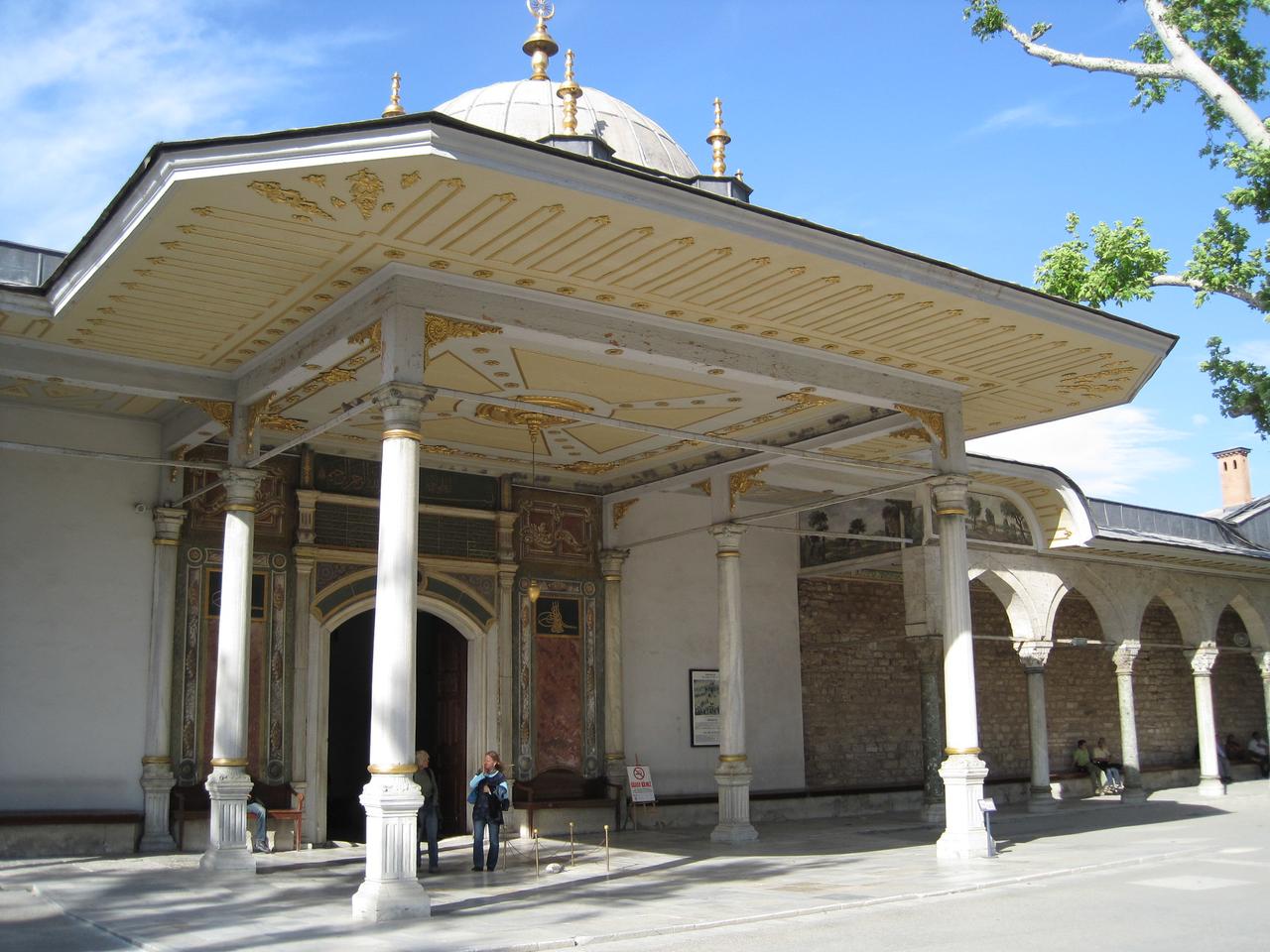
Bâbüssaâde / Topkapı Sarayı Flickr)
Initially, the most authoritative official of the harem was the Babüssaade Agha, who also managed the Enderun and was selected from the Ak Ağas. However, from the late 16th century onward, during the reign of Murad III (1574–1595), as the Harem-i Hümâyûn became fully established within Topkapı Palace and the political influence of the valide sultans increased, the authority of the Darüssaade Agha—the head of the Kara Ağas and direct administrator of the harem—began to rise. Habeşi Mehmed Ağa is regarded as the first figure who elevated the Darüssaade Ağas to a position of supremacy within the palace. From this period onward, the Darüssaade Aghaship surpassed the Babüssaade Aghaship in protocol precedence within the palace and state.
The Harem Aghaship institution was defined by both the layered physical layout of the space and the rigid hierarchical structure among its personnel. These two elements were fundamental to understanding the institution’s functioning and power dynamics.
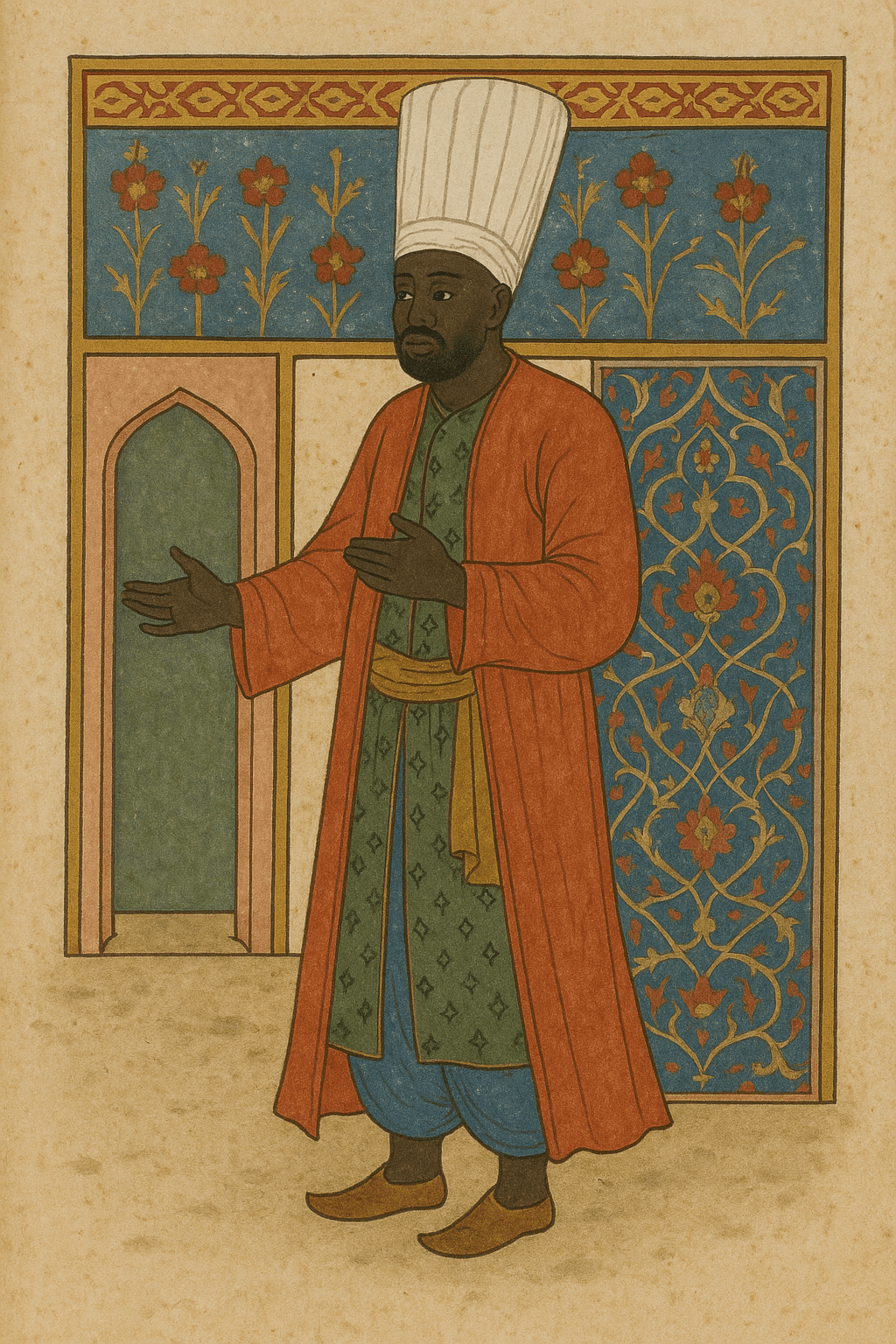
Depiction of a Harem Agha (Generated by Artificial Intelligence)
The Harem-i Hümâyûn within Topkapı Palace was not merely a residence but a layered structure reflecting privacy, security, and hierarchy. Its physical layout consisted of interconnected compartments with strictly controlled access, determined by the status and roles of its inhabitants. This structure could broadly be divided into two main sections: the Service Staff Section and the Residents Section.
This area served as the interface between the harem and the outside world and formed the first line of security. It encompassed the living and working quarters of the harem aghas and other servants.
This was the private living area of the sultan and his family, representing the highest level of privacy. Access to this section was granted through the Cümle Kapısı (Gate of the Assembly), which bore the inscription of the verse: “O you who believe, do not enter houses other than your own without seeking permission and greeting those inside...” This gate marked the boundary between two worlds.
This layered structure ensured security and preserved the privacy of its inhabitants by strictly regulating entry and movement according to established protocol and social status.
The Darüssaade Aghaship was a military-style institution, described as an “ocak” or guild, with strict internal rules and a formal promotion system. This structure provided a clear career path from the lowest to the highest ranks. Palace aghas were generally divided into three groups: the Birun Ağas, responsible for external palace services; the Ak Ağas, subordinate to the Babüssaade Agha and serving the Enderun (Inner Palace); and the Kara Ağas, subordinate to the Darüssaade Agha and serving the Harem-i Hümâyûn. The internal hierarchy of the Darüssaade Aghaship was as follows:
At the apex of the hierarchy stood the Darüssaade Agha (also known as the Great Agha or Kızlar Agha), the absolute administrator of the Harem-i Hümâyûn. He held a position of the highest protocol rank in the state, overseeing not only the harem but also major financial endowments such as the Haremeyn Vakıfları. His most important official assistants in harem administration were the Hazinedar Agha, the Hazine Vekili, and the Baş Kapı Gulamı. These aghas acted as deputies in the Darüssaade Agha’s absence.
Career Ladder within the Guild:
This system enabled even the lowest-ranking agha to rise to the highest position within the institution based on merit and loyalty.
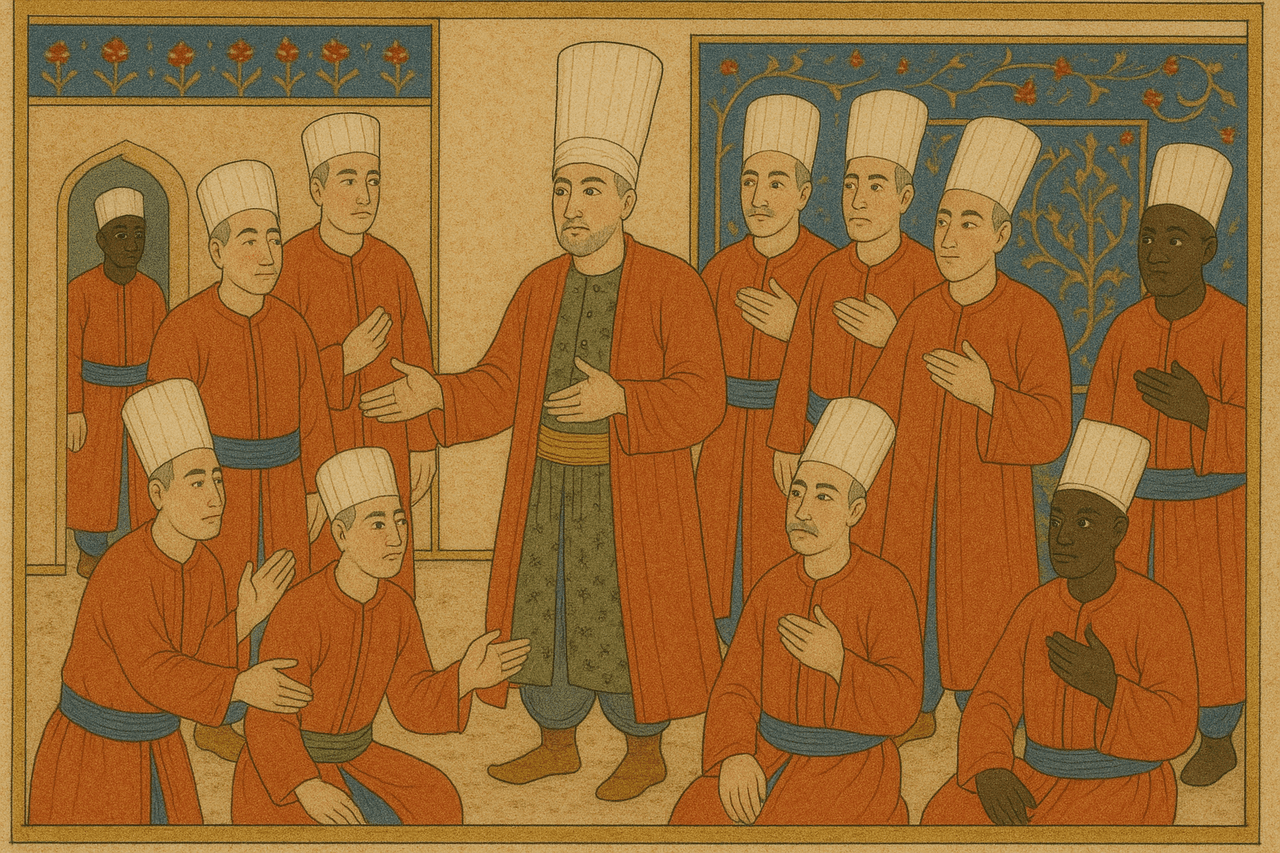
Depiction of the Harem Aghaship (Generated by Artificial Intelligence)
Perceptions of the harem aghas varied depending on the perspective of the observer.
Although the Harem Aghaship institution maintained its influence during the 18th century through figures such as Hacı Beşir Agha, it increasingly became a target of reform efforts aimed at strengthening central authority. Following the Tanzimat Edict, reforms gradually diminished the political and administrative power of the Darüssaade aghas, restricting their duties largely to the symbolic and administrative management of the harem. The institution persisted until the end of the Ottoman Empire.
Baran, Mine. “Osmanlı Klasik Dönem Saray Kültüründe Mahremiyet ve Harem.” *Milli Folklor Dergisi* 12, no. 93 (2012): 169–183. https://search.trdizin.gov.tr/en/yayin/detay/133866/osmanli-klasik-donem-saray-kulturunde-mahremiyet-ve-harem. Accessed June 11, 2025.
Demir, Nilüfer. “Osmanlı Devletinde Harem Kurumu.” *Istanbul Journal of Sociological Studies* 28 (2003): 77–87. https://dergipark.org.tr/en/download/article-file/101029. Accessed June 11, 2025.
Parent, Emmanuel. “Palais de Topkapı – Porte de la Félicité.” Flickr. Accessed June 14, 2025. https://www.flickr.com/photos/zamito44/
Tanındı, Zeren. “Topkapı Sarayı'nın Ağaları ve Kitaplar.” *Uludağ Üniversitesi Fen-Edebiyat Fakültesi Sosyal Bilimler Dergisi* 3, no. 3 (2002): 41–56. https://dergipark.org.tr/en/download/article-file/214774. Accessed June 11, 2025.
Turan, Ahmet Nezihi. “Mahremiyetin Muhafızları Darüssaade Ağaları.” *Osmanlı Araştırmaları / The Journal of Ottoman Studies* 19 (1999). https://dergipark.org.tr/en/download/article-file/112477. Accessed June 11, 2025.
Ulutürk, Muammer. “Osmanlı’da Harem Meselesi.” Tefekkür Dergisi, no. 44 (2011): 1–5. (Link)
Zengin, İlhan. “Osmanlı Sarayının En Ünlü Haremağası Hacı Beşir Ağa.” *İlahiyat Araştırmaları Dergisi* 13 (June 2020): 241–244. https://dergipark.org.tr/tr/pub/ilahiyatarastirmalaridergisi/issue/67628/1058660. Accessed June 11, 2025.
Şimşirgil, Ahmet. *Valide Sultanlar ve Harem: Osmanlı'nın Sır Dünyası*. İstanbul: Timaş Yayınları, 2014. Accessed June 11, 2025.

A Comparative Perspective with Other Palace Institutions
Historical Development
The Structure and Organization of the Harem: Space and Hierarchy
1. Spatial Organization and Layers of Privacy in the Harem-i Hümâyûn
Service Staff Section
Residents Section
2. The Harem Aghas Institution and Hierarchical Structure
Leadership and Management Cadre:
Duties, Responsibilities, and Areas of Power
Power Relations within the Harem and Interaction with Women
Perceptions within the Palace and Society
Transformation of the Institution and Decline of Its Influence