


This article was automatically translated from the original Turkish version.
Hark Island is the primary energy terminal and logistics hub located off the coast of Bushehr Province in Iran, in the Persian Gulf, through which the majority of the country’s crude oil exports are conducted.
Hark Island occupies a strategic position in the Persian Gulf, off the coast of mainland Iran. It lies approximately 30 kilometers from the Iranian mainland and about 55 kilometers from Bushehr Port. With an area ranging between 20 and 22 square kilometers, the island plays a central role in Iran’s energy infrastructure despite its small size.
Due to the surrounding deep natural waters, Hark Island is one of the few locations where large oil tankers can safely dock. Much of the Persian Gulf coastline features shallow waters, making it difficult for large-capacity tankers to approach mainland ports. As a result, the deep-water harbor around Hark Island provides a critical logistical advantage for exporting Iranian oil to global markets.
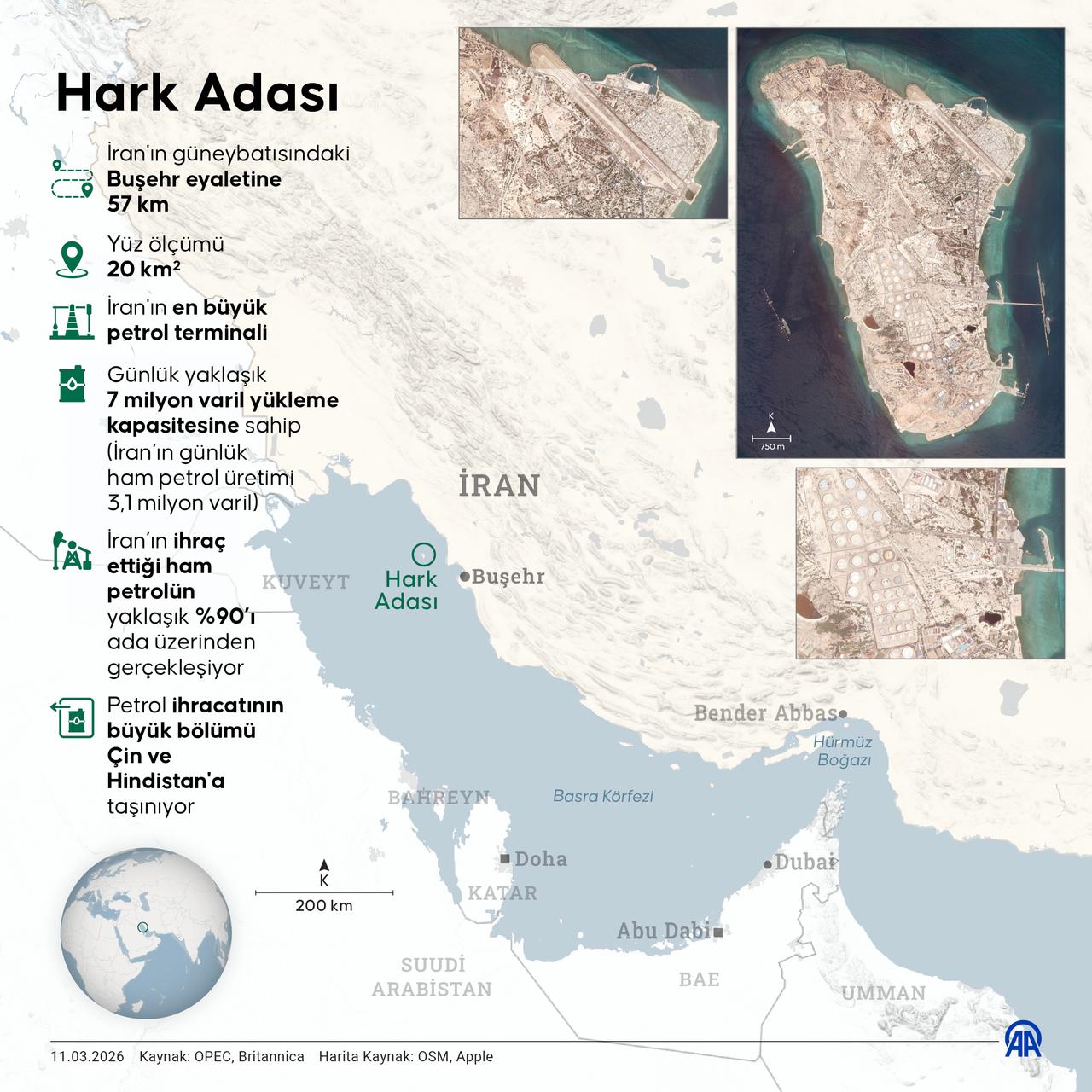
Iran’s Largest Oil Terminal: Hark Island (Anadolu Agency)
The island also functions as a residential area. With a population of approximately 8,200 people, Hark Island hosts both civilian settlements and oil infrastructure. Access to the island is restricted for security reasons, and visits generally require official permits.
Hark Island is recognized as Iran’s most important oil export center. According to Iranian media sources, approximately 90 percent of the country’s total oil exports are processed through this island. Consequently, it serves as the primary terminal linking Iran’s economy to global energy markets.
The storage capacity of the oil terminals on the island reaches approximately 28 million barrels. Loading capacity can rise to about 7 million barrels per day. This capacity establishes Hark Island as Iran’s largest oil export terminal.
Under normal conditions, the facility can handle annual oil shipments of approximately 950 million barrels. It is the main point through which Iranian oil is dispatched to international markets, particularly in Asia. China is one of the leading buyers of Iranian oil.
Due to unilateral sanctions imposed by the United States and restrictions on energy trade, actual export capacity operates below theoretical levels. Daily exports typically average around 1.6 million barrels, though they have occasionally risen to 4 million barrels. As a result, despite its technical capacity, exports generally occur at about 60 to 65 percent of the island’s maximum potential.
No oil production takes place on Hark Island. It functions primarily as a large-scale energy terminal designed for the storage and shipment of oil via tankers.
Crude oil extracted from Iran’s onshore and offshore oil fields is transported to the island via subsea pipelines. These fields include Abu Zer, Furuzan, and Dorud. Additionally, crude oil from certain onshore fields on the Iranian mainland is also conveyed through pipelines to storage facilities on Hark Island.
Oil arriving at the island is stored in large tanks and then shipped to international markets via massive tankers. The island hosts an intensive energy infrastructure comprising terminals, pipelines, and storage facilities.
This concentrated infrastructure has made Hark Island one of the key nodes in the global energy network. The concentration of major energy facilities on the island has positioned it as a critical center both economically and strategically.
The development of Hark Island as an oil export center began in the mid-20th century. In the late 1950s, the island was developed as Iran’s principal oil export terminal, and construction of its modern energy infrastructure commenced. The presence of a deep-water harbor enabled direct docking of large oil tankers, significantly enhancing the island’s role in oil trade.
With the discovery of offshore oil fields in the 1960s, the energy infrastructure on the island was expanded. During this period, terminals, storage tanks, and pipelines were constructed, establishing Hark Island as Iran’s primary oil export hub.
During the Iran-Iraq War in the 1980s, Hark Island became one of the key targets for attacks. The oil facilities on the island suffered heavy damage during the conflict but were subsequently rebuilt by Iran. This reconstruction process also included modernization of the energy infrastructure.
Due to its critical role in Iran’s energy infrastructure, Hark Island is subject to stringent security measures. The oil terminals and storage facilities on the island are classified as strategic infrastructure.
Access to the island is tightly controlled. Entry by foreign nationals, tourists, and new personnel is generally permitted only with official authorization issued by the Bushehr provincial administration or the National Iranian Oil Company. For this reason, the island is sometimes referred to as the “Forbidden Island.”
Moreover, Hark Island is regarded as one of Iran’s most heavily protected energy facilities. Military security forces and various defense systems have been deployed in the region to safeguard the energy infrastructure.
In recent years, rising regional tensions have prompted renewed discussions about the military and strategic importance of Hark Island. Some reports in U.S. and Israeli media have suggested that the island could be a potential military target aimed at disrupting Iran’s oil revenues.
Some analyses argue that gaining control over or blockading Hark Island could have severe consequences for Iran’s economy. Reports have indicated that potential military options targeting the island have been discussed within U.S. government circles.
However, it has also been noted that there are significant reservations regarding the implementation of such options. A direct attack on Hark Island could trigger major disruptions in global oil markets and potentially escalate regional conflicts.
A potential military intervention targeting Hark Island is assessed as capable of causing significant disruptions to energy markets. As the primary terminal through which the bulk of Iran’s oil exports are conducted, the island plays a vital role in the global energy supply chain.
During periods of regional tension, Iran’s potential restriction of oil transit through the Strait of Hormuz is also considered a risk to energy supply. Such a scenario could lead to a decline in oil supply and a rise in energy costs.
Iranian officials have repeatedly stated that any potential attack on Hark Island or other strategic energy infrastructure would be met with comprehensive retaliation. Such responses could include missile strikes and actions targeting energy transportation routes.
Al Jazeera. "The ‘Orphan Pearl’: Inside Kharg, the Beating Heart of Iran’s Oil Empire." Al Jazeera, March 11, 2026. Accessed March 12, 2026. https://www.aljazeera.com/features/2026/3/11/the-orphan-pearl-inside-kharg-the-beating-heart-of-irans-oil-empire
Anadolu Ajansı. “İran’ın petrol ihracındaki atar damarı: Hark Adası.” Anadolu Ajansı, March 12, 2026. Accessed March 12, 2026. https://www.aa.com.tr/tr/enerjiterminali/petrol/iran-in-petrol-ihracindaki-atar-damari-hark-adasi/55436
France 24. “Kharg Island: Iran–US–Israel War and the Strategic Importance of the Oil Hub.” France 24, March 10, 2026. Accessed March 12, 2026. https://www.france24.com/en/middle-east/20260310-iran-us-israel-war-middle-east-kharg-island-oil-hub-infrastructure-strategic-importance-global-economy
The Guardian. “Why Iran’s Vital Kharg Island Oil Hub Is Still Untouched by US–Israel Bombers.” The Guardian, March 11, 2026. Accessed March 12, 2026. https://www.theguardian.com/world/2026/mar/11/why-irans-vital-kharg-island-oil-hub-is-still-untouched-by-us-israel-bombers

Geographical Location and Physical Characteristics
Role in Iran’s Oil Exports
Energy Infrastructure and Logistics Operations
Historical Development
Security and Access Restrictions
Regional Tensions and Military Discussions
Potential Military Scenarios and Impact on Energy Markets