



HarmonyOS
Announced | 2021 | ||||||||
|---|---|---|---|---|---|---|---|---|---|
Developer(s) | Huawei | ||||||||
License | Proprietary software, except for some open-source components | ||||||||
Platform Support | – x64 and LoongArch – x86 – RISC-V – 64-bit ARM | ||||||||
Website(s) | harmonyos.com | ||||||||
Number of Languages | 77 | ||||||||
Huawei’s self-developed operating system, HarmonyOS, emerged amidst the economic and political tensions between the United States and Huawei, standing out as an alternative technology platform. In 2019, the U.S. blacklisted Huawei and restricted American companies from trading with the Chinese tech giant, prompting Huawei to make a strategic decision that accelerated the development of HarmonyOS. This article will examine the development of HarmonyOS, its features, multi-device integration, and its aim to build an independent ecosystem within the context of the needs that arose from the US-Huawei crisis.
Following the sanctions imposed by the U.S. on Huawei, the company felt the necessity to develop an independent operating system. HarmonyOS was designed to reduce Huawei’s dependence on Google’s Android ecosystem and to maintain its position in the global market.
The arrest of Huawei’s CFO Meng Wanzhou in Canada due to allegations of violating U.S. sanctions on Iran, and the blacklisting of Huawei by the U.S., led to the company’s exclusion from the Android ecosystem. This process accelerated Huawei’s efforts to develop its own independent operating system, HarmonyOS. The announcement of HarmonyOS in 2019 formed the foundation of Huawei’s strategy to reduce its dependence on Google and U.S.-based technologies.
After the crisis with the U.S., the expansion of restrictions on Huawei made the development of HarmonyOS even more urgent. For instance, the U.S. imposing limits on Huawei’s chip supply forced the company to not only develop an operating system but also create an independent ecosystem in terms of hardware.
HarmonyOS distinguishes itself from other operating systems with its multi-device compatibility, distributed architecture, and secure microkernel structure. With these features, Huawei aims to build an ecosystem that is not only usable on smartphones but also on IoT devices, tablets, televisions, and many other devices.
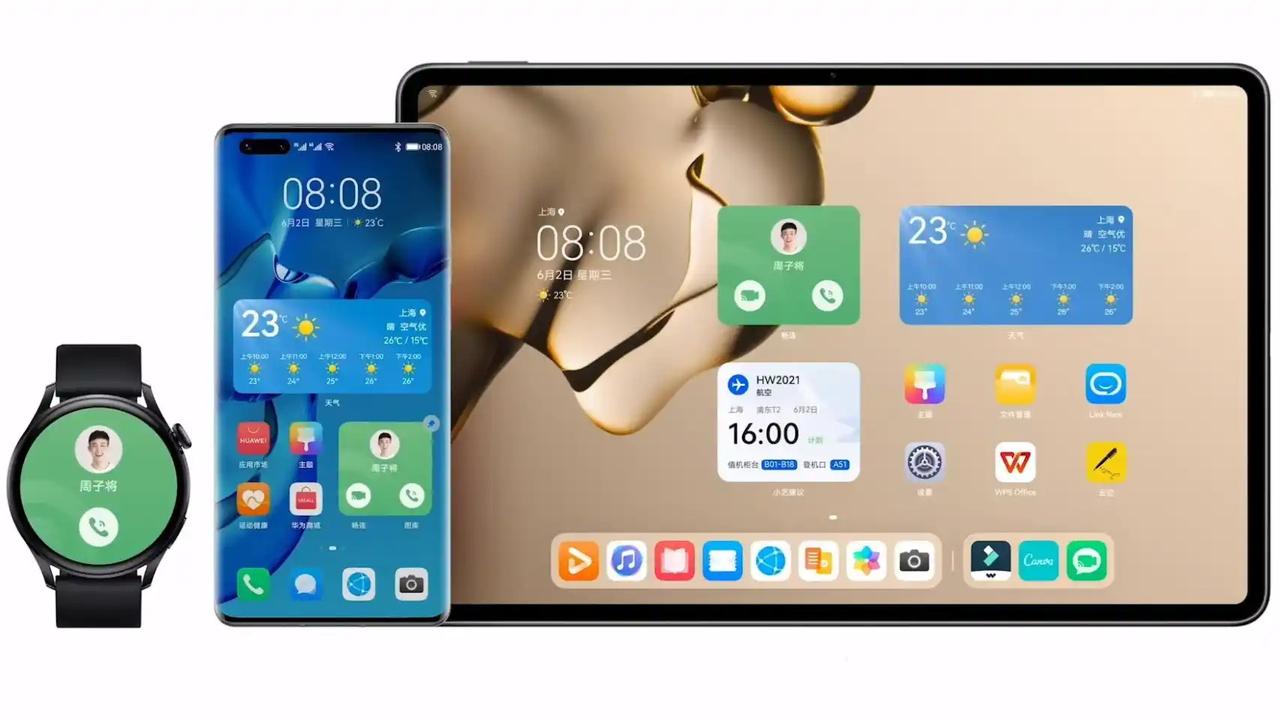
HarmonyOS has a distributed architecture that enables seamless functionality across various devices. This allows users to share data quickly between phones, tablets, televisions, and IoT devices, and to connect them to one another. For example, a file or media content on one device can be used smoothly on another. This provides a strong foundation for Huawei’s broad IoT solutions such as smart home and smart office applications.
The microkernel structure of HarmonyOS makes the operating system more efficient in terms of security and speed. Thanks to the microkernel, only necessary processes are executed, avoiding unnecessary resource usage. This structure allows it to work integrated with different hardware and ensures performance with low latency.
·Multi-Device Compatibility: HarmonyOS is designed to enable seamless operation of devices with different hardware under the same operating system. This allows users to easily share data between their phones, tablets, televisions, and IoT devices.
· Distributed Architecture: HarmonyOS uses a distributed architecture to ensure fast and seamless connection between devices. With this architecture, resources can be shared among devices, and for example, a device’s camera or speaker can be used by another device.
· Huawei Ecosystem: HarmonyOS supports applications through Huawei’s AppGallery and works integrated with Huawei’s own services. Through this ecosystem, Huawei aims to reduce its dependence on Google services and Android.
· Microkernel Structure: HarmonyOS has a microkernel-based structure to enhance security and performance. This structure provides a more secure and faster operation. Huawei claims that the microkernel runs only essential processes, reducing the attack surface and thereby increasing security.
· Flexibility and High Performance: HarmonyOS offers features like resource efficiency and low latency. The system aims to deliver a faster user experience by using device resources like processor and memory more efficiently.
· Application Compatibility: HarmonyOS is developed to support both its own applications and Android applications. This allows Android developers to easily adapt their applications to HarmonyOS.
The restrictions imposed by the U.S. on Huawei have paved the way for HarmonyOS to gain a foothold not only in the Chinese market but also internationally. Huawei is intensifying its efforts for HarmonyOS to be recognized not only as an operating system but also as a global ecosystem.
Huawei’s goal to spread HarmonyOS in markets outside the U.S. plays an important role in its development. By expanding its own application store, AppGallery, Huawei aims to offer an alternative platform to giants like Google Play Store and Apple App Store. This strategy will enable Huawei to compete not only in the Chinese market but also in major markets such as Europe and Asia. Although U.S. restrictions occasionally disrupt Huawei’s supply chain, the Chinese tech giant seems determined to build its own global ecosystem with HarmonyOS. Reports that Huawei continues to procure chips from Taiwan-based TSMC demonstrate that the company can maintain its growth strategies even under current restrictions.
HarmonyOS has joined the world of technology as a strategic innovation born from the political and economic crisis between the U.S. and Huawei. Developed as an alternative to the Android and iOS ecosystems, this operating system is a significant part of Huawei’s effort to survive as an independent technology giant. With its multi-device compatibility, distributed architecture, and security features, HarmonyOS positions Huawei beyond being just a mobile OS provider and places it at the center of a broad technology ecosystem. As tensions between the U.S. and Huawei persist, the global competitiveness of HarmonyOS and Huawei’s success in this field will continue to be closely observed.
Donanım Haber (2024). "ABD kısıtlamalarına rağmen Huawei TSMC çiplerini kullanıyor. " Last access: March 24, 2025. https://www.donanimhaber.com/abd-kisitlamalarina-ragmen-huawei-tscm-ciplerini-kullaniyor--183449
EkonomiM. "Huawei’de yasaklı çip krizi: Tayvan sevkiyatı askıya aldı." Last access: March 24, 2025. https://www.ekonomim.com/sektorler/teknoloji/huaweide-yasakli-cip-krizi-tayvan-sevkiyati-askiya-aldi-haberi-776157
Huawei Consumer. HarmonyOS Resmi Web Sitesi. Last access: March 24, 2025. https://consumer.huawei.com/tr/harmonyos/
Hürriyet (2019). "Huawei krizi: ABD ile Çin'in diplomatik soğuk savaşı mı?." Last access: March 24, 2025. https://www.hurriyet.com.tr/teknoloji/huawei-krizi-abd-ile-cinin-diplomatik-soguk-savasi-mi-41226031
Milliyet (2021). "Son dakika! Dünya bu krizi konuşmuştu! ABD ile anlaştı." Last access: March 24, 2025. https://www.milliyet.com.tr/teknoloji/son-dakika-dunya-bu-krizi-konusmustu-abd-ile-anlasti-6605523
Reuters. "Huawei's Harmony Aims to End China's Reliance on Windows, Android." Reuters. Last access: March 24, 2025. https://www.reuters.com/technology/huaweis-harmony-aims-end-chinas-reliance-windows-android-2024-06-27/

HarmonyOS
Announced | 2021 | ||||||||
|---|---|---|---|---|---|---|---|---|---|
Developer(s) | Huawei | ||||||||
License | Proprietary software, except for some open-source components | ||||||||
Platform Support | – x64 and LoongArch – x86 – RISC-V – 64-bit ARM | ||||||||
Website(s) | harmonyos.com | ||||||||
Number of Languages | 77 | ||||||||
Development and Purpose of HarmonyOS
The Impact of the US-Huawei Crisis on Development
Features of HarmonyOS
Multi-Device Compatibility and Distributed Architecture
Smart Devices Using HarmonyOS
General Features
HarmonyOS Interface
Global Market Target and Ecosystem Expansion
This article was created with the support of artificial intelligence.