


This article was automatically translated from the original Turkish version.
+1 More
HD 219134 b (HR 8832 b) is a super-Earth located just 21.25 light years from Earth in the direction of the Cassiopeia constellation. This planet is one of the closest known transiting exoplanets. It orbits a K-type star named HD 219134.
The high-precision measurement of both its mass and radius has made HD 219134 b an important reference point for scientific studies on the densities and internal structures of rocky exoplanets. Based on the obtained data, its dense structure suggests that it likely lacks a thick atmosphere and may possess an unusual mineralogical composition.
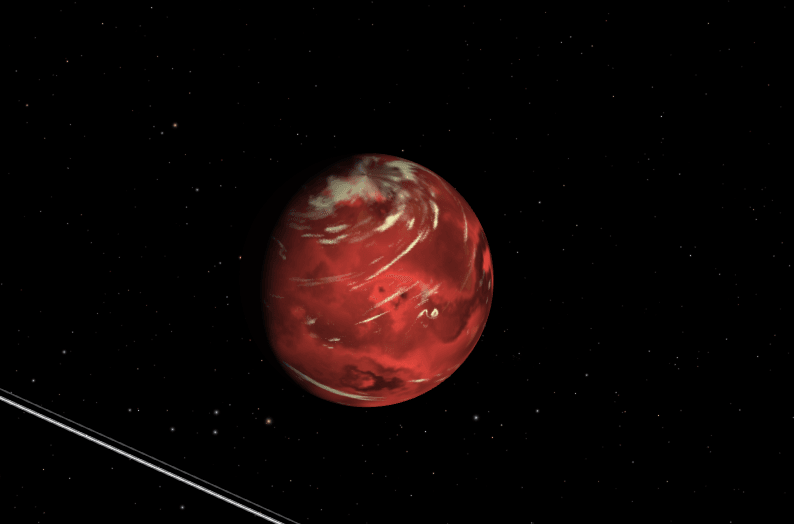
HD 219134 b (NASA)
The discovery of HD 219134 b was achieved through a two-phase observational process and announced in 2015. The first evidence of its existence came from radial velocity data collected by the HARPS-N (High Accuracy Radial velocity Planet Searcher for the Northern hemisphere) spectrograph attached to the 3.6-meter Telescopio Nazionale Galileo at the Roque de los Muchachos Observatory on the island of La Palma, Spain. A research team led by F. Motalebi from the University of Geneva analyzed regular oscillations in the star’s motion and detected the gravitational influence of multiple planets in the system.
To determine whether HD 219134 b transited its host star among these candidate planets, NASA’s Spitzer Space Telescope was employed. Spitzer successfully observed the slight dip in stellar brightness as the planet passed in front of the star. This confirmation allowed scientists to measure not only the planet’s minimum mass but also its physical radius directly. As a result, HD 219134 b has become one of the most significant transiting super-Earths due to its proximity and the detailed characterization possible for it.
HD 219134, also known as Gliese 892 or HR 8832, is an orange dwarf star of spectral class K3V. Its mass is approximately 81 percent of the Sun’s (0.81 M☉), and its radius is about 78 percent of the Sun’s (0.778 R☉). Its surface temperature is approximately 4,699 Kelvin, which is lower than that of the Sun.
Due to its proximity to Earth and apparent magnitude of 5.57, HD 219134 is one of the closest stars known to host exoplanets and is visible to the naked eye under both clear and dark skies. The system hosts at least four planets—and possibly more—making it a relatively rich planetary system.
HD 219134 b is one of the rare rocky exoplanets for which both mass and radius have been measured with high precision. Its mass is approximately 4.74 times that of Earth, and its radius is about 1.6 times Earth’s radius (1.602 ± 0.055 R⊕). These two measurements enable the calculation of its average density. The resulting density value is higher than Earth’s, confirming that the planet lacks a thick gaseous or aqueous envelope and instead has a solid, rocky structure.
Models of its internal structure suggest that HD 219134 b may possess a large iron-nickel core. More detailed analyses indicate that the conditions under which it formed may have resulted in a silicate mantle different from those of typical terrestrial planets. Some studies propose that its composition may be enriched in elements such as calcium and aluminum. This supports the hypothesis that abundant corundum minerals, which under high pressure form precious stones like sapphire and ruby, could exist in its deep interior.
HD 219134 b orbits extremely close to its host star. Its orbital period is only 3.09 days. Its average distance from the star, or semi-major axis, is approximately 0.0387 astronomical units (AU). This extreme proximity results in a very high surface temperature. The calculated equilibrium temperature is about 800 Kelvin (527 °C). This temperature places HD 219134 b firmly in the category of a “hot super-Earth,” far from habitable conditions.
HD 219134 hosts a compact and rich planetary system. HD 219134 b is the innermost known planet in the system. The other confirmed planets are:
This compact, multi-planet architecture serves as an important natural laboratory for testing theories of planet formation and evolution.
One of the most important features of HD 219134 b is that it is both a transiting super-Earth and located around a nearby, bright star. This combination makes it a primary target for atmospheric characterization studies.
Advanced observational instruments such as the James Webb Space Telescope (JWST) aim to analyze starlight filtered through the planet’s atmosphere—if it exists—or its exosphere to determine its chemical composition. Such observations will play a critical role in deepening our understanding of how hot super-Earths acquire and lose their atmospheres over time.
Gillon, M., et al. "The Spitzer search for the transits of HARPS low-mass planets II. Null results for 19 planets." *Astronomy & Astrophysics* 601 (May 2017): A117. Accessed July 20, 2025. https://www.aanda.org/articles/aa/full_html/2017/05/aa29270-16/aa29270-16.html.
Motalebi, F., et al. "The HARPS-N Rocky Planet Search I. HD 219134 b: A transiting rocky planet in a multi-planet system at 6.5 pc from the Sun." *Astronomy & Astrophysics* 584 (December 2015): A72. Accessed July 20, 2025. https://www.aanda.org/articles/aa/full_html/2015/12/aa26822-15/aa26822-15.html.
NASA Exoplanet Archive. "HD 219134 b." Caltech/NASA. Accessed July 20, 2025. https://exoplanetarchive.ipac.caltech.edu/overview/HD%20219134%20b.
NASA Jet Propulsion Laboratory. "NASA's Spitzer Confirms Closest Rocky Exoplanet." Press Release, July 30, 2015. Accessed July 20, 2025. https://science.nasa.gov/missions/spitzer/nasas-spitzer-confirms-closest-rocky-exoplanet/#:~:text=Using%20NASA's%20Spitzer%20Space%20Telescope,mere%2021%20light%2Dyears%20away.
NASA. "HD 219134 b." *NASA Science: Exoplanet Catalog*. Accessed July 20, 2025. https://science.nasa.gov/exoplanet-catalog/hd-219134-b/.

Discovery
Host Star: HD 219134
Physical Properties and Composition
Orbit and Temperature
HD 219134 Planetary System
Significance and Future Prospects