


This article was automatically translated from the original Turkish version.
+2 More
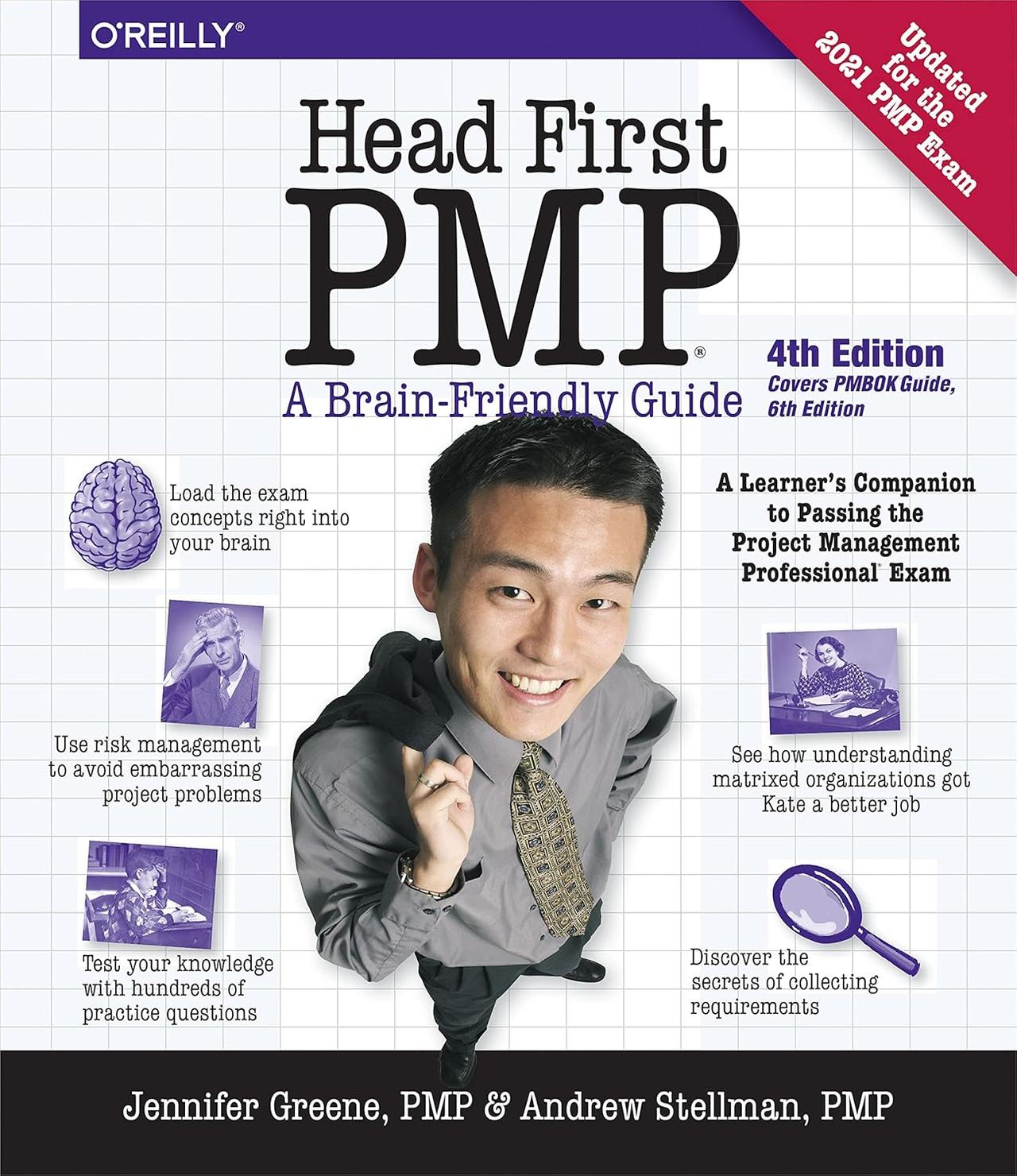
Head First PMP, 4th Edition (Book)
Book Full Title | Head First PMP, 4th Edition: The Student's Guide to Passing the Project Management Professional Exam | ||||||||
|---|---|---|---|---|---|---|---|---|---|
Author(s) | Andrew Stellman Jennifer Greene | ||||||||
Publisher(s) | O'Reilly Media | ||||||||
Edition | 4th Edition | ||||||||
Publication Year | September 2018 | ||||||||
Number of Pages | 922 pages | ||||||||
ISBN | 9781492029649 | ||||||||
Scope(s) | 100% Aligned with the PMI® PMBOK® Guide 6th Edition | ||||||||
Audience | Professionals Seeking to Learn the PMBOK 6th Edition CAPM Candidates Project Managers preparing for the PMP Exam | ||||||||
Language(s) | English | ||||||||
Size(s) | 20.32 x 4.32 x 23.11 cm | ||||||||
Head First PMP is a PMP exam preparation book published in its fourth edition in 2018 by O’Reilly Media. The authors are Jennifer Greene and Andrew Stellman. In this edition, the authors emphasize their aim to present the updated principles from the 6th edition of The PMBOK® Guide in a visual and learning science-based format. The book’s page layout follows the characteristic style of the Head First series; illustrations, diagrams, graphs and colorful visuals accompany the textual explanations.
The book is organized around the project management process groups and knowledge areas covered in the PMP exam. The initial chapters introduce project management, the role of the project manager, and the project environment and process framework. Subsequent chapters cover the PMBOK knowledge areas in sequence: Project Integration Management, Scope Management, Time Management, Cost Management, Quality Management, Resource Management, Communication Management, Risk Management, Procurement Management, and Stakeholder Management. The chapter titles are arranged to align with the PMI exam syllabus and follow the sequence of the PMBOK Guide. Thus, each chapter in the book presents the relevant PMBOK knowledge area concepts within a context designed to facilitate learning and retention.

Head First PMP (O'Reilly Media)
The fourth edition encompasses all principles and exam objectives from the PMBOK® Guide 6th edition. The authors explicitly state that the book includes all topics from the 6th edition of the PMBOK Guide. Consequently, the book’s scope directly corresponds to the content of the PMP certification exam. It is primarily aimed at experienced project managers preparing for the PMP certification and those seeking to effectively apply project management knowledge both in exams and in professional practice. The authors clearly indicate that this book is suitable for individuals who wish to prepare for the PMP exam and become better project managers as a result. Due to its coverage of fundamental project management concepts, the book is also usable by CAPM exam candidates. Additionally, the book includes exam strategies and hundreds of practice exam questions.
The book employs the Head First series’ customized pedagogical methods to facilitate learning and enhance information retention. Drawing on learning science and neuroscience research, visual multisensory techniques are applied in presenting information. Content is delivered through interactive puzzles, games, practical problems and simulated examples. Key features include:
All these methods aim for long-term learning beyond the exam; rather than providing rote information for test memorization, the book ensures deep conceptual understanding.
The book is highly aligned with the PMBOK Guide. Its chapter sequence and content are fully structured to mirror the PMBOK’s process groups and knowledge areas. The authors recommend using the book alongside the PMBOK Guide, emphasizing that this combination supports the exam preparation process. The book also includes PMP-specific tips and exam strategies, guiding readers through how process groups integrate and how to approach questions likely to appear on the exam. The latest edition of Head First PMP organizes all PMBOK principles underlying the PMP exam into a structured study plan.
The book’s page design heavily utilizes graphics and diagrams for information delivery. As per the Head First style, most pages feature images, schematics and eye-catching headings. These visual elements make abstract concepts concrete and easier to understand. For instance, in the Project Integration Management chapter, complex process flows are supported by visual diagrams; in the Time Management chapter, critical path calculations are illustrated with graphs. This visual format aids more effective encoding of information in the reader’s mind. Earlier chapters also include exam-style multiple-choice questions and elements such as “Crossword Puzzles.”
The fourth edition has been updated to reflect the new PMP exam content introduced by PMI in January 2021. In that year, PMI defined three main domains for the exam: “People,” “Process,” and “Business Environment,” while still basing the exam content on the 2017 PMBOK 6th edition. In alignment with this new structure, questions in chapters 15 and 16 have been rebalanced and new topics added to match the updated exam content. As a result, the book remains current with the PMP exam content as of 2021.
Greene, Jennifer, and Andrew Stellman. Head First PMP: A Learner’s Companion to Passing the Project Management Professional Exam. 4. baskı. Sebastopol, CA: O’Reilly Media, 2018.
O’Reilly Media. *Head First PMP, 4th Edition*. O’Reilly Online Store. Accessed May 18, 2025. https://shop.oreilly.com/product/0636920133766.do.

Head First PMP, 4th Edition (Book)
Book Full Title | Head First PMP, 4th Edition: The Student's Guide to Passing the Project Management Professional Exam | ||||||||
|---|---|---|---|---|---|---|---|---|---|
Author(s) | Andrew Stellman Jennifer Greene | ||||||||
Publisher(s) | O'Reilly Media | ||||||||
Edition | 4th Edition | ||||||||
Publication Year | September 2018 | ||||||||
Number of Pages | 922 pages | ||||||||
ISBN | 9781492029649 | ||||||||
Scope(s) | 100% Aligned with the PMI® PMBOK® Guide 6th Edition | ||||||||
Audience | Professionals Seeking to Learn the PMBOK 6th Edition CAPM Candidates Project Managers preparing for the PMP Exam | ||||||||
Language(s) | English | ||||||||
Size(s) | 20.32 x 4.32 x 23.11 cm | ||||||||
No Discussion Added Yet
Start discussion for "Head First PMP, 4th Edition (Book)" article
Content and Structure
Scope and Target Audience
Methodology and Educational Approach
PMBOK Alignment and Exam Preparation
Visual Content and Diagram Usage
Updates Specific to the Fourth Edition