

This article was automatically translated from the original Turkish version.
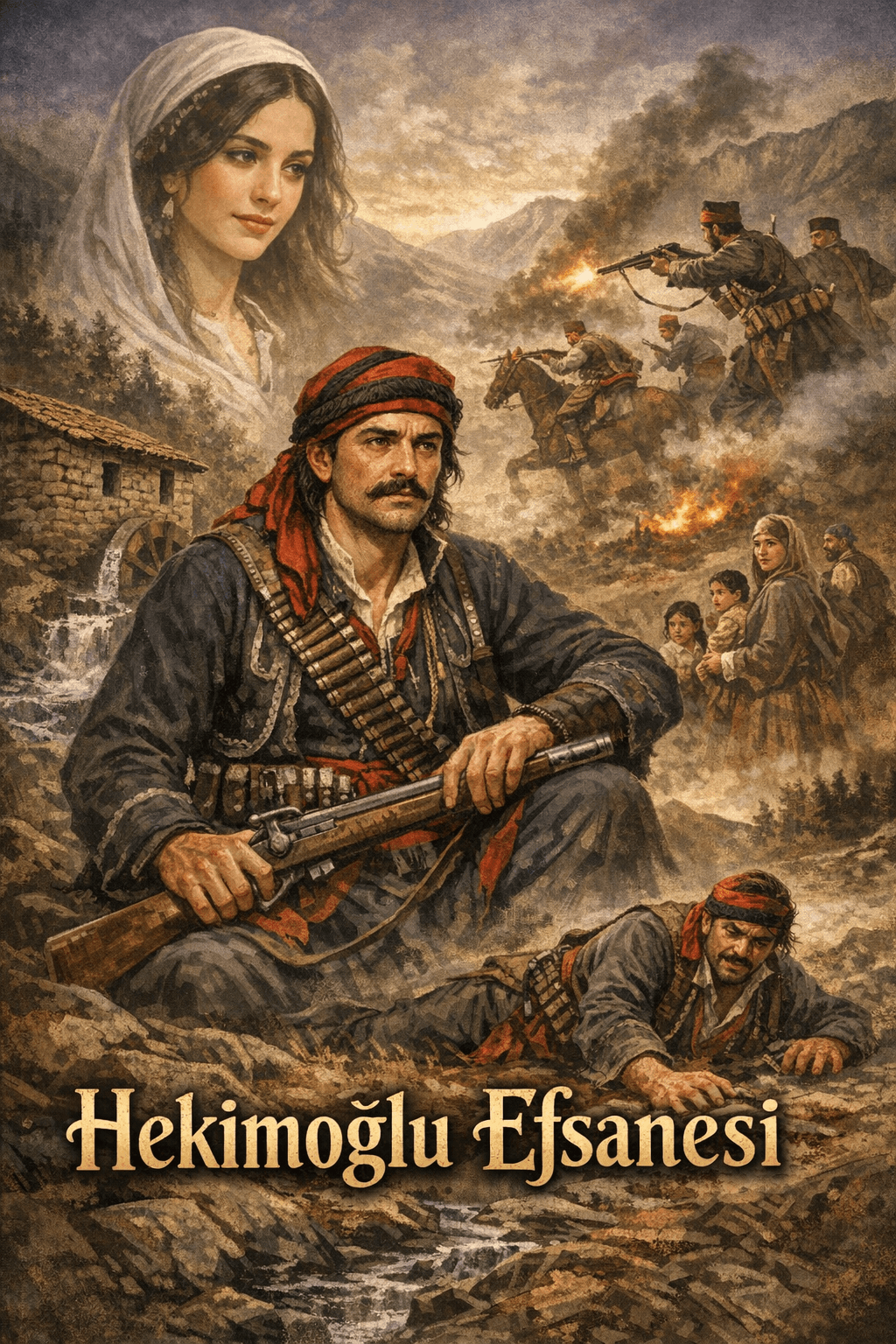
The Hekimoğlu Türküsü is an anonymous folk song shaped around the life, ascent to the mountains, and death of Hekimoğlu İbrahim, who lived in the Eastern Black Sea Region in the early twentieth century; it intertwines historical events with popular narrative.
It is stated that Hekimoğlu İbrahim came from Yassıtaş village in the Fatsa district of the Canik Sanjak and belonged to a poor family. At the beginning of the 1900s, a romantic dispute involving Georgian immigrants marked the beginning of the process that led to Hekimoğlu’s ascent to the mountains. While working at the mill of Georgian Sefer Ağa, this incident escalated into a fatal conflict with Seyyid Ağa, the Georgian landlord, and his circle.
Following this event, fearing revenge, Hekimoğlu fled to the mountains and began his activities as an outlaw; he roamed for a long time undetected around the provinces of Trabzon and Sivas. Although constantly pursued by Georgian bands, he was protected and supported by the local Turkish population, who were disturbed by the activities of the Georgian outlaws. Hekimoğlu’s killing of Tahmasoğlu Hulûsi Ağa with his signature “mirror pistol” brought him fame in the region and made his name the subject of folk songs.
According to archival records, Hekimoğlu İbrahim was killed during a prolonged clash in Yassıtaş village on the night of 26 April 1913; his associates were subsequently captured by the gendarmerie. After his death, stories about Hekimoğlu’s life and struggle continued to circulate among the people, laying the foundation for the formation of the Hekimoğlu Türküsü.
Outlawry refers to armed activities carried out by individuals or small groups in the Eastern Black Sea Region during the late nineteenth and early twentieth centuries, when state authority was limited in rural areas. This phenomenon often arose from personal grudges, notions of honor, revenge, and local social tensions.
In the case of Hekimoğlu İbrahim, outlawry did not emerge as a planned criminal organization but as a form of armed survival initiated after a murder, driven by fear for personal safety. Thanks to the mountainous geography of the region, which provided ample hiding places, these activities persisted for a long time; the protective attitude of a segment of the local population played a significant role in prolonging this process.
In this context, outlawry is viewed not merely as a public order issue but as a historical phenomenon shaped by the social structure of the era, local power relations, and the population’s perception of justice.
After fleeing to the mountains, Hekimoğlu İbrahim is said to have traveled through Trabzon, Ordu, Fatsa, Ünye, Niksar, and the surrounding areas of Sivas, evading capture for extended periods. It is emphasized that conflicts with Georgian bands were particularly prominent and that Hekimoğlu became a well-known figure in the region during this time.

Rifles(Ordu Provincial Directorate of Culture and Tourism)
The period in which Hekimoğlu İbrahim lived corresponds to a time when the social structure of the Eastern Black Sea Region was shaped by migrations, economic conditions, and security issues. After the 1877–1878 Russo-Turkish War, conflicts emerged between the Georgian immigrants resettled in the region and the local population over land use, livelihood resources, and social relations. This situation intensified social unrest and created conditions for occasional armed clashes.
The limited reach of state authority in rural areas and the concealment opportunities provided by the mountainous terrain created a favorable environment for the proliferation of outlawry. Part of the local population turned to self-reliance for security; during this period, certain outlaw figures were protected and supported at the local level. In this social context, concepts of honor, reputation, and power were decisive, and individual disputes could quickly acquire social dimensions. Hekimoğlu İbrahim’s flight to the mountains and the events that followed were shaped within the framework of the region’s social structure at the time.
The Hekimoğlu Türküsü is closely linked to the social structure, ethnic tensions, and public order issues of the Eastern Black Sea Region during the late nineteenth and early twentieth centuries. During this period, various conflicts occurred between Georgian immigrants from the Caucasus and the local Turkish population around Ordu, Fatsa, Ünye, and Niksar, negatively affecting the region’s atmosphere of peace. It is understood that, alongside the geographical features of the region that offered concealment and mobility, administrative and judicial gaps also contributed to the rise of outlawry. Hekimoğlu İbrahim’s conflict with Georgian immigrants gradually transcended a personal dispute and acquired the character of an ethnic tension; during this period, he was protected by the local Turkish population who were disturbed by the activities of the Georgian bands. The narratives in the folk song reveal this opposition as reflected in popular memory; Hekimoğlu is portrayed as a figure associated with justice and bravery in the region.
In this context, the Hekimoğlu Türküsü demonstrates that outlawry in the Eastern Black Sea Region was not merely a public order issue but also a cultural narrative shaped by social tensions, ethnic relations, and the people’s perception of justice, as reflected in folk music.
The story told in the song revolves around Hekimoğlu’s humble origins, disputes concerning the woman he loved, and how these events escalated into a confrontation with a Georgian landlord. According to the narrative, Hekimoğlu escaped an ambush, fled to the mountains, and began his life as an outlaw. He was protected and supported by part of the local population and became entrenched in popular memory as a figure who stood against Georgian bands.
Hekimoğlu, they say, was a young servant boy
With a belt of bullets from side to side
Hekimoğlu’s mother was that bloody woman
The snow on the mountains has melted away
They call me Hekimoğlu, my true name
I had a mirror pistol made for myself
Did you eat cream under the apple tree?
Did you say Hekimoğlu was the one who killed Hulûsi?
Don’t come, Hulûsi, don’t come, I’ll shoot you
I’ll put you among the blood
Before your house lies a field of barley
Hekimoğlu İbrahim, the color of quince
I built mansions with marble pillars
Hekimoğlu İbrahim, lion-hearted
I built mansions but could not lay the floor
I could not match Dadyan Arslan
Our mirror pistol must not choose a Georgian
Let the immigrant nation not pass here
Between Ünye and Fatsa, Ordu was established
Hekimoğlu İbrahim was shot dead
The lyrics of the folk song give the impression of a narrative spoken from Hekimoğlu’s own perspective. Beginning with descriptive phrases, the song emphasizes strength and heroism; later sections foreground expressions of lament and sorrow. The phrase “mirror pistol” is directly linked to both the historical figure and the symbolic elements of the narrative.
After Hekimoğlu İbrahim’s death, this song was passed down orally from generation to generation and entered the repertoire of folk music. It is regarded as an example of how a person historically identified as an outlaw was reinterpreted in popular memory through themes of heroism and resistance.

No Discussion Added Yet
Start discussion for "Hekimoğlu Folk Song" article
Historical Figure and Event Framework
The Concept of Outlawry
Outlaw Activities
Regional Social Structure
Regional and Cultural Context
The Story of the Song
Lyrics of the Song
Verbal Structure and Narrative Features
Place in Popular Memory