

This article was automatically translated from the original Turkish version.
+2 More
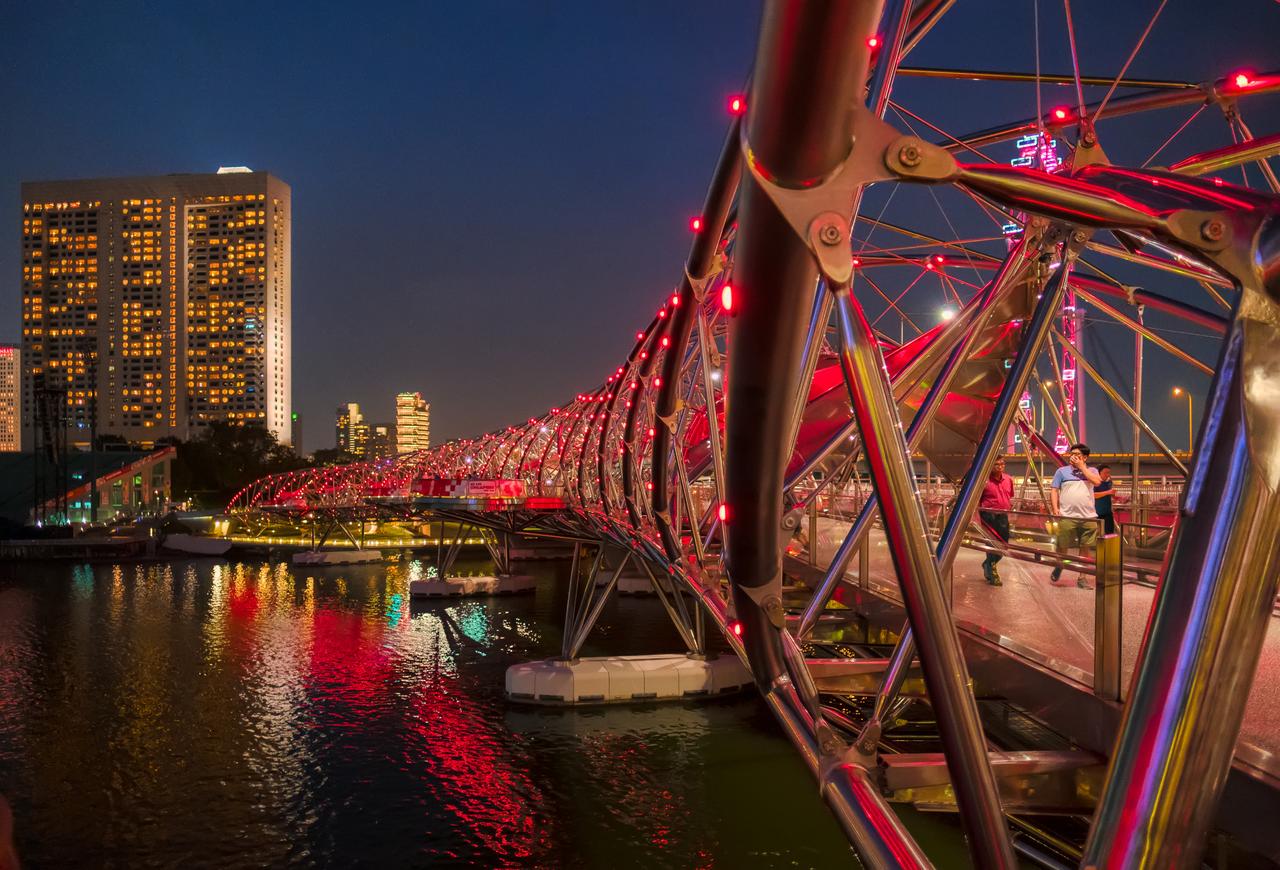
Helix Bridge is a pedestrian bridge located in the Marina Bay area of Singapore, extending across the mouth of Marina Bay. The structure connects Marina Centre with the Bayfront area, facilitating pedestrian access between Raffles Avenue and urban focal points such as Marina Bay Sands and Gardens by the Bay. Designed with a double-helix form inspired by the DNA spiral, the bridge is constructed on a steel structural system whose curved plan geometry guides pedestrian flow around the bay. The bridge was opened to the public in 2010.
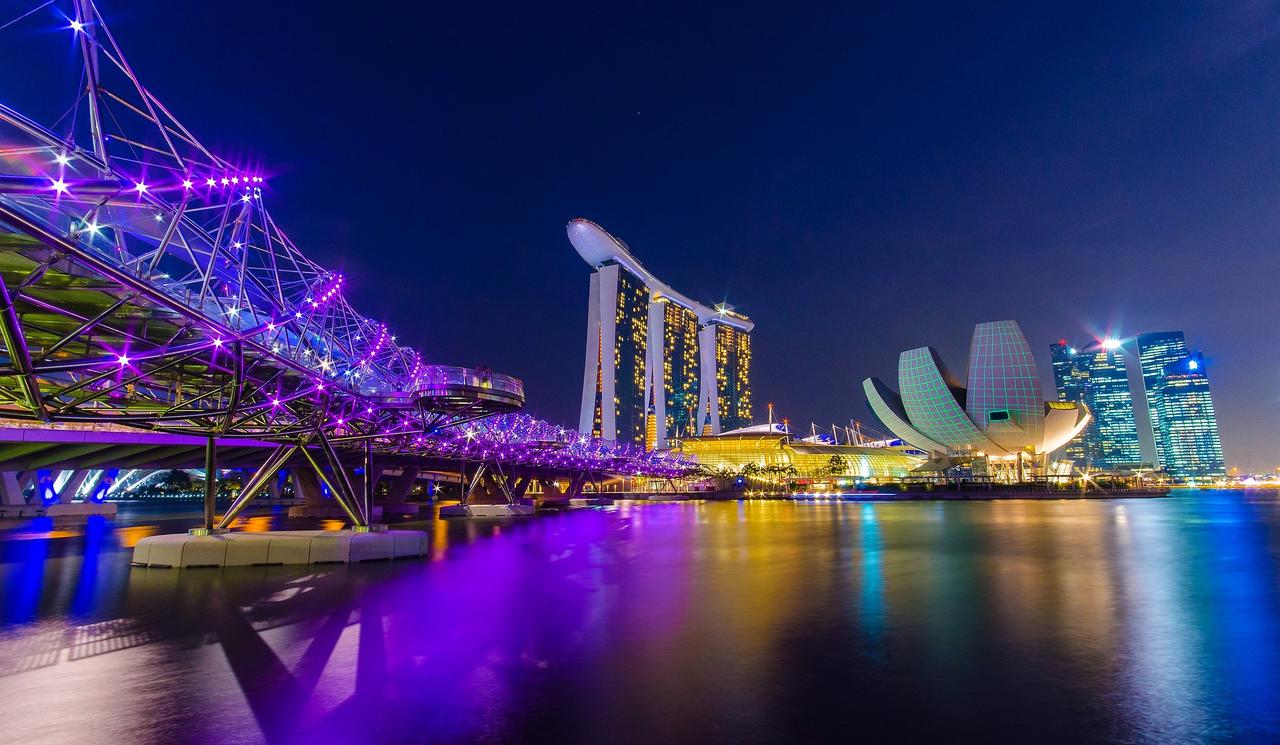
Helix Bridge (Pixabay)
The planning of Helix Bridge emerged in the mid-2000s as part of the Marina Bay urban regeneration project. The bridge was intended to provide a continuous pedestrian link between newly created public spaces around Marina Bay and existing urban areas. An international and local architectural design competition was conducted during the project process, adopting a geometric approach based on the DNA double helix. The selection of this design was driven by the goal of creating a pedestrian spine that connects the evolving commercial, tourism and recreational zones of Marina Bay.
Construction of the bridge began in 2007 and was completed and opened to the public in 2010.【1】 Following its opening, it quickly became a vital transportation link supporting pedestrian movement around Marina Bay. The structure is integrated into the waterfront pedestrian network developed as part of the Marina Bay shoreline improvements and has become an integral component of the region’s public space continuity. Helix Bridge occupies a key position within the urban system as one of the infrastructure elements connecting the shoreline during the Marina Bay development process.
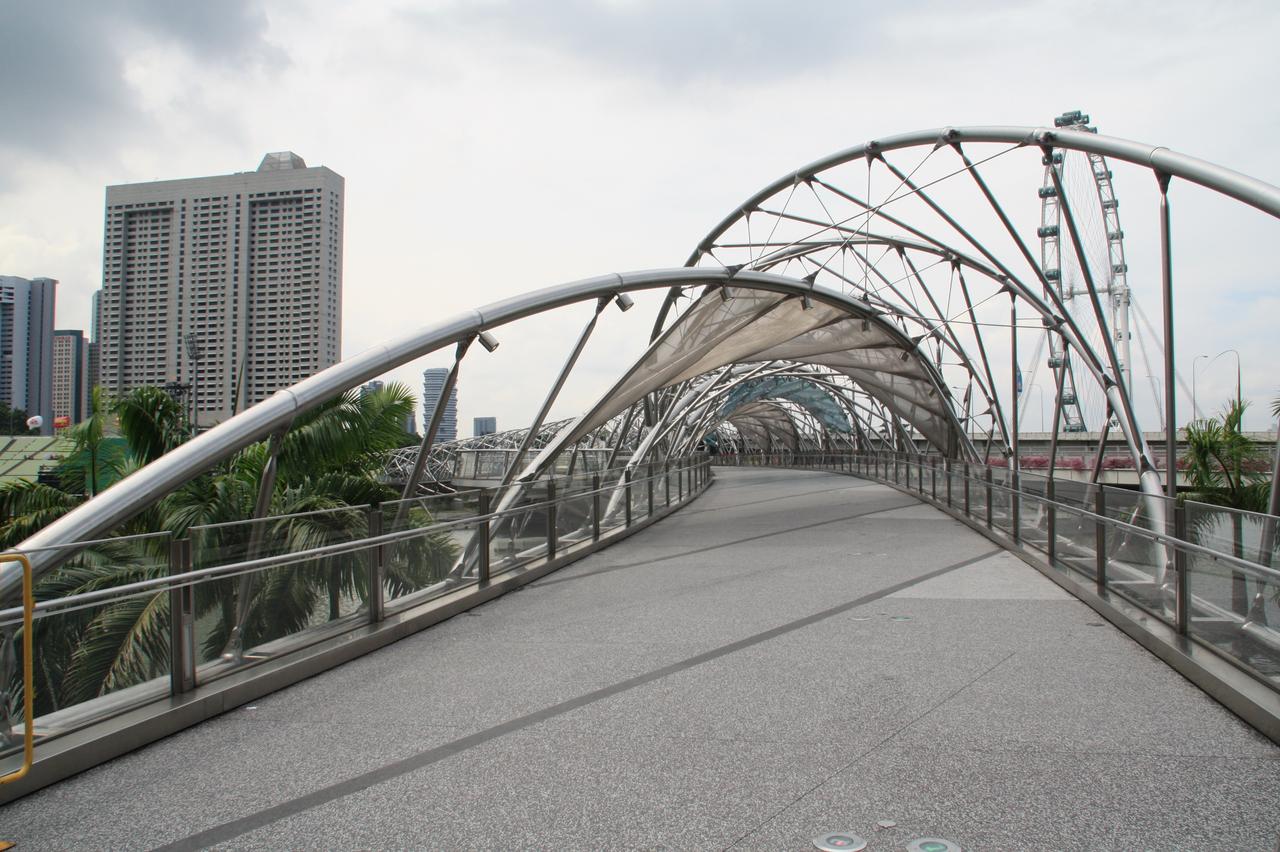
Helix Bridge (Flickr)
Helix Bridge is a pedestrian bridge shaped by an original design approach based on a double-helix geometry. The structure combines a curved plan layout and a helical form to unify structural functionality and architectural expression along the Marina Bay waterfront. Built on a steel structural system, the bridge integrates the pedestrian platform, overhead canopy and structural elements into a cohesive architectural composition. The overall form of the bridge was designed as a transitional element harmonizing with the surrounding urban landscape.
The structure is approximately 280 metres long and follows a curved geometry in plan. The main span consists of three central spans of approximately 65 metres each and two end spans of approximately 40 metres each. The pedestrian platform is approximately 6 metres wide, with the double-helix structural elements continuing continuously along both sides of the bridge.【2】 The bridge’s height above water level is approximately 8.8 metres, designed to allow passage for marine traffic.【3】 The overall height of the structure, including the helical elements, corresponds roughly to a three-storey building scale.
The design of Helix Bridge is based on a geometric approach inspired by the DNA double helix. This approach ensured the pedestrian bridge follows a sinuous path in plan and arranges its structural elements in helical formations. The form of the structure supports not only its function as a passage but also its role as an urban element that creates visual continuity along the Marina Bay waterfront. During the design process, the bridge was conceived as a linear structure guiding pedestrian flow and connecting diverse urban areas. The helical form enabled the integrated planning of the structural system and bridge geometry.
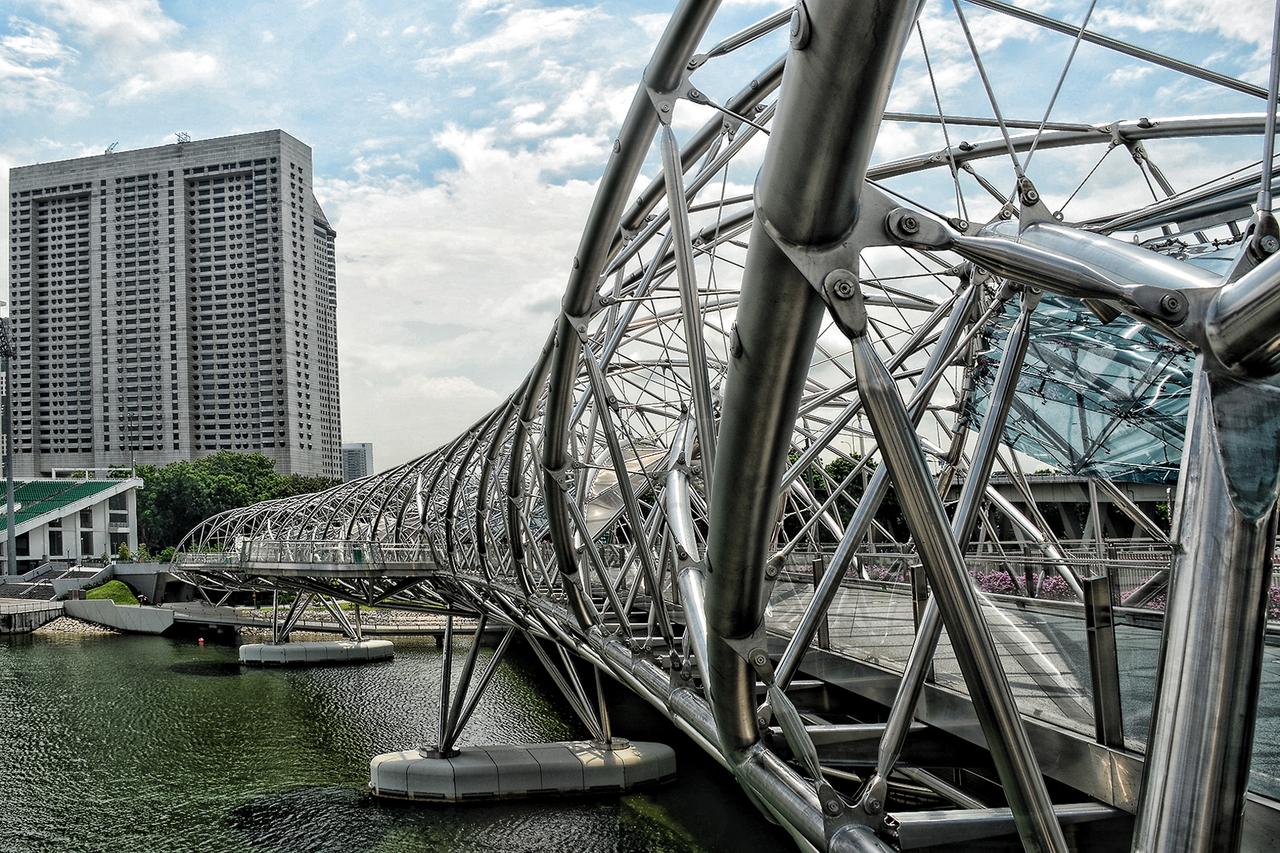
Helix Bridge (Flickr)
The primary structural system of Helix Bridge consists of steel pipe elements arranged in a double-helix configuration. These elements carry both structural loads and define the bridge’s distinctive aesthetic appearance. The pedestrian platform is integrated with the helical structural system to form a continuous structural arrangement along the bridge’s plan geometry. The structural system was designed to conform to the bridge’s curved form, with connections between elements arranged to ensure structural integrity.
The diameter of the steel pipe elements used in the structural system is 273 mm.【4】 The total length of steel pipe extending along the double helix is approximately 2,250 metres.【5】 The overall structural system of the bridge was constructed using approximately 600 tonnes of steel.【6】 The pedestrian platform is integrated into these helical structural elements, establishing a continuous structural relationship between support and deck. When considered together, the materials and structural system create a holistic structural organization that harmonizes with the urban context of Marina Bay.
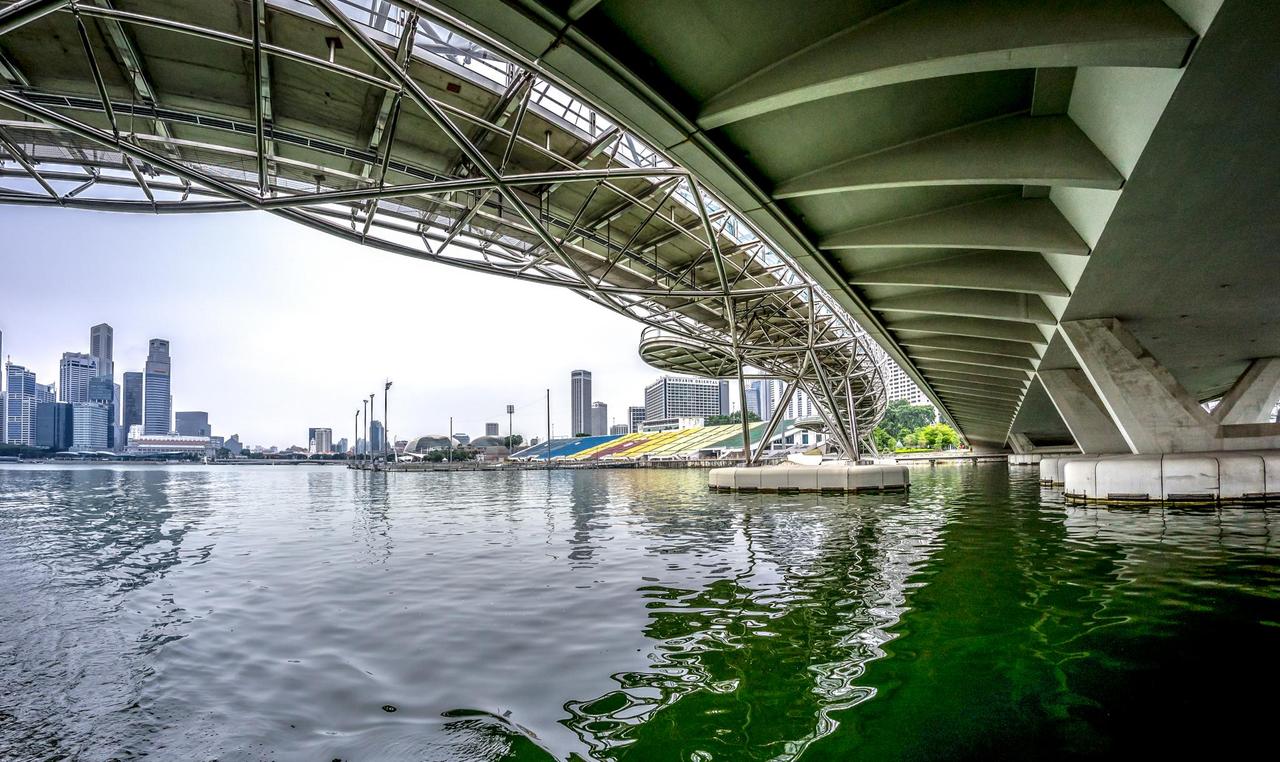
Helix Bridge (Flickr)
The engineering performance of Helix Bridge has been evaluated through experimental and numerical analyses focused on vibration behaviour and usage scenarios. Natural vibration modes of the bridge were determined through in-situ measurements and controlled loading tests, and the structure’s dynamic response under various frequencies and loading conditions was studied. Vibration behaviour was assessed under diverse load scenarios including pedestrian movement, jumping and group activities. Modal characteristics obtained from these tests were used to perform numerical simulations. The analysis demonstrated that the bridge maintains dynamic stability under different usage conditions and remains within established limit values. The engineering performance of the structure was analysed within a comprehensive dynamic framework, considering both pedestrian passage and viewing platform functions.【7】
Helix Bridge serves as a connectivity element providing pedestrian access throughout the Marina Bay area. It offers a continuous pedestrian passage between Marina Centre and the Bayfront area, facilitating access to surrounding cultural, commercial and recreational zones. The structure is used not only for daily pedestrian traffic but also as part of a pedestrian route linking key urban destinations around Marina Bay.
In addition to its pedestrian function, the bridge is also used as a viewing platform during specific periods. Observation points and cantilevered extensions along the bridge provide viewing opportunities during public events held around Marina Bay. This feature enables the structure to transcend its role as a mere transportation element and acquire the character of a public space associated with urban activities.
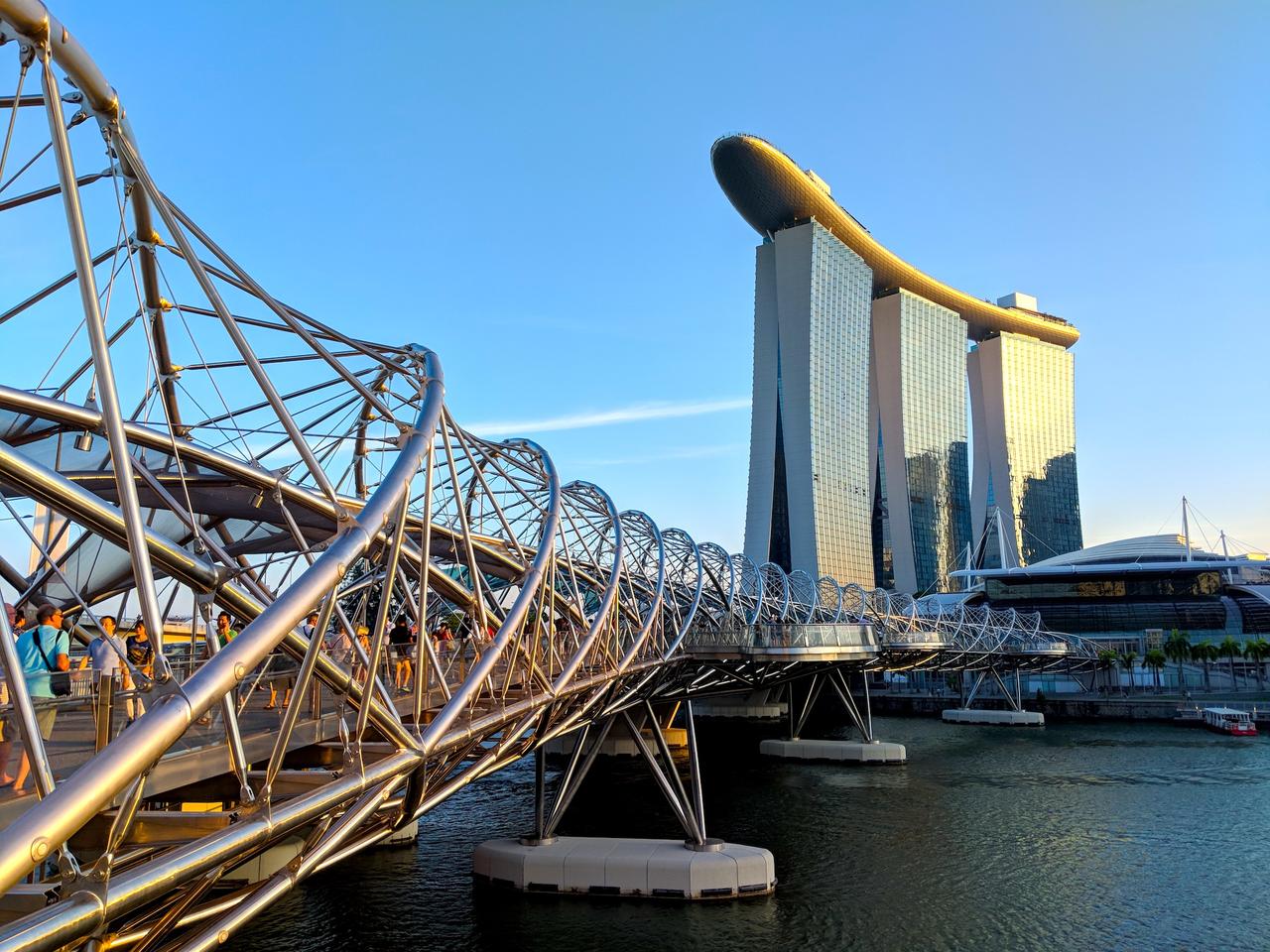
Helix Bridge (Flickr)
In addition to serving as a pedestrian connector in the Marina Bay area, Helix Bridge has become prominent for its role in sightseeing and gathering, driven by the high intensity of public use in the urban environment. Observation points along the bridge offer views of the city skyline during national celebrations and events organized by various organizations. The bridge’s location along the Marina Bay waterfront integrates pedestrian movement with public space usage, contributing to its role as an integral part of urban life. The double-helix form and open pedestrian layout enable users to establish direct visual relationships with surrounding architecture and the water surface, enhancing its function as a key element of the urban experience.
Brownjohn, James Mark William, Paul Reynolds, and P. Fok. “Vibration Serviceability of Helix Bridge, Singapore.” *Proceedings of the Institution of Civil Engineers – Structures and Buildings.* (2016): 1-19. Accessed April 24, 2026. https://ore.exeter.ac.uk/articles/journal_contribution/Vibration_serviceability_of_Helix_Bridge_Singapore/29722055?file=57155426
Bte Zakaria, Faizah. “Helix Bridge.” Singapore Government Agency Resmi Web Sitesi. Accessed April 24, 2026. https://www.nlb.gov.sg/main/article-detail?cmsuuid=40fb2a37-ebfd-4d9b-8a6c-2a0759bc9b59
Charters, Russell. "Singapore Helix Bridge-5." Flickr. Accessed April 24, 2026. https://www.flickr.com/photos/russellcharters/21784675054/
Focuszaa. "Singapur, Marina bay, Helix görseli." Pixabay. Accessed April 24, 2026. https://pixabay.com/tr/photos/singapur-marina-bay-helix-2696704/
Khora, Achresis. "Helix Bridge." Flickr. Accessed April 24, 2026. https://www.flickr.com/photos/26774111@N00/43658592641/
Mezger, Kathrin. "Helix Bridge." Flickr. Accessed April 24, 2026. https://www.flickr.com/photos/26094756@N04/15021616496/
Singapore Government Agency. "Helix Bridge - Jubilee Walk." Singapore GovernmentAgency Resmi Website. Accessed April 24, 2026. https://www.roots.gov.sg/places/places-landing/Places/landmarks/jubilee-walk/helix-bridge
Soo, Erwin. "Ritz Carlton from the Helix Bridge." Flickr. Accessed April 24, 2026. https://www.flickr.com/photos/erwin_soo/13562063733/
Subagio, Cliffano. "Helix Bridge Marina Bay." Flickr. Accessed April 24, 2026. https://www.flickr.com/photos/cliffano/25894919867/
WorldStainless. "Helix Bridge." WorldStainless. Accessed April 24, 2026. https://worldstainless.org/wp-content/uploads/2025/02/Helix_Bridge.pdf
Yut Shing, Choo. "Helix Bridge." Flickr. Accessed April 24, 2026. https://www.flickr.com/photos/25802865@N08/7182729497/
[1]
Faizah bte Zakaria. “Helix Bridge,” Singapore Government Agency Official Website, Last Accessed: 24 April 2026, https://www.nlb.gov.sg/main/article-detail?cmsuuid=40fb2a37-ebfd-4d9b-8a6c-2a0759bc9b59
[2]
James Mark William Brownjohn, Paul Reynolds and P. Fok, “Vibration Serviceability of Helix Bridge, Singapore,” Proceedings of the Institution of Civil Engineers – Structures and Buildings, (2016): 3, Last Accessed: 24 April 2026, https://ore.exeter.ac.uk/articles/journal_contribution/Vibration_serviceability_of_Helix_Bridge_Singapore/29722055?file=57155426
[3]
Faizah bte Zakaria. “Helix Bridge,” Singapore Government Agency Official Website, Last Accessed: 24 April 2026, https://www.nlb.gov.sg/main/article-detail?cmsuuid=40fb2a37-ebfd-4d9b-8a6c-2a0759bc9b59
[4]
WorldStainless, "Helix Bridge," WorldStainless, Last Accessed: 24 April 2026, https://worldstainless.org/wp-content/uploads/2025/02/Helix_Bridge.pdf
[5]
Faizah bte Zakaria. “Helix Bridge,” Singapore Government Agency Official Website, Last Accessed: 24 April 2026, https://www.nlb.gov.sg/main/article-detail?cmsuuid=40fb2a37-ebfd-4d9b-8a6c-2a0759bc9b59
[6]
WorldStainless, "Helix Bridge," WorldStainless, Last Accessed: 24 April 2026, https://worldstainless.org/wp-content/uploads/2025/02/Helix_Bridge.pdf
[7]
James Mark William Brownjohn, Paul Reynolds and P. Fok, “Vibration Serviceability of Helix Bridge, Singapore,” Proceedings of the Institution of Civil Engineers – Structures and Buildings, (2016): 6, Last Accessed: 24 April 2026, https://ore.exeter.ac.uk/articles/journal_contribution/Vibration_serviceability_of_Helix_Bridge_Singapore/29722055?file=57155426


History
Architectural Design and Structural Features
Design Approach
Materials and Structural System
Engineering Performance
Function and Usage Areas
Cultural Significance