
This article was automatically translated from the original Turkish version.
+1 More
Distance(s) | ~655 light years (approximately 200 parsecs) | ||||||||
|---|---|---|---|---|---|---|---|---|---|
Mass | ~0.3 – 0.5 M☉ (Solar mass) | ||||||||
Surface Brightness | ~13 mag/arcmin² | ||||||||
Apparent Magnitude (V) | Approximately +7.6 magnitude (mag) | ||||||||
Angular Diameter | 16′ to 20′ arcminutes (approximately 0.25° – 0.33°) | ||||||||
Constellation | Aquarius | ||||||||
Cloud Type | Planetary nebula | ||||||||
Catalog Names | NGC 7293, Helix Nebula, Caldwell 63 | ||||||||
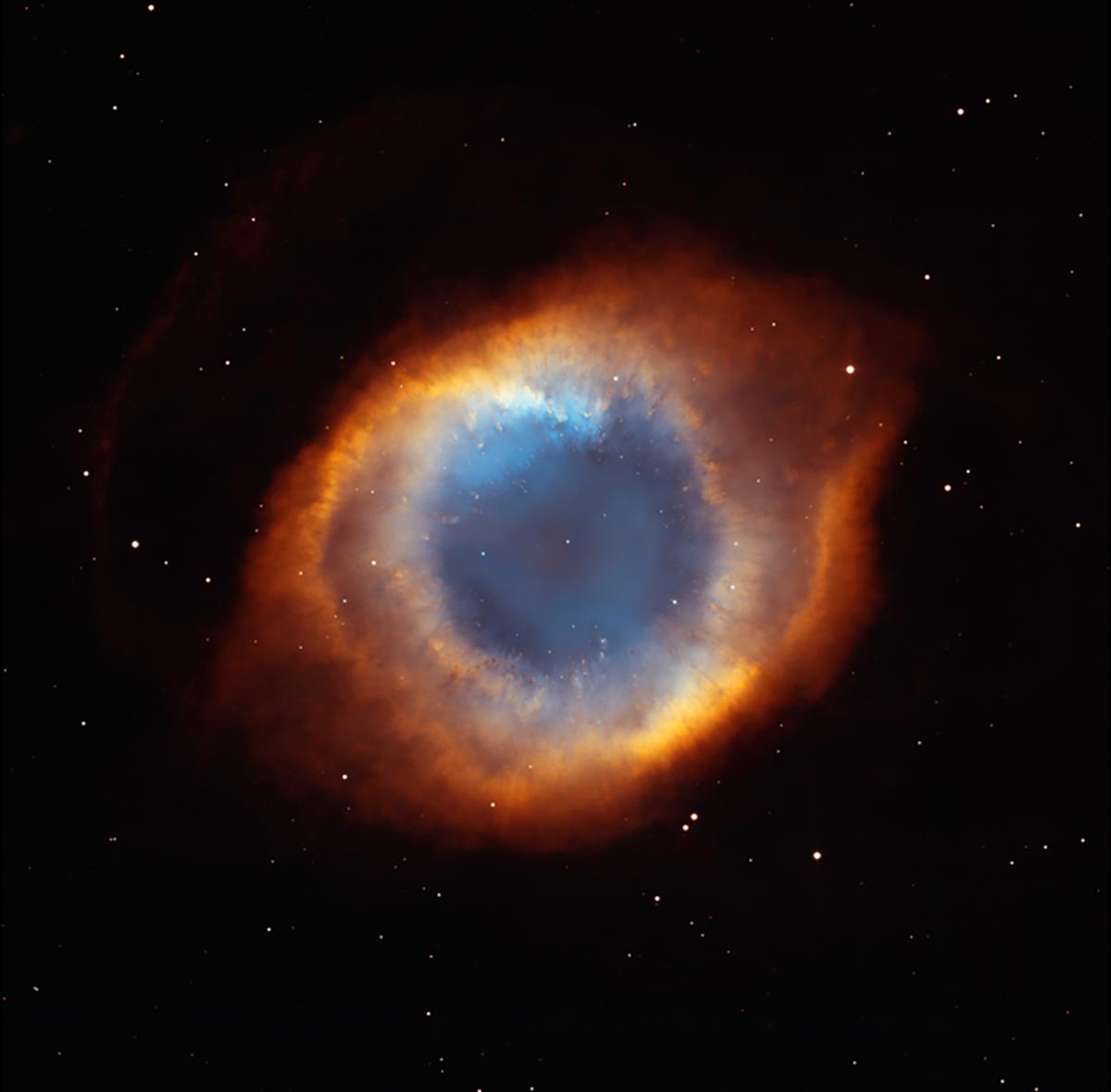
The Helix Nebula (NGC 7293), is a planetary nebula located relatively close to Earth. This structure, situated approximately 655 light-years away in the direction of the Aquarius constellation, is one of the largest planetary nebulae in terms of angular size as seen in the sky. It formed when the central star at its core ejected its outer layers during the final stages of its life. NGC 7293 is regarded as an important observational target for studying the late phases of stellar evolution and the morphological characteristics of planetary nebulae.

The Helix Nebula (NASA)
NGC 7293 is located at a distance of approximately 200 parsecs (655 light-years). The constellation Aquarius, in which it is observed, lies near the celestial equator and is visible from both hemispheres. The angular diameter of the Helix Nebula measures between 16 and 20 arcminutes, meaning it covers a larger area in the sky than the full Moon. Its true diameter is estimated to be about 2.5 to 3.0 light-years.
At the center of the nebula lies the remnant of a star transitioning into the white dwarf phase. The surface temperature of this star is approximately 100,000 K, and it emits ultraviolet (UV) photons that ionize the surrounding gas. This ionization process produces the nebula’s characteristic brightness and spectral features.
The estimated visible mass of the Helix Nebula ranges between 0.3 and 0.5 solar masses. Its composition is predominantly hydrogen and helium. Spectroscopic observations have also detected traces of heavier elements such as nitrogen (N), oxygen (O), carbon (C), sulfur (S), and neon (Ne). These elements were produced by nuclear fusion in earlier stages of the star’s life and were dispersed into the surrounding space during the ejection of its outer layers.
From an external perspective, NGC 7293 appears to have a ring-like structure. This morphological feature gave rise to its name “Helix,” meaning spiral. However, three-dimensional analyses and infrared observations reveal that the structure actually consists of multiple overlapping shells and a bipolar configuration. The layers of gas and dust expanding outward from the center were shaped by radiation pressure from the central star and the influence of previous stellar winds.
In the inner regions of the nebula, dense concentrations of gas known as “cometary knots” have been observed. These structures take the form of long tails extending up to 100 billion kilometers and have been shaped by radiation and stellar winds from the central star. Each knot is approximately 100 astronomical units (AU) in length. Although their exact formation mechanism remains unexplained, it is believed that they arise when cold gas clumps are ionized at their surfaces by UV radiation.
The Helix Nebula is characterized by prominent emission lines such as Hα (656.3 nm), [O III] (500.7 nm), and [N II] (658.3 nm). The [O III] line is the primary cause of the nebula’s bright greenish appearance. These emissions result from UV photons emitted by the central star ionizing the surrounding gas.
The nebula has been observed across optical, infrared, ultraviolet, and X-ray wavelengths. Observations by the Spitzer Space Telescope and GALEX have significantly advanced our understanding of dust structures and high-energy processes. Data from the Chandra X-ray Observatory indicate the presence of hot plasma regions surrounding the central white dwarf.
NGC 7293 is a typical example of the planetary nebula phase experienced by an intermediate-mass star (approximately 1–3 solar masses). After completing its red giant phase, the star shed its outer layers, leaving behind a core that evolved into a white dwarf. This process is driven by mass loss and the mechanisms of photon emission and ionization.
Planetary nebulae are crucial for understanding the advanced stages of stellar evolution, studying how chemical elements are dispersed into the interstellar medium, and modeling galactic chemical evolution. The Helix Nebula, due to its proximity and high observability, has been frequently studied in this context.
The Helix Nebula (NGC 7293) is a structure belonging to the class of planetary nebulae and represents the final evolutionary stage of intermediate-mass stars. Its ring-like morphology, dense gas knots, and complex structure revealed through multi-wavelength observations make it a valuable laboratory for understanding astrophysical processes.
ESA/Hubble. "Helix Nebula Detail." ESA/Hubble. Accessed July 10, 2025. https://esahubble.org/images/heic0307b/.
ESA/Hubble. “A new view of the Helix Nebula.” *ESA/Hubble*. Accessed July 10, 2025. https://esahubble.org/images/opo0432d/.
NASA. "NGC 7293: The Helix Nebula." Astronomy Picture of the Day (APOD), October 24, 2024. Accessed July 10, 2025. https://apod.nasa.gov/apod/ap241024.html.
NASA. “C63 (NGC 7293) – The Helix Nebula.” NASA Science. Accessed July 10, 2025. https://science.nasa.gov/image-detail/c63-1b/.

Distance(s) | ~655 light years (approximately 200 parsecs) | ||||||||
|---|---|---|---|---|---|---|---|---|---|
Mass | ~0.3 – 0.5 M☉ (Solar mass) | ||||||||
Surface Brightness | ~13 mag/arcmin² | ||||||||
Apparent Magnitude (V) | Approximately +7.6 magnitude (mag) | ||||||||
Angular Diameter | 16′ to 20′ arcminutes (approximately 0.25° – 0.33°) | ||||||||
Constellation | Aquarius | ||||||||
Cloud Type | Planetary nebula | ||||||||
Catalog Names | NGC 7293, Helix Nebula, Caldwell 63 | ||||||||
No Discussion Added Yet
Start discussion for "Helix Nebula (NGC 7293)" article
Distance, Position, and True Dimensions
Central Star and Chemical Composition
Ring Structure
Comet-Like Structures
Emission Lines and Multi-Wavelength Observations
Evolutionary Process and Significance