This article was automatically translated from the original Turkish version.
+2 More
Location | Hatay Türkiye Samandağ | ||||||||
|---|---|---|---|---|---|---|---|---|---|
Type(s) | Çınar (Platanus orientalis) | ||||||||
Feature(s) | The sacred tree said to have been greened by the staff of Prophet Moses | ||||||||
Age | Approximately 2,000 years | ||||||||
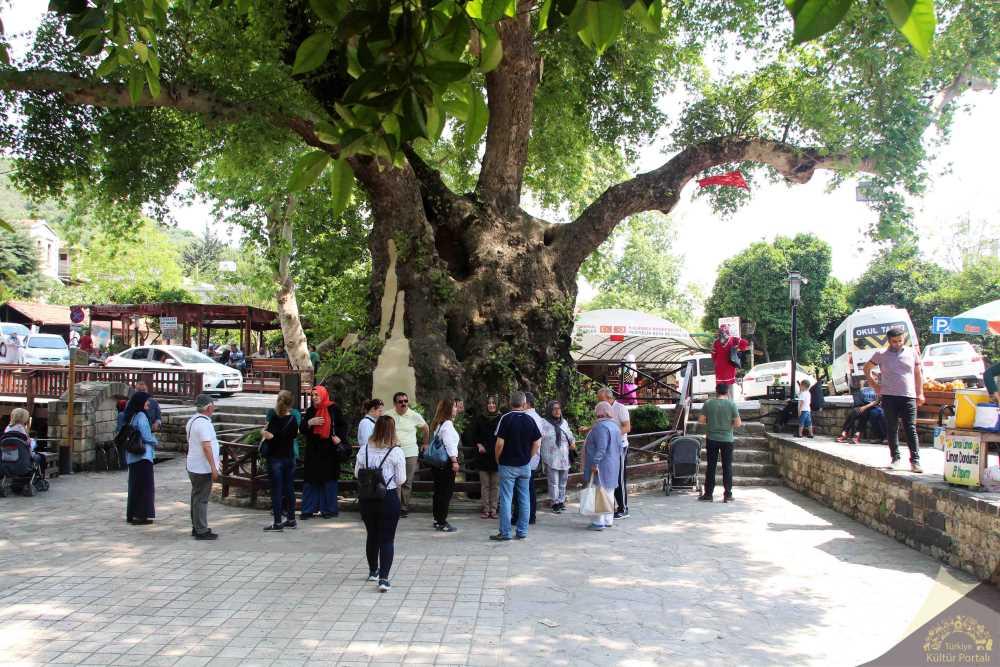
Within the boundaries of Hıdırbey Neighborhood in the Samandağ district of Türkiye’s Hatay province lies the Musa Ağacı, a monumental oak tree estimated to be approximately two thousand years old. It holds a significant place in the regional memory due to its impressive physical dimensions and the religious and cultural narratives that have developed around it. With a trunk diameter of about 7.5 meters and a height of 20 meters, the tree is situated at the foothills of the Amanos Mountains, in a fertile area surrounded by natural spring waters, stone-walled protective boundaries, and social spaces for visitors. These physical conditions not only support the tree’s long-lived structure but also make visible its integrated relationship with the natural environment.

Trunk of the Hıdırbey Musa Ağacı (Ministry of Culture and Tourism of the Republic of Türkiye)
The foundational legend of the Musa Ağacı attributes its origin to Hz. Musa, a shared figure in the Abrahamic faiths. This narrative has been passed down orally through generations and has gradually become an inseparable part of the regional identity. According to the tradition, when Hz. Musa arrived in the area of present-day Samandağ with his brother Hz. Harun, he stayed for a period near Hıdırbey Neighborhood and planted his staff in the ground to rest. The staff, it is said, miraculously sprouted, turned green, and over time grew into a massive oak tree. Although this story has no direct counterpart in historical or theological texts, its profound meaning within popular belief has conferred upon the tree a sacred status.
The Musa Ağacı is significant not only for its physical presence but also for the practices of visitation and popular beliefs that have formed around it. Visitors come beneath the tree to pray, make wishes, or tie pieces of cloth to its branches in the hope that their desires will be fulfilled. Due to its sacred status, it is widely believed among the local population that any harm or withering of the tree would bring misfortune. This belief demonstrates that the tree is regarded not merely as a natural entity but also as a spiritual being, around which a culture of faith-based protection has developed. Additionally, the spring water emerging from the area around the tree is locally described as “healing” and is used, especially during summer months, for both drinking and cooling.
To preserve the Musa Ağacı and make it accessible to visitors, various measures have been implemented by public institutions and local administrations. In particular, environmental improvement projects led by the Hatay Governorship and the Samandağ District Governorship have enclosed the tree’s surroundings with stone walls and installed seating areas, walking paths, and informational plaques. These interventions facilitate visitor guidance while contributing to the preservation of the tree’s natural balance. Simultaneously, the emergence of small-scale market areas where local producers can display their products enhances visitors’ interaction with the local culture and provides indirect support to the rural economy.

Branches of the Hıdırbey Musa Ağacı (Ministry of Culture and Tourism of the Republic of Türkiye)
The Musa Ağacı is more than just an ancient and majestic tree for the people of Hıdırbey Neighborhood and surrounding communities in Samandağ; it is regarded as a symbol of historical continuity and the spatial manifestation of a religious narrative. The oral stories, religious symbols, and local belief practices surrounding the tree transform it into a figure representing the relationship between nature and humanity, while also serving as a symbolic focal point that connects the past with the present within collective memory. In this sense, the Musa Ağacı offers a unique example of how natural entities acquire cultural meanings and how these meanings are sustainably maintained within social structures.
Video About the Musa Ağacı (CIVILIZATION TRACES)
Anadolu Ajansı. “Tarihin Canlı Tanığı 2 Bin Yıllık Musa Ağacı Özenle Korunuyor.” Accessed June 26, 2025. https://www.aa.com.tr/tr/yasam/tarihin-canli-tanigi-2-bin-yillik-musa-agaci-ozenle-korunuyor/2564343.
Hatay Valiliği. “Musa Ağacı Efsanesi.” Hatay Valiliği Resmî Web Sitesi. Accessed June 26, 2025. http://hatay.gov.tr/musa-agaci-efsanesi#:~:text=Rivayete%20g%C3%B6re%3B&text=Tam%20Musa%20A%C4%9Fac%C4%B1'n%C4%B1n%20bulundu%C4%9Fu,geli%C5%9Ferek%20bug%C3%BCnk%C3%BC%20halini%20ald%C4%B1%C4%9F%C4%B1na%20inan%C4%B1lmaktad%C4%B1r.
Medeniyet İzleri YouTube Channel. "Hz. Musa'nın Bastonunun Yeşerdiği Yer: Musa Ağacı | Hatay Samandağ Hıdırbey Köyü." Accessed June 26, 2025. https://youtu.be/w3iThCBfrrM?si=jL2FOLZmv7J36nKR.
Samandağ Kaymakamlığı Governorship. "Hz. Musa’nın Bastonunun Yeşerdiği Yer." Samandağ District Governorship Official Website. Accessed June 26, 2025. http://www.samandag.gov.tr/hz-musanin-bastonunun-yeserdigi-yer.
Turkish Ministry of Culture and Tourism. "Hıdırbey Musa Ağacı Efsanesi." *Kültür Portalı.* Accessed June 26, 2025. https://www.kulturportali.gov.tr/turkiye/hatay/gezilecekyer/hidirbey-musa-agaci-efsanesi.

Location | Hatay Türkiye Samandağ | ||||||||
|---|---|---|---|---|---|---|---|---|---|
Type(s) | Çınar (Platanus orientalis) | ||||||||
Feature(s) | The sacred tree said to have been greened by the staff of Prophet Moses | ||||||||
Age | Approximately 2,000 years | ||||||||
No Discussion Added Yet
Start discussion for "Hıdırbey Musa Ağacı" article
Legendary and Religious Narratives
Visitation Culture and Popular Beliefs
Conservation and Environmental Management
Place in Collective Memory and Symbolic Meaning