



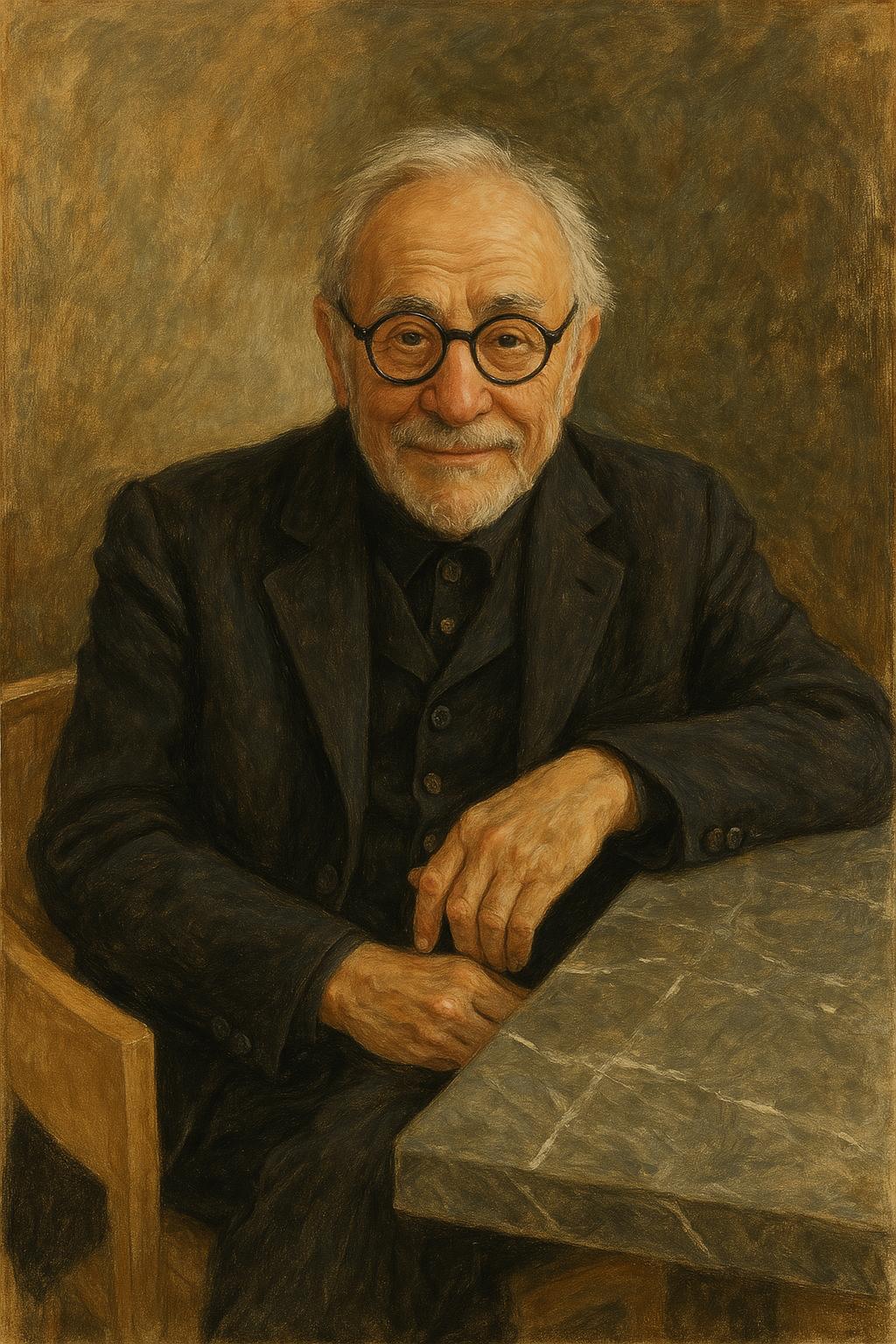
Hilmi Yavuz (created with YZ).
Year of Birth | 1936 | ||||||||
|---|---|---|---|---|---|---|---|---|---|
Place of Birth | Istanbul | ||||||||
Occupation(s) | Poet Thinker Writer | ||||||||
Education | Kabataş Boys High School (Istanbul) University of London Faculty of Arts - Department of Philosophy | ||||||||
Experience | BBC Turkish Service (1964–1969, London); Literary criticism in Cumhuriyet, Milliyet, and Yeni Ortam newspapers; Academia | ||||||||
Awards Received | 1978 Yeditepe Poetry Award (Eastern Poems), 1987 Sedat Simavi Literature Prize (Zaman Poems) | ||||||||
Hilmi Yavuz, born in Istanbul in 1936, is a poet and thinker who has produced works in both poetry and prose. After completing his secondary education at Kabataş Boys High School, he worked in journalism. While employed at the BBC Turkish Service in London from 1964 to 1969, he also pursued higher education at the University of London. Upon returning to Türkiye, he wrote literary criticism for the newspapers Cumhuriyet, Milliyet, and Yeni Ortam. Hilmi Yavuz, who has produced works in poetry and essay genres, has established a distinctive voice in literature through his poetics that harmonizes traditional poetic understanding with postmodern narrative forms.
He began showing interest in literature during his high school years and took his first steps in literary activity with poems published in the journal Dönüm between 1952 and 1953. After high school, Yavuz worked in journalism and spent the years 1964 to 1969 in England, where he worked at the BBC Turkish Service and completed his higher education in the Department of Philosophy at the Faculty of Letters of the University of London.
After completing his higher education, Hilmi Yavuz returned to Türkiye and published literary critiques and studies in Cumhuriyet, Milliyet, and Yeni Ortam, some under the pseudonym “Ali Hikmet.” His first poetry collection, Bakış Kuşu, was published in 1969 and gained attention in poetic circles with his book Bedreddin Üzerine Şiirler (1975). Published in 1977, Doğu Şiirleri stood out as a significant work reflecting his connection to Eastern culture.
Among Yavuz’s poetry collections are Yaz Şiirleri (1981), Gizemli Şiirler (1984), Zaman Şiirleri (1987), Söylen Şiirleri (1989), Ayna Şiirleri (1992), Çöl Şiirleri (1996), Akşam Şiirleri (1998), and Yolculuk Şiirleri (2001). He compiled his collected poems in two volumes titled Gülün Ustası Yoktur and Erguvan Sözler (both 1993).
The poet won the 1978 Yeditepe Poetry Award for Doğu Şiirleri and the 1987 Sedat Simavi Literature Prize for Zaman Şiirleri. In addition to poetry, he published essay and study books including Felsefe ve Ulusal Kültür (1975), Roman Kavramı ve Türk Romanı (1977), Kültür Üzerine (1987), Felsefe Üzerine (1987), Yazın Üzerine (1987), and Dilin Dili (1991). He has also produced works in narrative genres such as Taormina (1990), Fehmi K.’nın Acayip Serüvenleri (1991), and Kuyu (1994).
The intense exploration of individual, inner, and cultural contexts in his poems reflects the poet’s intellectual accumulation and the literary manifestation of his life experiences. His intellectual engagement with Eastern and Western cultures reveals that his quest extends beyond literature into philosophy. While constructing his own poetics, Yavuz draws on both individual and collective pasts, embedding in his works sensitivity toward identity, time, space, and language.
Hilmi Yavuz’s poetics is grounded in the view that poetry is not merely a product of inspiration but a constructed object shaped by knowledge, technique, and structure. For him, poetry is an act of engineering. This perspective led him to evaluate poetry as a planned, thematic, structural, and conscious process. In this regard, Hilmi Yavuz belongs to the group of poets who advocate the concept of “construction” in poetry, and his approach parallels Rainer Maria Rilke’s notion of “dinge Gedicht” (poetry as object).
Another central principle in Yavuz’s poetics is the decisive role of “language” in poetry. According to him, modern poetry should rely on imagery or sound; these two elements are actively employed in Hilmi Yavuz’s poetry. He argues that poetic language should aim not at communication but at generating aesthetic pleasure. Consequently, he composes poems with layered, sometimes incomplete structures that push meaning to the background.
Hilmi Yavuz perceives his relationship with tradition not as repetition or imitation but as re-creation. His connections with Eastern and Western cultures, manifested through the integration of mythological, religious, and Sufi elements into his poetry, lend his poetics a universal depth. He regards poetry not only as a space for individual expression but also as a ground for the re-creation of cultural identity.
Moreover, he frequently constructs structures in his poems based on binary oppositions such as poetic language–prose language, sound–silence, and East–West. These structures impart both philosophical and aesthetic dimensions to his poetry. Meaning is often deferred through ambiguity, allusion, inversion, or silent play, demonstrating that in his poetic understanding, form and sonic organization take precedence over meaning.
Hilmi Yavuz has developed a unique poetics in modern Turkish poetry, both in form and content. His view of poetry as a knowledge-based, technique-oriented, and culturally grounded construction has charted a path distinct from the traditional conception that centers inspiration. Yavuz’s understanding of poetry has drawn attention not only for embracing the modern poetic structure based on imagery and sound but also for integrating tradition, mythology, and philosophy into this structure.
The diversity of linguistic structures in his poems, along with methods such as the deliberate deferral or layering of meaning, bring his work close to postmodern poetic understanding. In his narratives, themes such as fragmentation, identity questioning, ambiguity, and critiques of reality perception come to the fore. This tendency is evident in works such as Taormina, Kuyu, and Fehmi K.’nın Acayip Serüvenleri.
Hilmi Yavuz, both as a poet and a theorist, has reflected deeply on the nature of poetry and how it ought to be, and he has implemented these ideas through his literary texts. He is regarded as one of the strongest representatives in Turkish literature of the notion that “poetry is an engineering task.”
Aka, Pınar. Hilmi Yavuz Şiirine Metin-Merkezli Bir Bakış. Master's thesis, Bilkent Üniversitesi, Ekonomi ve Sosyal Bilimler Enstitüsü, 2002.
Koçakoğlu, Bedia. “Hilmi Yavuz’un Postmodern Anlatıları Üzerine.” *Selçuk Üniversitesi Türkiyat Araştırmaları Dergisi*, no. 32 (2012): 95–113. https://dergipark.org.tr/en/download/article-file/257654
Taşdelen, Vefa, and Abdülkerim Uzağan. "Reiner Maria Rilke ve Hilmi Yavuz’un Poetikaları Üzerine Bir Karşılaştırma Denemesi." Turkish Studies 11, no. 10 (2016): 591–604.

Hilmi Yavuz (created with YZ).
Year of Birth | 1936 | ||||||||
|---|---|---|---|---|---|---|---|---|---|
Place of Birth | Istanbul | ||||||||
Occupation(s) | Poet Thinker Writer | ||||||||
Education | Kabataş Boys High School (Istanbul) University of London Faculty of Arts - Department of Philosophy | ||||||||
Experience | BBC Turkish Service (1964–1969, London); Literary criticism in Cumhuriyet, Milliyet, and Yeni Ortam newspapers; Academia | ||||||||
Awards Received | 1978 Yeditepe Poetry Award (Eastern Poems), 1987 Sedat Simavi Literature Prize (Zaman Poems) | ||||||||
Youth and Education
Career and Achievements
Personal Life
Poetics
Works
Poetry Collections
Essays and Studies
Narrative and Memoir Books
Legacy and Influence