

This article was automatically translated from the original Turkish version.
+2 More
Location | Kızılırmak River Türkiye Kırşehir | ||||||||
|---|---|---|---|---|---|---|---|---|---|
Construction Process | 1953–1959 | ||||||||
Purpose(s) | Fishing and Domestic Water Supply Agricultural Irrigation Flood Control Electricity Generation (Hydroelectric) | ||||||||
Surface Area | Approximately 263–280 km² | ||||||||
Reservoir Volume | 5.980–7.630 hm³ | ||||||||
Elevation Above Sea Level | ~856 m | ||||||||
Hydroelectric Power Plant Capacity | 128.000 kW | ||||||||
Hirfanlı Dam Lake is an artificial freshwater lake located in Türkiye’s Central Anatolia Region, constructed on the Kızılırmak River. Situated within the boundaries of Kırşehir Province, this lake serves multiple functions including energy production, agricultural irrigation, freshwater fisheries, and the preservation of ecological diversity, making it strategically important among regional water resources. The lake constitutes a dynamic hydroecological system shaped by both natural processes and human activities.
Hirfanlı Dam Lake was constructed between 1953 and 1959 to regulate the flow of the Kızılırmak River. Its surface area varies between approximately 263 and 280 km², while its reservoir volume at normal water level ranges from 5,980 to 7,630 hm³. The reservoir supports a hydroelectric power plant with an installed capacity of 128,000 kW. The region where the dam is located features a undulating and plateau-like topography.
The dam basin lies within a semi-arid climate zone. Annual temperature data show a clear upward trend during summer months. Significant increasing trends in temperature have also been detected during spring and autumn. This climatic variability directly affects the lake’s water regime, evaporation rates, and water quality.

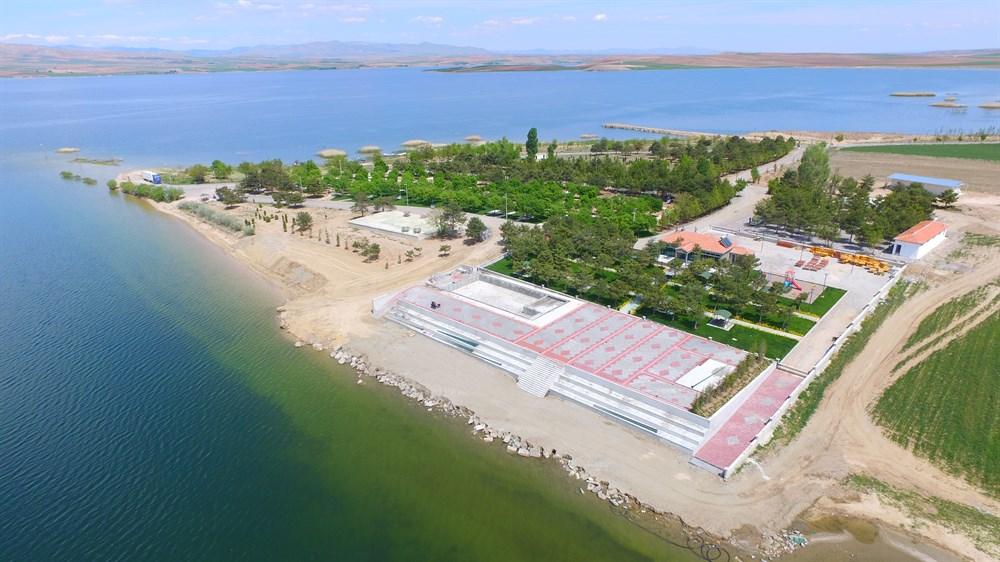
Hirfanlı Dam Lake (AA)
Hydroelectric power generation is one of the lake’s primary purposes. The dam’s annual energy production capacity varies depending on water levels and flow velocity. Analyses using artificial neural network models have determined that climatic factors—particularly precipitation and temperature—play a decisive role in production efficiency. This highlights the direct impact of climate change on energy supply security.【1】
The environmental threats facing the dam lake include degradation of water quality, decline in biological diversity, climatic variability, and agricultural pollution. These threats jeopardize the lake’s long-term ecological balance. For sustainable use of the lake, integrated water management policies, scientific monitoring systems, and environmental awareness initiatives must be coordinated and implemented effectively.

Sunset at Hirfanlı Dam Lake (Pıxabay)
The lake’s algal flora exhibits high levels of biological diversity. Research has identified a total of 329 algal species.【2】 Dominant groups include Bacillariophyta, Chlorophyta, and Cyanophyta. Within the phytoplankton community, Cyclostephanos dubius is predominant, while epipelagic and epiphytic algae are commonly found in nearshore areas.【3】 The lake water is slightly alkaline, with oxygen levels sufficient in pelagic zones but seasonally limited in littoral zones.【4】
Hirfanlı Dam Lake Shores (Mehmet Büyükbunar)
Anadolu Ajansı. “Hirfanlı Baraj Gölü’nde Özel Probiyotiklerle Kırmızı Etli Somon Üretiliyor.” Anadolu Ajansı, September 24, 2020. Accessed June 20, 2025. https://www.aa.com.tr/tr/ekonomi/hirfanli-baraj-golunde-ozel-probiyotiklerle-kirmizi-etli-somon-uretiliyor/1983968.
Anadolu Ajansı. “Hirfanlı Gölü ‘Balık Üretim Üssü’ Oluyor.” Anadolu Ajansı, September 29, 2019. Accessed June 20, 2025. https://www.aa.com.tr/tr/ekonomi/hirfanli-golu-balik-uretim-ussu-oluyor/1597008.
Baykal, Tülay, and İlkay Açıkgöz. “Hirfanlı Baraj Gölü Algleri.” *Ahi Evran Üniversitesi Kırşehir Eğitim Fakültesi Dergisi* 5, no. 2 (2004): 115–136. https://dergipark.org.tr/tr/download/article-file/1336980.
Evren Kaymakamlığı. "Evren Sahili ve Hirfanlı Barajı." Accessed June 20, 2025. http://evren.gov.tr/evren-sahili-ve-hirfanli-baraji.
Kalaycı, Şükrü. “Hirfanlı Baraj Gölünde Eser Elementlerin ICP-OES ile Tayini.” *Gazi Üniversitesi Fen Bilimleri Dergisi Part C: Tasarım ve Teknoloji* 8, no. 2 (2020): 451–457. https://dergipark.org.tr/tr/download/article-file/1140098.
Ministry of Culture and Tourism of the Republic of Turkey,Kırşehir İl Directorate of Culture and Tourism. “Hirfanlı Barajı.” Accessed June 20, 2025. https://kirsehir.ktb.gov.tr/TR-196433/hirfanli-baraj.html.
Ozbay Karakus, Mucella, and Cemil Altın. “Yield of the Hydroelectric Power Plant Using Feed Forward and Recurrent Neural Networks: Hirfanlı Dam Application Example.” *Electronic Letters on Science and Engineering* 10, no. 2 (2014): 1–14. https://dergipark.org.tr/en/download/article-file/303865.
Pixabay. “Gün Batımı, Hirfanlı Baraj Gölü, Akşam.” Accessed June 20, 2025. https://pixabay.com/tr/photos/g%C3%BCn-bat%C4%B1m%C4%B1-hirfanl%C4%B1-baraj-g%C3%B6l%C3%BC-ak%C5%9Fam-1807819/.
Yiğit, Sibel, and Ahmet Altındağ. “A Taxonomical Study on the Zooplankton Fauna of Hirfanlı Dam Lake (Kırşehir), Turkey.” *Gazi University Journal of Science* 18, no. 4 (2010): 563–567. https://dergipark.org.tr/en/download/article-file/83290.
YouTube. "Hirfanlı Baraj Gölü – Gün Batımı Videosu." Accessed June 20, 2025. https://youtu.be/TMgRioBY_8M?si=eUewXOEXbxak_LPl.
Yılmaz, Mehmet, Ali Gül, and Ömer Saylar. “Hirfanlı Baraj Gölü'nde Yaşayan Cyprinus carpio L. 1758’in Büyüme Özellikleri.” *Gazi Üniversitesi Gazi Eğitim Fakültesi Dergisi* 27, no. 1 (2007): 37–57. https://dergipark.org.tr/tr/download/article-file/77178.
Zeybekoğlu, Utku, and Gaye Aktürk. “Homogeneity and Trend Analysis of Temperature Series in Hirfanli Dam Basin.” *Türk Doğa ve Fen Dergisi* 11, no. 1 (2022): 49–58. https://dergipark.org.tr/tr/download/article-file/1835242.
[1]
Ozbay Karakus, Mucella, ve Cemil Altın. “Yield of the Hydroelectric Power Plant Using Feed Forward and Recurrent Neural Networks: Hirfanlı Dam Application Example.” Electronic Letters on Science and Engineering 10, no. 2 (2014): 1–14. Erişim 20 Haziran 2025. https://dergipark.org.tr/en/download/article-file/303865.
[2]
T. Baykal ve İ. Açıkgöz, “Hirfanlı Baraj Gölü Algleri,” Ahi Evran Üniversitesi Kırşehir Eğitim Fakültesi Dergisi 5, no. 2 (2004): 115–136, https://dergipark.org.tr/tr/download/article-file/1336980.
[3]
S. Yiğit ve A. Altındağ, “A Taxonomical Study on the Zooplankton Fauna of Hirfanlı Dam Lake (Kırşehir), Turkey,” Gazi University Journal of Science 18, no. 4 (2010): 563–567, https://dergipark.org.tr/en/download/article-file/83290.
[4]
Ş. Kalaycı, “Hirfanlı Baraj Gölünde Eser Elementlerin ICP-OES ile Tayini,” Gazi Üniversitesi Fen Bilimleri Dergisi Part C: Tasarım ve Teknoloji 8, no. 2 (2020): 451–457, https://dergipark.org.tr/tr/download/article-file/1140098.

Location | Kızılırmak River Türkiye Kırşehir | ||||||||
|---|---|---|---|---|---|---|---|---|---|
Construction Process | 1953–1959 | ||||||||
Purpose(s) | Fishing and Domestic Water Supply Agricultural Irrigation Flood Control Electricity Generation (Hydroelectric) | ||||||||
Surface Area | Approximately 263–280 km² | ||||||||
Reservoir Volume | 5.980–7.630 hm³ | ||||||||
Elevation Above Sea Level | ~856 m | ||||||||
Hydroelectric Power Plant Capacity | 128.000 kW | ||||||||
Geographical Location and Physical Characteristics
Climate Characteristics and Thermal Trends
Energy Production
Environmental Challenges and Sustainability
Phytoplankton and Algal Composition