


This article was automatically translated from the original Turkish version.
+1 More
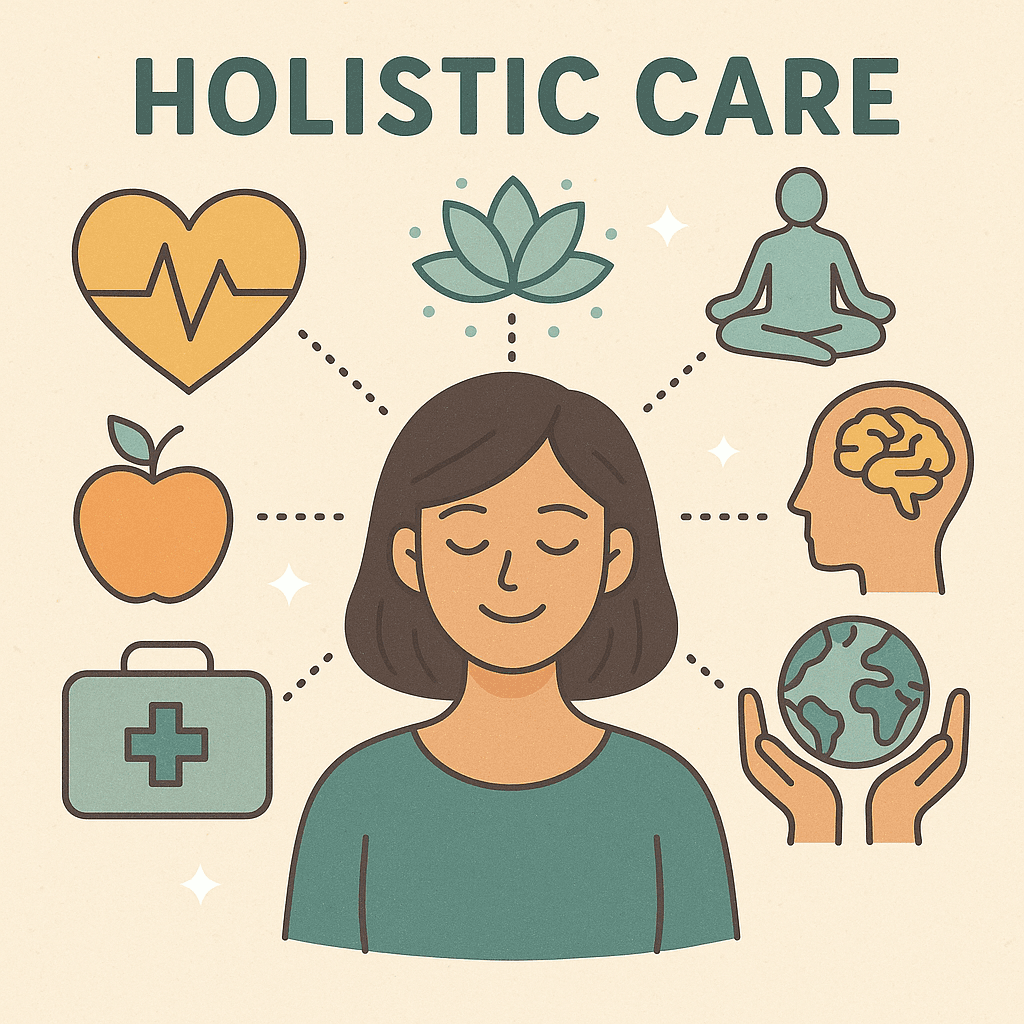
Holistic Care
Concept | Holistic (Integral) Care | ||||||||
|---|---|---|---|---|---|---|---|---|---|
Field | Nursing, Health Sciences | ||||||||
Fundamental Principle | The individual's physical and psychological dimensions being considered as a whole | ||||||||
Application Area(s) | Patient-centered care Alternative and complementary medicine approaches Nursing practices | ||||||||
Purpose(s) | To support and enhance the individual's health in all aspects | ||||||||
Holistic care is an approach in healthcare that aims to consider the individual as a whole—encompassing physical, emotional, social, cultural, and spiritual dimensions—rather than focusing solely on illness or symptoms. This form of care seeks to deliver comprehensive health services by taking into account not only the body but also the individual’s emotions, thoughts, beliefs, lifestyle, and environment. In nursing practice, this approach is gaining increasing importance as it moves beyond the technical orientation of modern medicine to promote a human-centered, sensitive, and integrative understanding of health.
Holistic care is derived from the Greek word “holos,” meaning “whole.” In the context of health, this term encompasses the evaluation and care of the individual in all aspects of their being. This approach does not limit itself to the physical manifestations of disease; it also considers the individual’s psychological state, social relationships, cultural values, life philosophy, and spiritual needs. Within this framework, holistic care creates a multidimensional and personalized model of care by addressing all factors that influence an individual’s health.
In the discipline of nursing, holistic care plays a vital role in enhancing quality of life, promoting active participation in the healing process, and supporting long-term health. This perspective requires nurses to be equipped not only with technical skills but also with humanistic abilities such as empathy, communication, and cultural sensitivity.
The concept of holistic care predates modern medicine by centuries. In ancient times, medical practices associated illness not only with physical causes but also with spiritual, environmental, and cosmic factors. As advocated by Hippocrates, an individual’s physical condition is influenced by their psychological and environmental circumstances. However, with the advancement of modern medicine, particularly during the 20th century, the biomedical model came to dominate, focusing exclusively on the somatic aspects of the individual. This led to the perception of the person merely as a “diseased body,” often neglecting their psychological, social, and cultural dimensions.
From the 1970s onward, increasing patient dissatisfaction, the rise of chronic illnesses, and growing emphasis on quality of life prompted a renewed interest in holistic approaches. In nursing, professionals who engage in direct patient interaction recognized these gaps and reintegrated holistic care into nursing theories and practice. Florence Nightingale’s approach of considering the patient within their environment exemplifies the historical roots of holistic care in nursing.
The foundation of holistic care lies in viewing the individual as a unified whole and understanding all dimensions of their being. The key principles developed within this framework are as follows:
1. Individuality and Person-Centeredness: Each person possesses unique life experiences, beliefs, values, and needs. Holistic care acknowledges this uniqueness and tailors care accordingly.
2. Awareness of Complex Interactions: The physical, emotional, social, and environmental factors affecting an individual are interrelated. A change in one area can influence others. The holistic approach conducts a comprehensive assessment that accounts for these interactions.
3. Support of Healing Potential: Holistic care does not focus solely on symptoms but also recognizes the individual’s innate capacity for healing. It aims to activate the person’s internal resources.
4. Communication and Interaction: Effective and empathetic communication forms the cornerstone of holistic care. A trusting relationship between the nurse and the individual enhances the quality and success of care.
5. Consideration of Environmental Factors: The individual’s physical surroundings, family, social support systems, and cultural context directly impact health and well-being. Holistic care shapes the care process by taking these factors into account.
Holistic care has a multidimensional structure, composed of the following key components:
1. Physical Dimension: The individual’s bodily health is a vital component of holistic care. Issues such as diagnosis, treatment, symptom management, nutrition, sleep, pain control, and hygiene are addressed within this dimension. When assessing physical needs, the nurse considers not only current health problems but also risks of chronic illness and lifestyle factors.
2. Psychological Dimension: Emotional state, stress levels, anxiety, depression, self-esteem, and psychological resilience are included in the psychological dimension. In holistic care, evaluating this dimension is an integral part of the nursing process. Supportive communication, counseling, and relaxation techniques are employed to meet psychological needs.
3. Social Dimension: The fact that humans are social beings lies at the heart of holistic care. Family structure, peer networks, social support systems, and the individual’s role in society are assessed within this dimension. Considering the social dimension in nursing helps individuals cope with negative conditions such as loneliness, exclusion, or social isolation.
4. Cultural Dimension: An individual’s cultural values, belief systems, traditions, and lifestyle directly influence health behaviors. Holistic care seeks to provide respectful, non-conflicting care by recognizing and honoring the individual’s cultural characteristics. Cultural sensitivity is a key factor in enhancing the individual’s adaptation to the care process.
5. Spiritual Dimension: Beliefs, meaning of life, hope, prayer, and meditation constitute the spiritual dimension. Holistic care involves recognizing the individual’s spiritual needs and responding to them with sensitivity. Particularly in end-of-life care or during serious illness, addressing this dimension contributes to the individual’s sense of peace and psychological strength.
The nursing profession, by its inherently human-centered nature, naturally embraces many principles of holistic care. Nurses plan care by considering not only physical symptoms but also emotions, thoughts, social conditions, and value systems. Therefore, nursing practices largely align with the principles of holistic care.
Holistic nursing is a form of care applied with empathetic and conscious awareness, encompassing all existential dimensions of the individual. Holistic nursing applications can be grouped under the following headings:
In modern medicine, technological advancements sometimes cause the human aspects of care to be overlooked. Holistic care has emerged as a response to this issue, offering a care model that places the human dimension at the center. The holistic approach has the potential to strengthen the humanistic nature of healthcare by addressing not only illness but also well-being, life satisfaction, and the search for meaning.
This form of care offers particular advantages in the management of chronic illnesses, terminal conditions, psychiatric disorders, and geriatric patients. Holistic care has been shown to be an effective method in promoting active patient participation in care, improving quality of life, and supporting internal motivation for healing.
The holistic care approach affects an individual’s health status in a multidimensional way. Research and clinical observations demonstrate that the holistic approach produces positive effects on overall well-being. These effects can be summarized as follows:
These outcomes provide benefits not only for the individual but also for the healthcare system, including cost-effectiveness, efficient resource use, and improved service quality.
Holistic care applications are carried out within a systematic framework aligned with the nursing process, encompassing all stages from assessment to planning, implementation, and evaluation.
Holistic assessment goes beyond examining physical symptoms and involves comprehensive data collection across the following areas:
Based on this assessment, the individual’s health needs are identified in a multidimensional way, and a care plan is developed accordingly.
In this process, which considers all aspects of the individual, the nurse establishes personalized care goals based on the individual’s needs and expectations. These goals may:
Holistic care planning requires active participation from the individual. This involvement enhances the person’s sense of control over their own health.
During the implementation phase of holistic care, both conventional and complementary methods may be used:
During these interventions, a personalized approach is adopted with full respect for the individual’s values, preferences, and beliefs.
The effectiveness of implemented care is evaluated based on the individual’s responses. In holistic care, improvement is not measured solely by symptom reduction but also by changes in overall quality of life, psychological adjustment, and social integration. Feedback gathered from the individual enables revision and refinement of the care plan.
Although holistic care is a person-centered approach, its implementation may encounter various barriers and challenges. These include:
Overcoming these challenges is possible through emphasizing holistic approaches in nursing education, strengthening person-centered policies in healthcare, and providing awareness training for healthcare workers.
Today’s healthcare systems tend to prioritize faster, more efficient, and outcome-driven services due to technological advancements. However, neglecting the human element in this process can negatively affect the quality of healthcare. In this context, holistic care is poised to become one of the foundational approaches for sustaining person-centered care in future healthcare systems.
The aging population, increasing prevalence of chronic diseases, growing demand for personalized healthcare, and rising psychosocial issues are all heightening the need for holistic approaches. This trend further elevates the role of nursing and demands that nurses be equipped with multidimensional competencies.
Dem Demirsoy, NİLÜFER. "Eski Uygarlıklardan Günümüze Yansıyan Holistik Tıp Uygulamaları." Türkiye Klinikleri Tıp Etiği-Hukuku Tarihi Dergisi, vol. 22, no. 3, 2014, pp. 106-119. Accessed May 20, 2025. https://avesis.ogu.edu.tr/yayin/25cad42f-3c50-4608-9b3c-3ee7015815d2/eski-uygarliklardan-gunumuze-yansiyan-holistik-tip-uygulamalari.
Korkut, Bayındır, Sevda, and Sevil Biçer. “Holistik Hemşirelik Bakımı.” *İzmir Kâtip Çelebi Üniversitesi Sağlık Bilimleri Fakültesi Dergisi* 4, no. 1 (2019): 25–29. Accessed May 20, 2025. https://dergipark.org.tr/tr/download/article-file/709534
Maryville University. “What Is Holistic Care in Nursing?” Accessed May 20, 2025. https://nursing.maryville.edu/blog/what-is-holistic-care-in-nursing.
İstanbul Gelişim Üniversitesi Sağlık Bilimleri Yüksekokulu. “Holistik Bakım Nedir?” Accessed May 20, 2025. https://sbyo.gelisim.edu.tr/tr/akademik-bolum-hemsirelik-haber-holistik-bakim-nedir-.

Holistic Care
Concept | Holistic (Integral) Care | ||||||||
|---|---|---|---|---|---|---|---|---|---|
Field | Nursing, Health Sciences | ||||||||
Fundamental Principle | The individual's physical and psychological dimensions being considered as a whole | ||||||||
Application Area(s) | Patient-centered care Alternative and complementary medicine approaches Nursing practices | ||||||||
Purpose(s) | To support and enhance the individual's health in all aspects | ||||||||
Definition of Holistic Care
Historical Development of Holistic Care
Core Principles of Holistic Care
Components of Holistic Care and Its Place in Nursing
Holistic Nursing Approach and Applications
Importance of Holistic Care
Impact of Holistic Care on Treatment Outcomes
Process of Implementing Holistic Care
1. Assessment of the Individual
2. Planning Care
3. Implementation of Care
4. Evaluation and Feedback
Challenges of Holistic Care
The Future of Holistic Care