This article was automatically translated from the original Turkish version.
+1 More
Hookworm (Ancylostoma duodenale)
Classification(s) | Order Strongylida Family Ancylostomatidae | ||||||||
|---|---|---|---|---|---|---|---|---|---|
Basic Symptom | Severe anemia, Melena (bloody stool) | ||||||||
Transmission Routes | Skin (percutaneous), Mouth (oral), Milk, Placenta | ||||||||
Distinguishing Structure | Buccal capsule (toothed or plate-like oral cavity) | ||||||||
Feeding Method | Hematophagous (feeding on blood) | ||||||||
Settlement Site | Small intestine mucosa | ||||||||
Primary Hosts | Dog, Cat, Human, Mammals | ||||||||
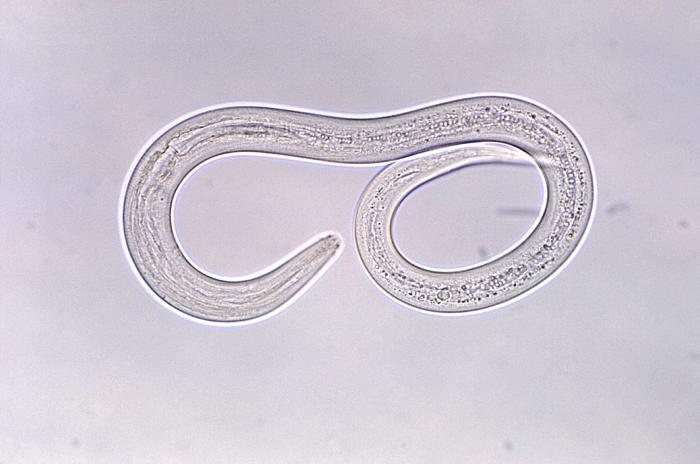
Hookworm (Ancylostoma duodenale) is a collective term for two medically significant species of nematodes (Ancylostoma duodenale and Necator americanus) that parasitize the small intestine of humans. These organisms are threadlike parasitic worms belonging to the order Strongylida that attach to the intestinal mucosa using hook-like teeth or cutting plates in their oral structures and feed on blood. They are of major importance to human health and veterinary medicine due to their prevalence in hot humid regions with inadequate hygiene.
The body structure of hookworms has evolved to suit their parasitic lifestyle. Their name derives from the curved shape of the anterior end of their body. Their bodies are cylindrical with pointed ends.
The most defining feature in classification is the structure of the "buccal capsule" located at the anterior part of the head. Within this capsule are hardened structures that enable attachment to host tissues:
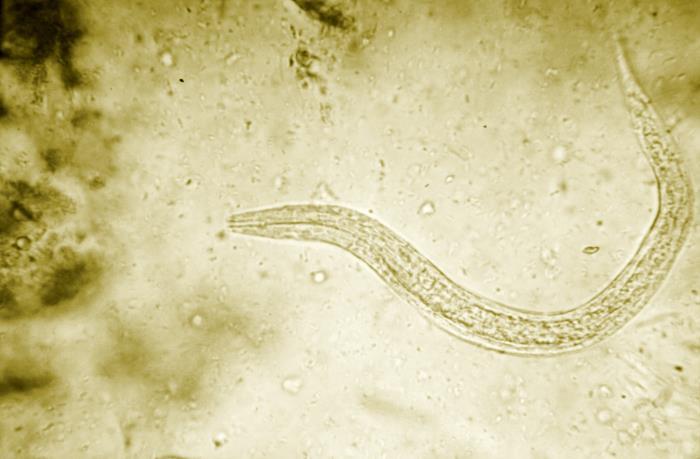
Hookworm (Ancylostoma duodenale)
Males are smaller than females and possess a specialized organ called the "bursa copulatrix," which resembles a ribbed umbrella and is used to grasp the female during copulation.
Hookworms have a "direct life cycle" requiring no intermediate host to complete their development.
An infected host excretes thousands of eggs into the environment daily. Under suitable moisture and temperature conditions, these eggs hatch within 24 to 48 hours to release first-stage larvae (L1). These larvae feed on organic matter in the environment, undergo two molts, and develop into the infective third-stage larvae (L3) within approximately one week. L3 larvae do not feed and are highly resistant to environmental conditions while waiting for a host on soil or vegetation.【1】
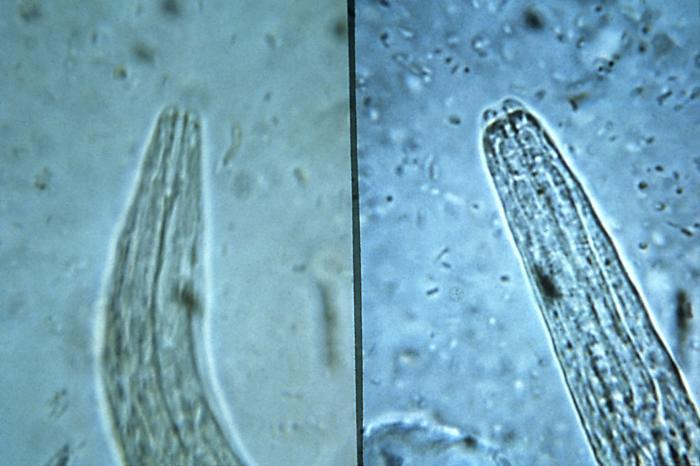
Hookworm (Ancylostoma duodenale)
Transmission occurs through four primary routes:
Hookworm infections cause the greatest damage due to the parasite’s feeding behavior. Parasites secrete a substance that prevents blood clotting when attaching to the intestinal wall. This causes continued bleeding even after the parasite detaches.
Hookworm species specific to animals are also a source of disease in humans. Particularly in people walking barefoot on sandy beaches or in gardens, larvae penetrate the skin. However, since the human body is not a suitable host for these parasites, the larvae cannot reach the intestines. Instead, they migrate beneath the skin, creating tunnels. This condition is known as Cutaneous Larva Migrans. It causes intense itching and visible winding, red tracks on the skin.
Definitive diagnosis is made by examining fecal samples using flotation techniques in a laboratory setting and identifying parasite-specific eggs under a microscope.
Prevention strategies include:
Warning: The content presented here is for general encyclopedic information only. These details must not be used for diagnosis treatment or medical advice. Always consult a veterinarian or qualified healthcare professional before making any health-related decisions. The author and KÜRE Encyclopedia assume no responsibility for any consequences arising from the use of this information for diagnostic or therapeutic purposes.
Adanır, Ramazan, and Onur Köse. “Kedi ve Köpeklerde Ancylostomatidosis.” *Erciyes Üniversitesi Veteriner Fakültesi Dergisi* 9, no. 2 (2012): 141–147. Accessed February 6, 2026. https://dergipark.org.tr/tr/download/article-file/66203
Companion Animal Parasite Council (CAPC). "Hookworms." Accessed February 6, 2026. https://capcvet.org/guidelines/hookworms/
Hotez, Peter J., Paul J. Brooker, and Jeffrey M. Bethony. “Hookworm Infection.” *The New England Journal of Medicine* 351, no. 8 (2004): 799–807. Accessed February 6, 2026. https://pmc.ncbi.nlm.nih.gov/articles/PMC1069663/
Kırımhan, Sücaattin, trans. “Hayvansal Artıklarla Toprağa Karışan Patojenlerin Durumu.” *Atatürk Üniversitesi Ziraat Fakültesi Dergisi* 11, no. 1–2 (2010). Accessed February 6, 2026. https://dergipark.org.tr/tr/download/article-file/34953
Mehmet AkifErsoy Üniversitesi Faculty of Veterinary Medicine. "Helmintology: Nematode-3." Lecture notes for Helmintology (15302), Faculty of Veterinary Medicine Open Course Repository. Accessed February 6, 2026. https://uyg.mehmetakif.edu.tr/vetadh/files/bahar/sinif-3/15302-helmintoloji/nematod-3.pdf
[1]
Companion Animal Parasite Council (CAPC), “Hookworms,” accessed 6 February 2026, https://capcvet.org/guidelines/hookworms/

Hookworm (Ancylostoma duodenale)
Classification(s) | Order Strongylida Family Ancylostomatidae | ||||||||
|---|---|---|---|---|---|---|---|---|---|
Basic Symptom | Severe anemia, Melena (bloody stool) | ||||||||
Transmission Routes | Skin (percutaneous), Mouth (oral), Milk, Placenta | ||||||||
Distinguishing Structure | Buccal capsule (toothed or plate-like oral cavity) | ||||||||
Feeding Method | Hematophagous (feeding on blood) | ||||||||
Settlement Site | Small intestine mucosa | ||||||||
Primary Hosts | Dog, Cat, Human, Mammals | ||||||||
No Discussion Added Yet
Start discussion for "Hookworm (Ancylostoma duodenale)" article
Structural Characteristics and Classification
Oral Structure and Species Differentiation
Life Cycle and Transmission Mechanisms
Environmental Stage
Host Entry and Internal Migration
Pathogenic Effects and Clinical Signs
Clinical Signs
Human Health and Zoonotic Risk
Diagnosis Treatment and Prevention