

This article was automatically translated from the original Turkish version.
Technology no longer merely simplifies our lives; it directly intervenes in our bodies and existence. Artificial intelligence, gene-editing techniques (CRISPR), stem cell research, cloning, artificial womb projects, and transhumanist approaches that claim to biologically “enhance” humans… All these developments force us to reconsider a single question:
Where should the boundary begin when humans are capable of such intervention?
This question is not merely scientific; it is also moral, philosophical, and metaphysical. For what is at stake is no longer simply treating diseases, but defining what it means to be human and what humanity ought to be.
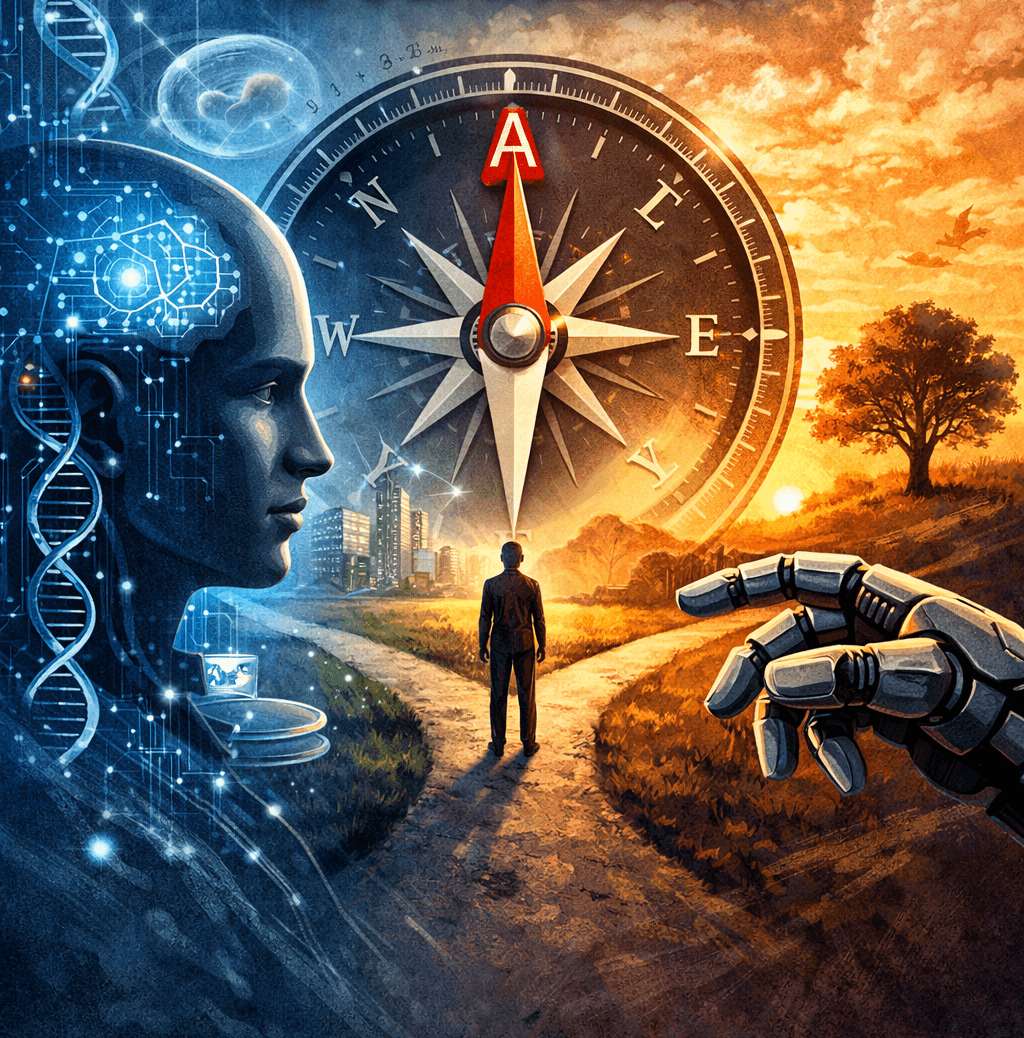
An Image Symbolizing the Human Moral Quest in the Age of Biotechnology (Generated by Artificial Intelligence)
In recent years, some scientific approaches have sought to explain human behavior largely in terms of genetic structure. According to this view, a person’s intelligence, character, tendencies, and even moral preferences are all outcomes of their genetic code. Thus, the human being is less a free agent than the output of a biological program. This perspective is known as “genetic determinism.”
But a serious problem arises here: If humans cannot choose their actions, how can responsibility be meaningful? For instance, if we explain a person’s violent tendencies solely through their genes, how can we justifiably hold them accountable for their actions? Similarly, viewing moral virtues merely as products of genetic inheritance effectively renders conscious human choice irrelevant.
The Islamic intellectual tradition does not view the human being as a mechanical entity. Although different schools of kalam offer varying interpretations, they share a common principle: “The human being possesses free will and is responsible.”
According to the Ash‘ari tradition, humans choose their actions and “acquire” them (kasb).
Maturidi scholars hold that humans possess genuine agency in their actions.
According to the Mu‘tazili school, humans are the creators of their actions and possess complete freedom.
Though these views differ, they agree on one point:
“The human being is an entity morally accountable for their actions. Therefore, reducing humans to their genes alone renders morality meaningless.”
On the other hand, modern scientific understanding does not present a one-sided picture. Research in epigenetics demonstrates that genetic codes alone are not deterministic. Environmental factors, living conditions, nutrition, stress, culture, beliefs, and conscious human choices can all influence how genes function. This means: humans are not merely prisoners of the genetic inheritance they are born with.
By changing their lifestyle, transforming their habits, and making conscious choices, humans can exert influence over their own lives.
In this sense, the human being:
• Can construct their own character,
• Can transform their behavior,
• Can remain a moral subject.
This offers us significant hope: “Even as technology advances, the human being has not ceased to be an accountable entity.”
The problem is that biotechnology is advancing at a rapid pace, while moral evaluation has not kept up. The question “Can we do it?” often overshadows “Should we do it?” Yet being able to do something does not mean we ought to do it.
For example:
• Should unlimited experiments be conducted on human embryos?
• Should human genetics be redesigned to create a “better species”?
• Should the process of death be entirely left to technical decisions?
None of these are merely medical or technical issues. They concern human value and dignity. Therefore, we must thoughtfully and healthily consider their moral and ethical dimensions.
In the age of biotechnology, humanity needs a compass to determine its direction. If this compass is based solely on utility, efficiency, or technological possibility, the following danger emerges: humans begin to believe they are absolute masters of their fate.
Yet a metaphysically grounded moral understanding reminds us:
According to this understanding, technology must serve humanity; humanity must not become the servant of technology.
Genetic interventions directly touch human nature. Therefore, there is a fundamental difference between “treating disease” and “redesigning the human being.” Treatment aims to restore the human to their natural state; redesign seeks to transform the human into something entirely different. Similarly, efforts to artificially prolong life indefinitely, the tendency to delegate decisions about death to technology, and the view of the human body as a laboratory object are not merely scientific issues. They are directly tied to the question of what it means to be human.
In the modern world, morality is often thought of in human-centered terms: the criterion is human preference. But this approach risks ignoring human limits. A metaphysically grounded moral understanding places humanity at the center without absolutizing it. It sees the human being as both valuable and limited.
According to this perspective:
• Humans are not creators, but created beings.
• The powers they possess are entrusted to them.
• These powers must be used with a sense of responsibility.
This understanding provides a framework that limits the use of technological power in ways that undermine human dignity.
Science gives us possibilities, but it does not show us direction. Direction must come from the human being’s responsibility to God, their obligations to other humans, and their moral self-awareness. “If humanity loses this compass, technology will advance, but humanity will lose its way.”
In the age of biotechnology, the real issue is not what we can do, but what we ought to do.
Therefore, the direction of modern developments will be determined not only in laboratories, but in the human conscience and moral understanding. As long as humanity does not lose its compass, it will not lose its way.
Barış, Maide. Umut ve Kaygı Arasında Genetik Müdahale: Biyoetik Bir Çözümleme. İstanbul: Betim Kitaplığı, 2022.
Can, Seyithan. "Intervention in Fıtrah in the Context of Genetic Intervention and the Problem of Mutability of Fıtrah".
Eliş, Veysel, and Can, Seyithan. “Teoloji ve Biyolojinin Kavşağında: Genotip, Fenotip ve Kümûn-Ẓuḥûr Teorisi”. *Van İlahiyat Dergisi* 13/22 (June 2025): 41–54. https://doi.org/10.54893/vanid.1611849
Güngör, Sümeyye, and Erdem, Ramazan. “Genetik Determinizme Dair Kavramsal İnceleme”. *19 Mayıs Sosyal Bilimler Dergisi* 2, no. 3 (2021): 660–674. https://doi.org/10.52835/19maysbd.934782
Kocatepe İslami İlimler Dergisi 8, no. 2 (December 2025): 284-293. https://doi.org/10.52637/kiid.1731716
Kādî Abdülcebbâr, Ebü’l-Hasen Kādı’l-kudât. el-Muğnî fî Ebvâbi’t-Tevhîd ve’l-Adl (Teklif). thk. Muhammed Khodor Nabha. Beyrut: Dâru’l-Kütübi’l-İlmiyye, 2012.
Lewontin, Richard C. - Rose, Steve, Kamin, Leon J. Not In Our Genes: Biology, Ideology and Human Nature. London: Penguin Books, 1990.
Mâtürîdî, Ebû Mansûr Muhammed. Kitâbu’t-Tevhid, thk. Bekir Topaloğlu ve Muhammed Aruci. Lübnan: Mektebetu’l-İrşâd, 2001.
Soysal, Esra Kartal. Gen Ötesi-İnsan Sonrası: Epigenetik Felsefesine Giriş. İstanbul: Ketebe Yayınları, 2022.
Zwart, Hub. "Genetic Determinism". Encyclopedia of Global Bioethics. ed. Henk Ten Have. Cham: Springer International Publishing, 2014.
İbn Fûrek, Ebû Bekr Muhammed b. el-Hasen. Mücerredu Makâlati’ş-Şeyh Ebi’l-Hasen el-Eş’arî. thk. Daniel Gimaret. Beyrut: Dâru’l-Meşrik, 1987.
Is a human nothing more than their genes?
Does science make humans entirely free?
Technology is advancing—what about morality?
Why is a moral compass necessary?
Where should we draw the line?
Human-centered or human-dignified?
Conclusion: A journey without a compass is impossible!