This article was automatically translated from the original Turkish version.
Power Plant Types | Tidal and Depression Type Pumped Storage Dam Type River Type | ||||||||
|---|---|---|---|---|---|---|---|---|---|
Hydraulic energy is a form of energy derived from the movement of water. Electrical energy can be generated by harnessing the potential and kinetic energy of water sources such as rivers, streams, and waterfalls. This energy source is renewable and sustainable because it relies on the natural water cycle.

Hydroelectric Power Plant (Endesa)
Humans have used the power of water for various purposes for thousands of years. The ancient Greeks used water wheels to grind wheat, while the Egyptians practiced agricultural irrigation using the Archimedes screw in the 3rd century BCE. The development of modern hydroelectric turbines began in the 18th century with the publication of the French engineer Bernard Forest de Bélidor’s work Architecture Hydraulique.
In 1880, a theater and store in Grand Rapids, Michigan, were illuminated with arc lamps powered by a dynamo driven by a water turbine. In 1881, a dynamo connected to a flour mill at Niagara Falls in New York provided street lighting. These applications used direct current technology. With the development of alternating current, electricity could be transmitted over longer distances, and in 1893 the first commercial alternating current hydroelectric plant was established in Redlands, California. This plant used Pelton wheels and three-phase generators.
Hydroelectric power generation is based on the conversion of the potential energy that water possesses due to its elevated position into kinetic energy via turbines, then into mechanical energy, and finally into electrical energy. This process typically occurs within dam systems built across rivers or streams. Below is a detailed step-by-step explanation of this transformation:
1. Water Storage (Storage of Potential Energy)
The water accumulated behind a dam forms a reservoir. This reservoir holds water at a high elevation, storing gravitational potential energy. This energy arises from the tendency of water to flow downward due to gravity. The amount of potential energy depends on the height of the water (hydraulic head) and its volume. Therefore, the height of the dam and the reservoir capacity are critical for energy production.
2. Opening of Spillway Gates (Initiation of Flow)
To begin electricity production, spillway gates (or inlet gates) are opened in a controlled manner. Water, under the influence of gravity, flows from a higher to a lower elevation through channels known as penstocks (pressurized tunnels or pipes) toward the turbines. During this process, potential energy is converted into kinetic energy as the water gains speed. The faster the water flows, the more kinetic energy it carries.
3. Turbine Rotation (Conversion of Kinetic Energy to Mechanical Energy)
The water carrying kinetic energy strikes the blades (runner) of the hydraulic turbine, causing it to rotate. The turbine is a machine that converts the energy of water into mechanical rotational energy. The type of turbine used (Pelton, Francis, Kaplan, etc.) is selected based on the water flow rate and pressure.
4. Generator Activation (Conversion of Mechanical to Electrical Energy)
The electrical generator connected to the turbine operates according to Faraday’s law of electromagnetic induction. The mechanical rotation drives a shaft that interacts with magnetic fields and conductive windings inside the generator to produce alternating current (AC) electricity. This stage represents the conversion of mechanical energy into electrical energy.
5. Use of Transformers (Voltage Step-Up)
To enable the transmitted electrical energy to travel long distances through transmission lines, its voltage must be increased. This is achieved using transformers located at the plant’s output. For example, a voltage level of 13.8 kV may be stepped up to 154 kV or higher to minimize energy losses.
6. Grid Integration (Distribution of Electricity)
The high-voltage electricity is transmitted via transmission lines to urban grids or industrial areas. At this stage, the electricity is later stepped down to appropriate levels by step-down transformers for end-use (for example, to 220 V for household applications). Thus, the energy produced at the hydroelectric plant reaches the final consumer.
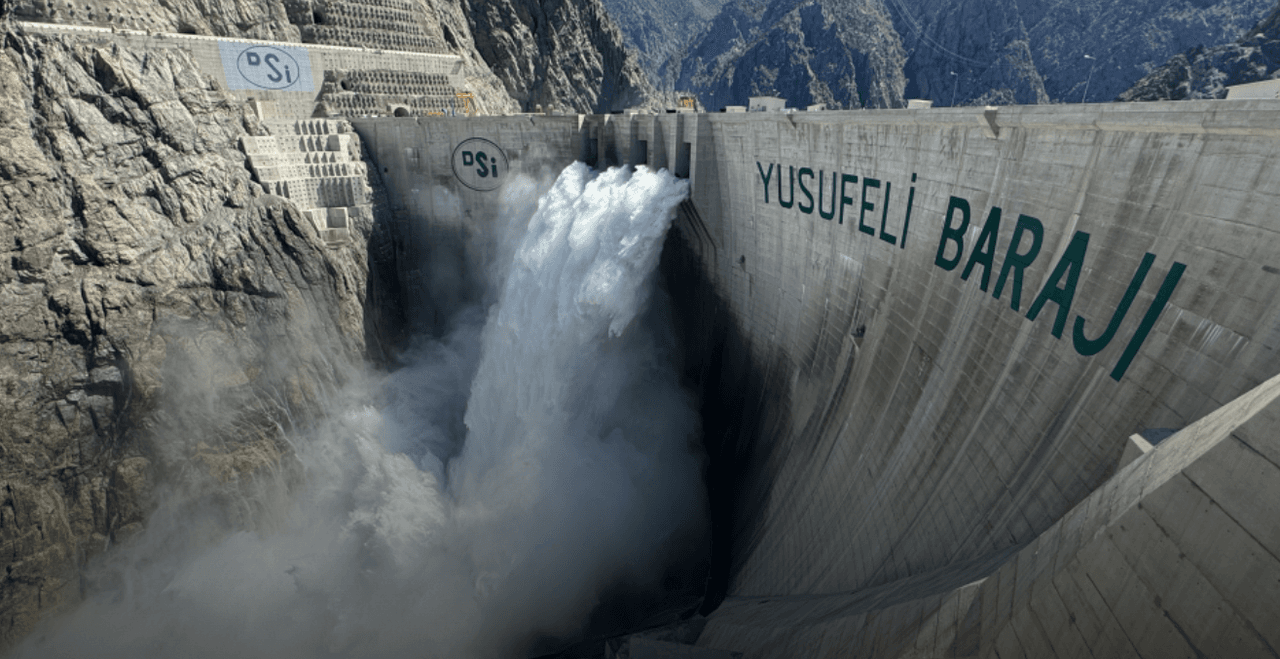
Yusufeli Dam Water Discharge (General Directorate of State Hydraulic Works)
Hydraulic head is a value that indicates the amount of mechanical energy available in a watercourse and is typically expressed in meters. The hydraulic head difference corresponds to the elevation difference between the reservoir water level and the outlet point of a hydroelectric plant and determines its energy production capacity.
Hydroelectric power calculation formula:
P = ρ · Q · g · Δh
Where:
Head Types:
Head Losses:
In hydraulic systems, energy losses due to friction and changes in flow direction are defined as head losses. The actual power output is the net power obtained by subtracting these losses from the gross power.
Hydroelectric power plants are classified according to various criteria:
1. According to Installed Capacity:
2. According to Location and Water Source:
In 2019, Türkiye generated 68,452 gigawatt-hours (GWh) of electrical energy solely through hydroelectric power plants. This value constituted a significant portion of the country’s annual total electricity production, demonstrating the strategic position of hydroelectric energy in Türkiye’s energy supply. As of 2020, the number of operational hydroelectric power plants in the country reached 653. Some of these plants operate integrated with large-scale dams, while others function as river-type (stream-type) HES. Türkiye’s geographically rich terrain, characterized by mountainous regions and abundant rivers, ensures a high hydroelectric potential. According to data from the State Hydraulic Works (DSİ), Türkiye’s theoretical hydroelectric potential is approximately 433 billion kilowatt-hours (kWh). A large portion of this potential is technically and economically viable for exploitation.
Hydraulic energy is the leading method of electricity production among renewable energy sources worldwide. According to data from organizations such as the International Energy Agency (IEA) and the World Energy Council, approximately 71% of electricity generated from renewable sources is produced by hydroelectric power plants. This share exceeds the combined output of other renewable sources such as solar, wind, biomass, and geothermal. Hydroelectric energy accounts for approximately 20% of global electricity production, meaning that one-fifth of all electricity generated outside fossil fuels and nuclear power comes from hydropower. The share varies by country. For example, in Spain, hydroelectric energy constitutes about 17% of total electricity production. In countries like Norway, this share exceeds 90%, while in nations with limited water resources, it remains much lower. The high levels of hydroelectric production are determined not only by technological advancements but also by geographical structure, climatic conditions, water resource management, and national energy policies.
Hydraulic energy holds a significant place among renewable energy sources. Due to its reliance on the water cycle, it stands out for sustainable energy production. However, this energy type has both advantages and limitations from technical, economic, and environmental perspectives.
Canada. Natural Resources. "Hydroelectric Energy." Natural Resources Canada. Accessed July 17, 2025. .
DSİ (Devlet Su İşleri). "Barajlar ve HES Bilgileri." dsi.gov.tr. Accessed July 17, 2025. .
DSİ (Devlet Su İşleri). "Hidroelektrik Enerji Potansiyeli ve Kullanımı." dsi.gov.tr. Accessed July 17, 2025. .
DSİ (Devlet Su İşleri). "Hidroelektrik Enerjide Büyük Atılım." dsi.gov.tr. Accessed July 17, 2025. .
Endesa. "Hydraulic Energy." Endesa. Accessed July 17, 2025. .
Energy Education. "Hydraulic Head." EnergyEducation.ca. Accessed July 17, 2025. .
Energy Education. "Pneumatic Hydraulic Energy." EnergyEducation.ca. Accessed July 17, 2025. .
United States. Department of Energy. *History of Hydropower*. Office of Energy Efficiency & Renewable Energy. Accessed July 17, 2025. .
United States. Department of Energy. *Hydropower Basics*. Office of Energy Efficiency & Renewable Energy. Accessed July 17, 2025. .
YouTube. "How Hydroelectric Energy Works | ENEL." YouTube Video, 2:42. Date Published September 20, 2022. https://www.youtube.com/watch?v=EKlffykMYPk.

Power Plant Types | Tidal and Depression Type Pumped Storage Dam Type River Type | ||||||||
|---|---|---|---|---|---|---|---|---|---|
History
Principle of Operation of Hydraulic Energy
Hydraulic Head
Types of Hydroelectric Power Plants
Hydroelectric Energy in Türkiye
Global Status of Hydraulic Energy
Advantages and Disadvantages of Hydraulic Energy
Advantages
Disadvantages