


This article was automatically translated from the original Turkish version.
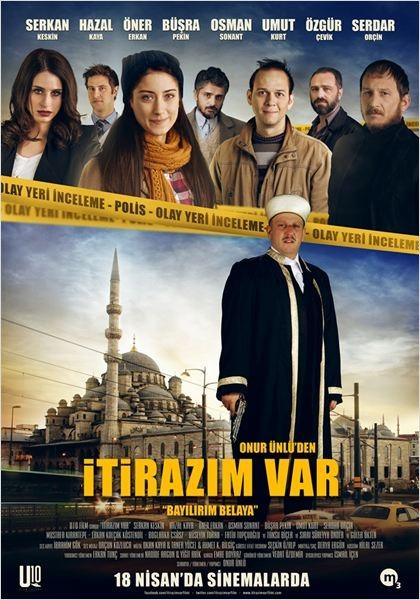
I have an objection
Vision History | 18.04.2014 | ||||||||
|---|---|---|---|---|---|---|---|---|---|
Director(s) | Onur Ünlü | ||||||||
Screenplay(s) | Onur Ünlü Sırrı Süreyya Önder | ||||||||
Producer(s) | Onur Ünlü | ||||||||
Cast(s) | Serkan Keskin Turgay Erman Güler Ökten Boglarka Csösz Erkan Kolçak Köstendil Ahmet Kaynak Hüseyin Turan Tansu Biçer Mustafa Kırantepe Özgür Çevik Umut Kurt Serdar Orçin Osman Sonant Öner Erkan Büşra Pekin Hazal Kaya | ||||||||
Duration | 110 minutes | ||||||||
IMDb Rating | 7.7 | ||||||||
“İtirazım Var” is a 2014 Turkish black comedy and crime drama film written and directed by Onur Ünlü. The film draws particular attention for its distinctive narrative style and blending of genres.
Trailer of the Film “İtirazım Var” (YouTube)
The film’s protagonist, Selman Bulut, is an unusual character who once boxed professionally but now serves as an imam at a small mosque in Istanbul. One day, a murder committed within the mosque disrupts his routine life. Dissatisfied with the police investigation, Selman Hoca attempts to solve the crime using his own methods. In the process, he questions both his faith and his past. Although the film follows the structure of a classic murder mystery, it deepens through religious inquiries, philosophical dialogues, and absurd humor.
One of the film’s central themes is the internal turbulence, doubts, and moral searching experienced by Selman Bulut, the imam protagonist. As a religious figure becomes entangled in a murder investigation, a conflict emerges between dogmatic religious frameworks and individual conscience. Selman Hoca, portrayed as a character who does not view religion as mere ritual but as something to be questioned and challenged, invites viewers to reconsider the personal and social dimensions of faith. While confronting his past and his beliefs, he presents a human portrait that acknowledges his own sinfulness.
Selman Hoca’s refusal to trust the police investigation and his pursuit of justice through personal means constitutes a subtle critique of the existing justice system and bureaucracy. The film adopts a stance against superficial conformity, distorted economic structures, and the tendency of power to favor the winners. It draws attention to social and economic injustices through references to loan-sharking, the banking system, and the assertion that “wealth beyond need is haram.”
In response to the events he encounters, the character listens to the voice of his own conscience rather than conforming to societal expectations or rigid roles. Actions such as his rebellion inside the mosque after his daughter is kidnapped or his pursuit of a suspect to a tavern underscore his sense of personal responsibility and his refusal to fit into conventional molds.
Through the character of Selman Bulut—a former boxer, an intellectual with an anthropology background, and a mosque imam—the film interrogates the concept of identity and the individual’s place in society. This character, who embodies multiple identities, engages in an existential struggle as these identities clash and seek reconciliation. As Onur Ünlü notes, Selman’s analytical thinking stems from his interest in chess, his problem-solving skills from boxing, and his dissent against established religious interpretations from his knowledge of anthropology.
The film narrates a serious subject—murder—through Onur Ünlü’s signature blend of black comedy and absurd elements. Dialogues, situations, and character reactions create a tragicomic atmosphere that both amuses and provokes thought. This style intensifies the exposure of the social and personal distortions being critiqued.
The film offers a broad social critique through religious institutions, social relationships, and individual moral stances. Events unfolding around a murder in which everyone is a suspect expose societal hypocrisy, hidden secrets, and lies. It also includes critiques of how what is presented in the name of religion and tradition has drifted far from the essence of the Qur’an, giving rise to a social clerical class.
Selman Bulut’s process of solving the murder becomes an internal journey of confronting his own past, mistakes, and choices. This confrontation deepens the character and helps clarify the motivations behind his actions.
Onur Ünlü directed and wrote the screenplay. Serkan Keskin stars in the lead role. The film, which combines crime, drama, and black comedy genres, runs for approximately 110 minutes. “İtirazım Var” was released in Türkiye on 18 April 2014.
“İtirazım Var” received acclaim for its original narrative approach, genre fusion, and Serkan Keskin’s compelling performance. Onur Ünlü’s distinctive cinematic language earned the film positive reviews from critics. The film won several awards, including Best Director at the 33rd Istanbul Film Festival.
Beyazperde. "İtirazım Var". Accessed May 7, 2025. https://www.beyazperde.com/filmler/film-227064/
Box Office Türkiye. "İtirazım Var." Accessed May 7, 2025. https://boxofficeturkiye.com/film/itirazim-var--2012154
IMDb. "İtirazım Var". Accessed May 7, 2025. https://www.imdb.com/title/tt3646462/
Sinemalar. "İtirazım Var." Accessed May 7, 2025. https://www.sinemalar.com/film/225192/itirazim-var
YouTube. "İtirazım Var Fragman." Accessed May 7, 2025. https://www.youtube.com/watch?v=0XAOC6AwvSo

I have an objection
Vision History | 18.04.2014 | ||||||||
|---|---|---|---|---|---|---|---|---|---|
Director(s) | Onur Ünlü | ||||||||
Screenplay(s) | Onur Ünlü Sırrı Süreyya Önder | ||||||||
Producer(s) | Onur Ünlü | ||||||||
Cast(s) | Serkan Keskin Turgay Erman Güler Ökten Boglarka Csösz Erkan Kolçak Köstendil Ahmet Kaynak Hüseyin Turan Tansu Biçer Mustafa Kırantepe Özgür Çevik Umut Kurt Serdar Orçin Osman Sonant Öner Erkan Büşra Pekin Hazal Kaya | ||||||||
Duration | 110 minutes | ||||||||
IMDb Rating | 7.7 | ||||||||
Plot
Thematic Structure
Belief, Doubt, and Moral Inquiry
Quest for Justice and Systemic Critique
Individual Conscience and Responsibility
Identity, Existence, and Alienation
Black Comedy and Absurdism
Social Critique and Hypocrisy
Confronting the Past
Cast
Production and Release Information
Popularity and Awards