


This article was automatically translated from the original Turkish version.
Author(s) | Muhammed Hacı Yusuf | ||||||||
|---|---|---|---|---|---|---|---|---|---|
Publisher(s) | Nefes Yayınları | ||||||||
Publication Date | 15.01.2018 | ||||||||
Page | 288 | ||||||||
Language(s) | Turkish | ||||||||
Genre | Philosophy | ||||||||
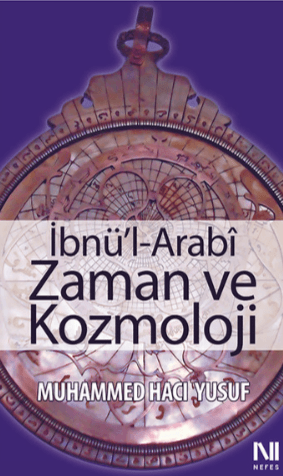
Muhammad Hacı Yusuf’s work Ibn al-Arabi: Time and Cosmology examines Ibn al-Arabi’s concepts of time and universe by comparing these ideas with modern scientific theories. The book particularly highlights Ibn al-Arabi’s concept of “ân-ı dâim.” This concept posits that time exists as a continuously renewed and unbroken “one.” According to the Islamic thinker, past and future converge within this perpetual “an,” and this perspective exhibits certain parallels with modern scientific theories such as quantum mechanics and the theory of relativity such as. The book suggests that these parallels may contribute to a deeper understanding of some fundamental paradoxes in modern physics.
Work, by interpreting Quranic verses concerning cosmology in Law, presents a original cosmological model in which time and space are understood as an integrated whole. This model offers a new perspective on scientific and philosophical debates such as the EPR paradox and Zeno’s paradox.
1. The Nature and Concept of Time
2. Cosmology and the Structure of the Universe
3. Metaphysical and Ontological Dimensions
4. Interpretation of the Quran and Hadith
5. Comparison with Scientific Paradigms
6. The Doctrine of Wahdat al-Wujud
Unity-i existence (the oneness of existence) in Islamic Sufism expresses the belief that all beings are manifestations of a single reality, namely Allah. According to this view, apparent multiplicity is merely different expressions of one singular existence. Ibn al-Arabi interprets the concept of wahdat al-wujud within the context of the creation and operation of the universe. For him, God is uniquely and absolutely one, and all entities in the universe are manifestations of His names and attributes. From this perspective, time and space are also reflections of these divine manifestations.
The book also examines Ibn al-Arabi’s concept of “ân-ı dâim” (continuous an) within this framework. This concept asserts that time exists as an unbroken and perpetual “an,” in which past and future continuously converge. It emphasizes that all existence and time are in fact different dimensions of a single reality.
7. Creation
According to Ibn al-Arabi, the creation of the universe occurred through the manifestation of God’s names and attributes. These manifestations appear at different levels known as entity stages, each representing a reflection of one of God’s names. Arabî refers to the creation of the universe as “continuous creation.” Under this view, God perpetually creates at every moment, and creation is an uninterrupted process. Time and space are regarded as dimensions of this continuous creation. The understanding of time as a continuously renewed “ân-ı dâim” (continuous an) demonstrates that the universe is in a state of perpetual and ongoing creation.
The book also notes that Sufi thinkers emphasize the transition from material time to spiritual time in grasping the true nature of time. According to them, perceiving this reality and attaining the “ân-ı dâim” becomes possible for one who progresses along the Right path. In this context, the concepts of beginning (before) and end (âhir) are said to converge within the perpetual “an.” Reference is made to the saying of Prophet Muhammad (peace be upon him), “There is neither morning nor evening with your Lord,” illustrating how a person who reaches this spiritual level can traverse immense long distances within a single short temporal moment.
Yusuf, Muhammed Hacı. İbnü'l-Arabî: Zaman ve Kozmoloji. İstanbul: Nefes Yayıncılık, [2018].

Author(s) | Muhammed Hacı Yusuf | ||||||||
|---|---|---|---|---|---|---|---|---|---|
Publisher(s) | Nefes Yayınları | ||||||||
Publication Date | 15.01.2018 | ||||||||
Page | 288 | ||||||||
Language(s) | Turkish | ||||||||
Genre | Philosophy | ||||||||
No Discussion Added Yet
Start discussion for "Ibn Arabi: Time and Cosmology (Book)" article
Themes in the Book “Ibn al-Arabi: Time and Cosmology”