

This article was automatically translated from the original Turkish version.
+1 More
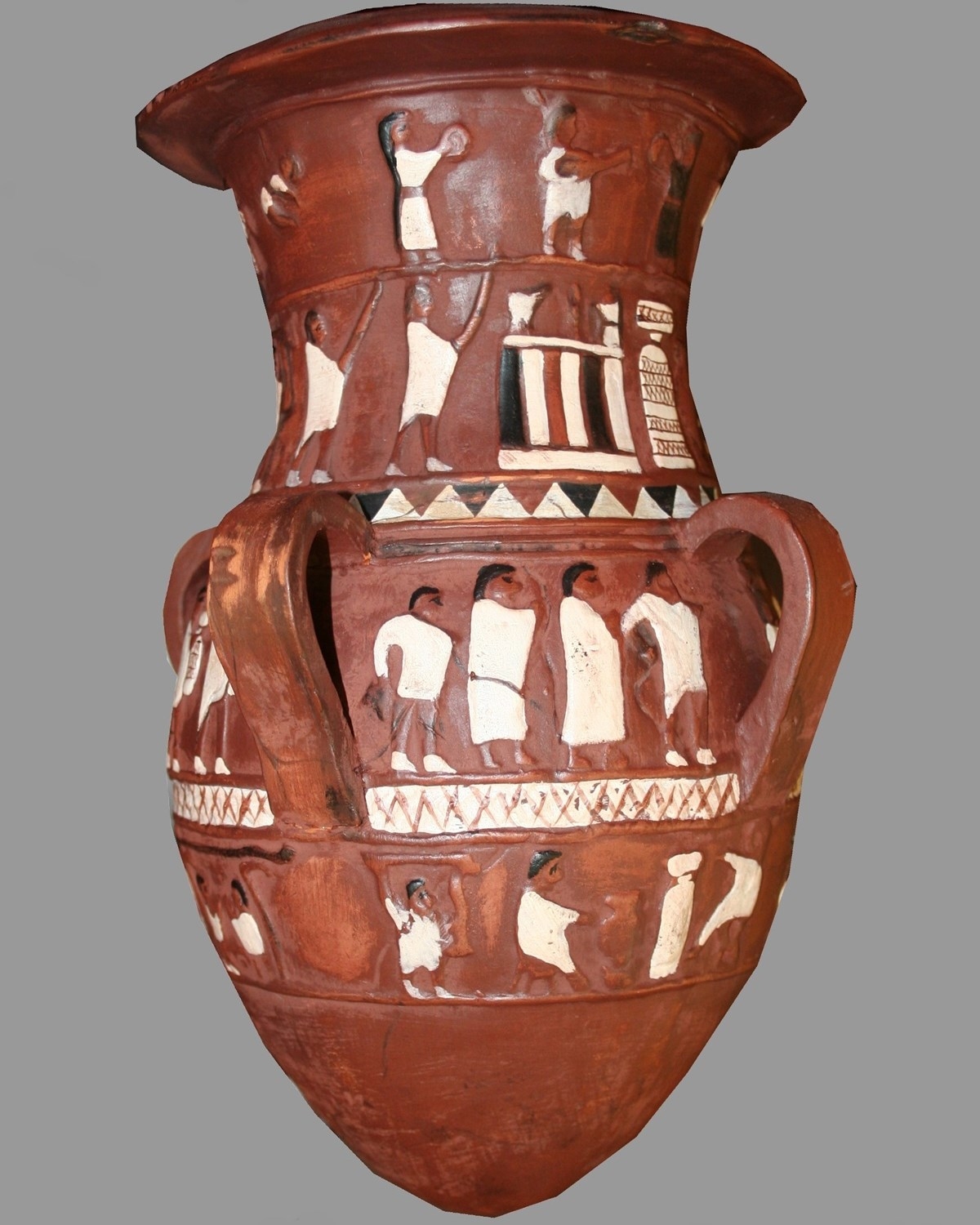
Inandık Vase is a molded ceramic vessel made of fired clay, dated to the Old Hittite period in Central Anatolia. Due to its figurative scenes, it is regarded as one of the narrative examples among Old Hittite ceramics. The artifact was discovered at the İnandıktepe settlement within the boundaries of Çankırı Province and provides visual evidence regarding the ritual practices and social structure of the period through its find context and decorative program.
Documentary on the Inandık Vase (TRT2)
The Inandık Vase was found in an area associated with architectural remains during excavations at İnandıktepe. Its context suggests that the vessel was not intended for everyday use but rather served a specific functional role. Stratigraphic data and the conditions of discovery indicate that the vase was deliberately placed and likely used in a ritual context.
The vase has a broad body that narrows toward the top. Its surface is decorated with relief bands arranged horizontally. It is understood that the reliefs were modeled by hand while the clay was still wet and then fired as a single unit. This production technique demonstrates that the reliefs were planned as an integral part of the vase’s form.
The relief scenes are organized as narrative bands encircling the vase. These bands depict human figures, animals, and various objects. The deliberate sequence and order of the figures indicate that the scenes were constructed within a structured narrative framework rather than as random decorative elements. Recurring figure types and motifs are particularly noticeable in the composition.
The human figures depicted in the reliefs are mostly shown standing. Some scenes portray figures facing each other, while others include representations associated with musical instruments. Animal figures serve as complementary elements within these scenes. This visual narrative reflects ritual practices involving collective participation.

Relief Depiction of Ritual Figures from the Inandık Vase (Generated by Artificial Intelligence)
The reliefs on the Inandık Vase provide indirect evidence of ritual practices during the early Hittite period, a time when written records are limited. The arrangement of objects and figures accompanying the scenes indicates that rituals were conducted according to specific sequences and rules. Objects depicted in the ritual context are evaluated alongside sacred and ceremonial items mentioned in Hittite texts.
The Inandık Vase is considered one of the most prominent examples of Old Hittite narrative ceramics. Due to its figurative scenes, production technique, and find context, it is among the key archaeological sources used to assess the Old Hittite ceramic tradition. In this regard, the artifact is recognized as one of the primary materials employed in the study of Old Hittite ritual practices in Anatolian archaeology.

Discovery Site and Find Context
Formal Characteristics and Production Technique
Arrangement of Relief Scenes
Figures and Ritual Depictions
Relationship to Hittite Ritual Practices
Significance in Anatolian Archaeology