


This article was automatically translated from the original Turkish version.
Interplanetary Logistics; An interdisciplinary field concerned with the sustainable planning execution and support of human and robotic space activities between Earth the Moon Mars and other celestial bodies. This field integrates classical logistics approaches with the physical technical and operational constraints of the space environment to achieve holistic management of material energy information and human flows. The long duration and complexity of interplanetary missions elevate logistics from a supporting function to a central element of mission design.
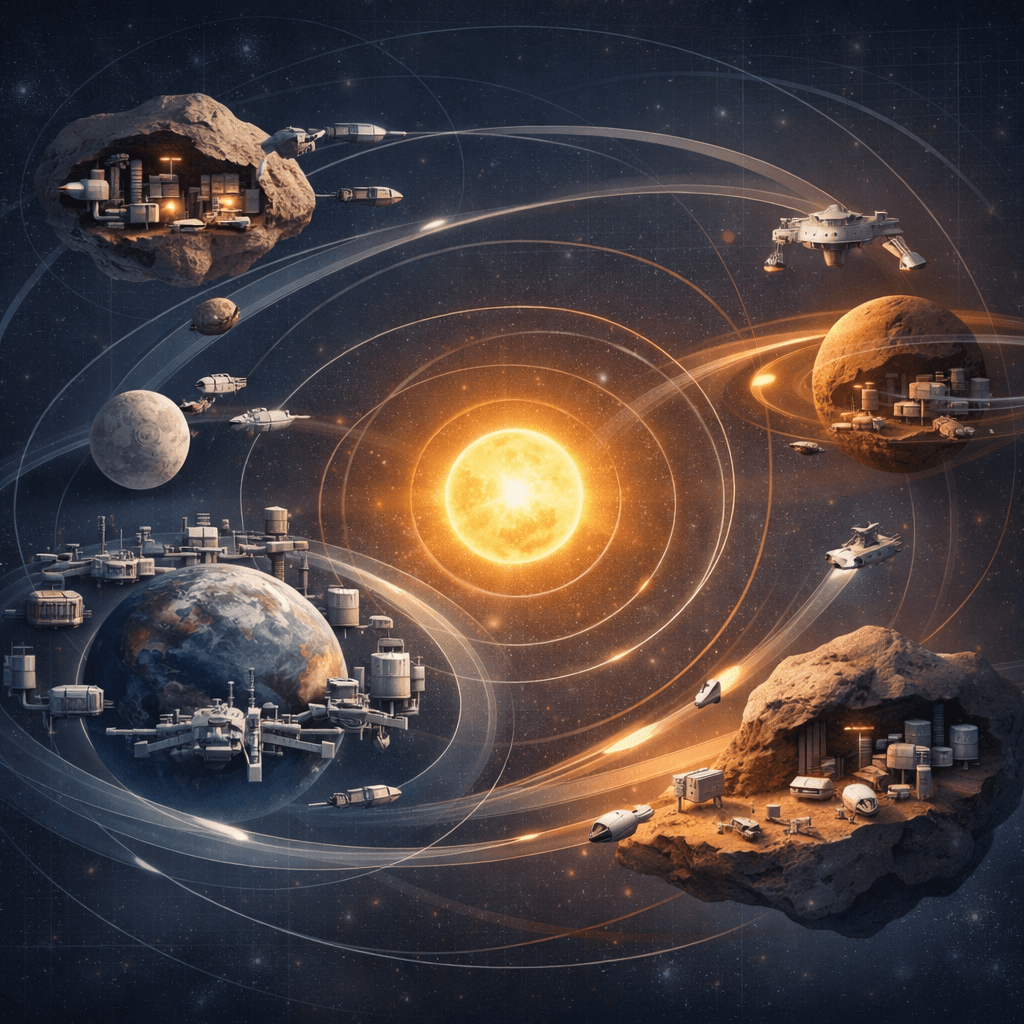
A Visual Representing Interplanetary Logistics (Generated by Artificial Intelligence.)
Interplanetary logistics encompasses the entire lifecycle of resources required for space missions from production to consumption. Within this framework pre-launch preparations in transit transfers planetary surface operations and return processes are treated as an interconnected system. Logistics activities involve not only the transportation of physical materials but also the flow of information decision making processes and organizational coordination. This approach ensures that missions focus not only on technical success but also on operational continuity.
Interplanetary logistics systems are commonly represented using network-based models. In these models planets orbits equilibrium points and surface bases are defined as nodes; transfers between these nodes are conducted via connections constrained by time and energy limitations. The network structure enables systematic comparison of different transportation options and mission scenarios. This allows for the evaluation of which routes time intervals and carriers should be used to move resources. This approach contributes to reducing uncertainties in interplanetary missions.
In interplanetary logistics the concept of supply chain extends from Earth-based production and storage activities to utilization points in the space environment. This chain includes various resource types such as propellant life support consumables spare parts and scientific equipment. The limited capacity for resupply in space necessitates meticulous preplanning of resource usage. Consequently strategies such as inventory management prepositioning and in situ resource utilization play a critical role. These strategies aim to balance mission cost and risk levels.
The complexity of interplanetary logistics systems necessitates the use of advanced modeling and simulation tools. These tools analyze material and equipment flows over time under different mission scenarios. Through simulations the impacts of demand fluctuations delays and system failures can be evaluated in advance. This enables decision makers to develop more flexible and resilient logistics plans in the face of uncertainty. Model-based approaches support the development of interplanetary logistics as a scientific discipline.
Interplanetary logistics faces various risks unique to the space environment. Technical failures environmental factors communication delays and human factors are among the primary sources of these risks. Designing logistics systems to be resilient against these risks is critical to mission success. Risk management encompasses not only the reliability of individual components but also the interoperability of the entire system. Therefore interplanetary logistics is viewed as a continuously updated and learning system.
Interplanetary logistics is gaining increasing importance alongside the planning of long duration human missions focused on the Moon and Mars. The establishment of permanent infrastructure in space requires a shift from a one-time mission mindset to a continuous operations mindset. This transformation elevates logistics from a supportive element of space exploration to one of its fundamental determinants. In the future interplanetary logistics is expected to serve as a foundational element of the space economy and multiplanetary human activities.
Bahengam, Amiratabak, Mohammad-Ali Miri, R. J. Rupert, Wesley Dyk, and Hao Chen. “Quantum-Assisted Space Logistics Mission Planning.” *AIAA SCITECH 2025 Forum*, January 2025. Accessed December 15, 2025 http://dx.doi.org/10.2514/6.2025-1107
Galluzzi, Michael, Edgar Zapata, Martin Steele, and Olivier de Weck. *Foundations of Supply Chain Management for Space Application*. NASA Kennedy Space Center, 2017. Accessed December 15, 2025. https://ntrs.nasa.gov/api/citations/20170011140/downloads/20170011140.pdf
Gkaravela, Evangelia, Hang Woon Lee, and Hao Chen. “Distributed Space Resource Logistics Architecture Optimization Under Economies of Scale.” *Journal of Spacecraft and Rockets* 62, no. 5 (September 2025): 1654–1666. Accessed December 15, 2025. http://dx.doi.org/10.2514/1.A36271
Ho, Koki, Yuri Shimane, and Masafumi Isaji. “Generalizing Space Logistics Network Optimization with Integrated Machine Learning and Mathematical Programming.” *Journal of Spacecraft and Rockets* 62, no. 2 (March 2025): 682–686. Accessed December 15, 2025. http://dx.doi.org/10.2514/1.A36122
MIT Space Logistics. “Interplanetary Supply Chain Management and Logistics Architecture.” Massachusetts Institute of Technology. Accessed December 15, 2025. https://strategic.mit.edu/spacelogistics/about.php
Salmaso, Marco, and Mark Jernigan. “Space Logistics Supply Chain for Interplanetary Missions.” AIAA 2024-85933, Date Published July 25, 2024. Accessed December 15, 2025 https://doi.org/10.2514/6.2024-85933
Toraman, Yavuz. “Uzay Lojistiği ve Risk: Uzay Araçları Üzerine Bir Çalışma.” *Politeknik Dergisi / Journal of Polytechnic* 28, no. 2 (2025): 573–584. Accessed December 15, 2025. https://dergipark.org.tr/tr/download/article-file/3882494
Varon Hoyos, Manuel, Volker Hessel, Eduardo Salas, John Culton, Karen Robertson, Andrea Laybourn, Marc Escribà-Gelonch, Nigel Cook, and Melissa de Zwart. “Supply Chain Sustainability in Outer Space: Lessons to Be Learnt from Remote Sites on Earth.” *Processes* 12, no. 10 (2024): 2105. Accessed December 15, 2025. https://doi.org/10.3390/pr12102105
Zapata, Edgar. "The NASA Human Space Flight Supply Chain, Current and Future." Paper, 42nd Space Congress, April 2007. Accessed December 15, 2025. https://ntrs.nasa.gov/api/citations/20170011139/downloads/20170011139.pdf

No Discussion Added Yet
Start discussion for "Interplanetary Logistics" article
Conceptual Framework and Scope
Network-Based Logistics Approach
Supply Chain and Resource Management
Role of Modeling and Simulation
Risks and Operational Challenges