
This article was automatically translated from the original Turkish version.
+1 More
Type(s) | Religious and cultural festival | ||||||||
|---|---|---|---|---|---|---|---|---|---|
Origin(s) | Inca Period | ||||||||
Name(s) | Inti Raymi (Sun Festival) | ||||||||
Prominent Regions | Otavalo, Cotacachi, Imbabura | ||||||||
History | June, winter solstice (particularly June 22–24) | ||||||||
Geography | Andes Mountains Ecuador and Peru | ||||||||
Inti Raymi is one of the most important spiritual and cultural celebrations among the Kichwa and Aymara communities in the Andes Mountains. The festival carries the legacy of the Inca belief system, which reveres the Sun as the deity Inti, and reflects the identity and continuity of Andean communities through its political, religious, and social dimensions. Throughout the period from the Inca era to the present, Inti Raymi has played a vital role in preserving local cultural expressions, transmitting traditions across generations, and strengthening community solidarity.

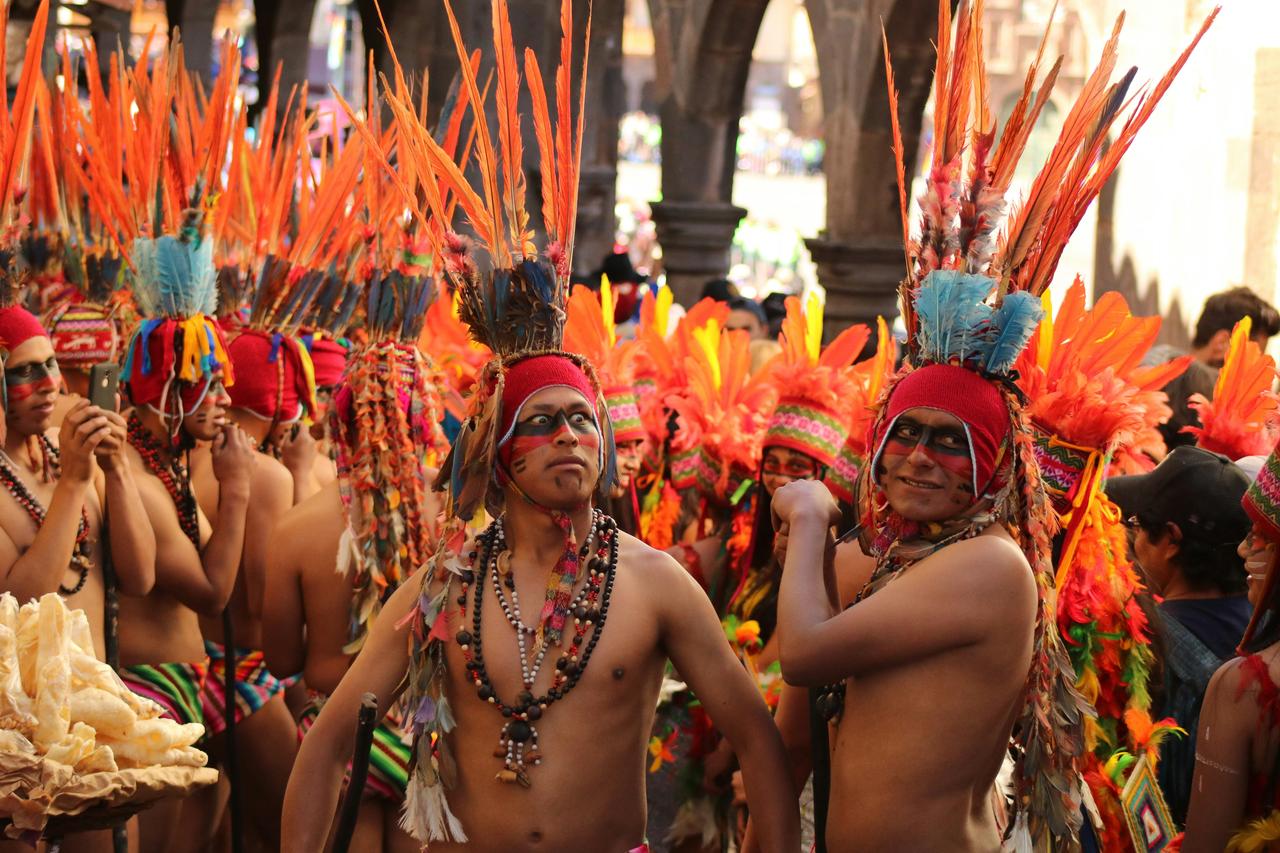
Inti Raymi Celebrations, Peru (Pexels)
According to 16th-century chronicles, Inti Raymi is regarded as one of the most fundamental spiritual celebrations for the Kichwa and Aymara communities. Inca Garcilaso de la Vega describes this festival as taking place in June and dedicated to the Sun, known as Intip Raimi, meaning “the solemn feast of the Sun.”【1】This celebration was held to honor the Sun as the sole and universal deity who nourishes and sustains all life on Earth. It also included a ritual acknowledging that the first Inca, Manco Cápac, his consort Mama Ocllo Huaco, and all subsequent rulers were the natural children and descendants of this deity.
Chronicler José de Acosta reports that the festival occurred in the seventh month, corresponding to June (Aucaycuzqui Intiraymi), during which hundreds of guanaco males were sacrificed.【2】Additionally, during this month, numerous statues were carved from quinoa wood, adorned with rich garments, and placed along the roads; flowers were scattered on the pathways, and indigenous people painted their faces to participate in the ceremonies. According to Garcilaso de la Vega, curacaras—local leaders and former commanders—from across the empire attended these religious rites and acts of homage to the Inca ruler, dressed in gold- and silver-plated garments, wearing gold plates in their beards and magnificent headdresses on their heads.【3】
During the colonial administration and subsequent republican periods, the spiritual and political power embodied in Inti Raymi was perceived as a threat by dominant authorities. Particularly in the 17th century, under the leadership of figures such as Francisco de Ávila, the “Law for the Extirpation of Idolatry” (Ley de Extirpación de Idolatrías) aimed to identify indigenous sacred sites (waka) and eradicate their rituals entirely. This law subjected indigenous spiritual leaders to intense pressure and used violence to prevent the performance of traditional ceremonies.
In response to severe repression, indigenous leaders developed a strategy of simulation and syncretism, concealing their spiritual symbols and festivals behind Christian names and figures. In this context, Inti Raymi was overlaid with Catholic festivals such as Saint John the Baptist (San Juan), Saint Peter (San Pedro), Saint Paul (San Pablo), and Corpus Christi. For example, during the celebrations of Hatun Puncha, or the Great Day, indigenous communities attending church services placed Inti Raymi symbols atop statues of San Juan, secretly sustaining their ancient rituals within the framework of these Christian feast days.
During this period, traditions carried out under the names of Corpus Christi in Cañar, San Pedro in Cayambe, and San Juan in Otavalo and Cotacachi were in fact clandestine expressions of the indigenous people’s enduring loyalty to their ancestral roots, their land, and the Sun. This camouflage strategy preserved the festivals’ sonic dimensions, dances, and spiritual essence until the present day. Beginning in the 1970s and 1980s, cultural movements led to the removal of colonial names and the public revival of the festival under its original name, Inti Raymi, which came to be recognized as a source of pride for indigenous identity.【4】

Qorikancha Temple, Cusco, Peru (Unsplash)
The Incas revered the Sun as the deity Inti and imposed this cult throughout all territories they conquered. Worship of local deities was permitted only if it remained subordinate to the worship of Inti. Cristóbal Molina reports that the Incas began singing hymns at sunrise and raised their hands in worship until sunset.
According to the chronicler José de Acosta, during the month of June (Aucaycuzqui Intiraymi), hundreds of guanaco males were sacrificed, and magnificent statues carved from quinoa wood were adorned with elaborate garments. Flowers were scattered along the roads during the festival, and local leaders known as curacaras and former commanders participated in these sacred rites dressed in gold- and silver-plated attire with magnificent headdresses. A tradition that continues to this day is the offering of the “rama de 12 gallos,” or the branch of twelve roosters, which expresses respect for local authorities and gratitude to the earth within the framework of reciprocity.
Animal offerings hold a central place in Inti Raymi. Llamas, guinea pigs, rabbits, and various game birds were sacrificed, and the consumption of alcoholic beverages during rituals was a notable feature. Human sacrifices were typically performed during the ascension of a new ruler or to avert natural disasters. Archaeological findings, particularly the mummified remains of Inca children discovered in the Ampato and Isla de La Plata regions, corroborate these rituals.

Inti Raymi Celebrations (Generated by Artificial Intelligence)
Inti Raymi represents a cosmic moment linked to the winter solstice (June 21–22), when universal energy unites with the earth (Allpamama/Pachamama) and water, sanctifying nature’s fertility and vitality. In the Southern Hemisphere, the night of June 22 is the shortest day and the longest, coldest night of the year. During this natural phenomenon, it is believed that cosmic energy concentrates in water, enhancing the fertility of the soil. The ritual bath known as Armay tuta, performed on this sacred night, is regarded as a healing process that purifies the body and spirit of negative energies. This concentrated energy, hidden within the water, prepares the individual for a new life cycle, offering spiritual renewal.
During this period, when the Sun is at its farthest point from Earth and its light weakens, communities light large fires in open hearths (fogones) on the night of June 28 to warm the atmosphere and symbolically sustain the Sun’s fire. This astronomical and agricultural cycle is tracked through special columns and markers at ancient observation sites such as the Cochasquí pyramids in Cayambe and the Panecillo in Quito, which align with equinoxes and solstices. These rituals serve as an expression of the community’s spiritual bond with the cosmos and with "Allpa Mama" (Mother Earth), embodying the paternal and maternal qualities of this sacred connection.

Pachamama (Generated by Artificial Intelligence)
Inti Raymi reinforces the values of the community-based organizational system known as the Ayllu. During the festival, ethical values such as honesty (ama llulla), trust, and generosity are practiced at the highest level. Community members open their homes to visitors, and there is no concern regarding property security.
A tangible expression of community solidarity is the Pampamesa ritual, in which communal meals are prepared. Each person places their food—known as kukawi—on cloths spread on the ground. Under prayers, the foods are mixed and shared collectively. This sharing is an act of gratitude for the abundance provided by Allpa Mama, or Mother Earth, and it is believed that those who share will receive better harvests in the future. During the rituals, figures such as Ayauma, Capitán, and Wachukamak are responsible for maintaining discipline among dancers and ensuring group safety.
During the colonial period, indigenous communities preserved the festival by concealing it behind Catholic figures such as San Juan, San Pedro, and Corpus Christi through a strategy of simulation. Beginning in the 1970s and especially in the 1980s, cultural movements in the Imbabura province—particularly in Otavalo, Cotacachi, and Natabuela—revived the festival under its original name, Inti Raymi, in public spaces. Music and dance groups such as Peguche, Ñanda Mañachi, and Rumiñawi were pioneers of this cultural awakening.

Andean Musician in Traditional Attire. Cusco, Peru (Pexels)
In the modern era, Inti Raymi is no longer confined to rural celebrations; it has become a symbol of Ecuador’s Plurinational State identity. The government and educational institutions support these festivities to honor indigenous identity and encourage the celebration of Inti Raymi alongside other festivals such as Kapak Raymi, Pawkar Raymi, and Kuyak Raymi in schools. Moreover, thanks to the Kichwa merchants known as Mindalae, the festival has become an event celebrated in global cities such as New York, Madrid, and Toronto.
The festival calendar consists of distinct stages.
June 22 marks the beginning with Armay tuta, the ritual bath that renews energy.
June 24 is the Great Day, known as Hatun Puncha, when communities descend into town squares.
Tinkuy, the gathering in the square, is a ritual of encounter and display of strength among different communities. This interaction symbolizes the collision of positive and negative energies, generating a new and mature energy.
Aya Puncha and Kunchu Maskay are the concluding stages, during which the spirits (Aya) are believed to accompany the final drops of chicha, the traditional beverage.
A central figure of the festival, Ayauma, unites past, present, and future—ñawpa, kay, and kipapacha—through a two-faced mask. The twelve horns on the mask represent either the months of the year or the rays of the Sun. The whip held in the hand is used to drive away negative energies.

Inti Raymi Celebrations (Unsplash)
Inti Raymi is a ritual that carries memory through the concept of Achikyachik, which expresses a cultural strategy linking past, present, and future. Solar and lunar observations, along with sites such as the Cochasquí pyramids and the Panecillo temple, reinforce the astronomical and ritual meaning of the celebrations.
The festivities have extended beyond rural areas, acquiring an intercultural dimension in the urban center of Otavalo through the participation of mestizo youth and foreigners. Inti Raymi continues to exist as a ritual that strengthens cultural identity, community memory, and creative expression.
Chacon, Richard J., Yamilette Chacon, and Angel Guandinango. “The Inti Raymi Festival among the Cotacachi and Otavalo of Highland Ecuador: Blood for the Earth.” In *Latin American Indigenous Warfare and Ritual Violence*, edited by Richard J. Chacon and Rubén G. Mendoza, pp. 116–141. Tucson: University of Arizona Press, 2007. Accessed March 24, 2026. https://www.researchgate.net/publication/350444661_The_Inti_Raymi_Festival_among_the_Cotacachi_and_Otavalo_of_Highland_Ecuador_Blood_for_the_Earth
Gutmann, Margit. “Time and Space: Contemporary Quechua Oral Tradition, Astronomy and the Inca Pilgrimage of the Sun ‘Inti Raymi.’” *Estudios Latinoamericanos* 44 (2024): 213–241. Accessed March 24, 2026. https://estudioslatinoamericanos.pl/index.php/estudios/article/view/447/346
Kowii, Ariruma. *Inti Raymi: La fiesta sagrada de los Kichwa Runa*. Quito: Universidad Andina Simón Bolívar, Sede Ecuador, 2019. Accessed March 24, 2026. https://repositorio.uasb.edu.ec/bitstream/10644/6674/1/CON-PAP-Kowi%2C%20A-La%20fiesta.pdf
Solorzano, Diego. “Brown Concrete Building Under Blue Sky and White Clouds During Daytime - QoriKancha.” Unsplash. Accessed April 20, 2026. https://unsplash.com/photos/brown-concrete-building-under-blue-sky-and-white-clouds-during-daytime-UlmzG8wXvRo
Tuaza, Luis Alberto. “La fiesta del Inti Raymi en la construcción del Estado plurinacional en el Ecuador.” *Amérique Latine Histoire et Mémoire. Les Cahiers ALHIM* 33 (2017). Accessed March 24, 2026. https://journals.openedition.org/alhim/5703
Viajes con Astro Cartografía. "People Wearing Costumes." Unsplash. Accessed March 24, 2026. https://unsplash.com/photos/people-wearing-costumes-3xRDFO5zRJ8
Villarreal, Renso. "Canlı Kıyafetleriyle Geleneksel And Müzisyeni." pexels. Accessed April 24, 2026. https://www.pexels.com/tr-tr/fotograf/canli-kiyafetleriyle-geleneksel-and-muzisyeni-33789183/
Zavaleta, Jhonatan. "Peru." Pexels. Accessed April 24, 2026. https://www.pexels.com/tr-tr/fotograf/adam-insanlar-kent-simgesi-gorulecek-yer-17022566/
[1]
Ariruma Kowii, ''Inti Raymi: La fiesta sagrada de los Kichwa Runa,'' Quito: Universidad Andina Simón Bolívar, Sede Ecuador, 2019. Syf. 3. https://repositorio.uasb.edu.ec/bitstream/10644/6674/1/CON-PAP-Kowi%2C%20A-La%20fiesta.pdf
[2]
A.e., 3.
[3]
A.e., 3-4.
[4]
A.e., 11-12.

Type(s) | Religious and cultural festival | ||||||||
|---|---|---|---|---|---|---|---|---|---|
Origin(s) | Inca Period | ||||||||
Name(s) | Inti Raymi (Sun Festival) | ||||||||
Prominent Regions | Otavalo, Cotacachi, Imbabura | ||||||||
History | June, winter solstice (particularly June 22–24) | ||||||||
Geography | Andes Mountains Ecuador and Peru | ||||||||
Historical Origins and the Colonial Period
Inca Era and Ancient Rituals
Colonial Repression and the “Extirpation of Idolatry” Policies
Religious Syncretism and Secret Resistance
Sun Worship and Sacrifices in the Inca Era
Pachamama and the Cosmic Dimension
Social Structure: Ayllu Values, Reciprocity, and Pampamesa
Inti Raymi Today
Ritual Cycle, Tinkuy, and Symbolic Figures
Cultural and Spiritual Significance