


This article was automatically translated from the original Turkish version.
+1 More
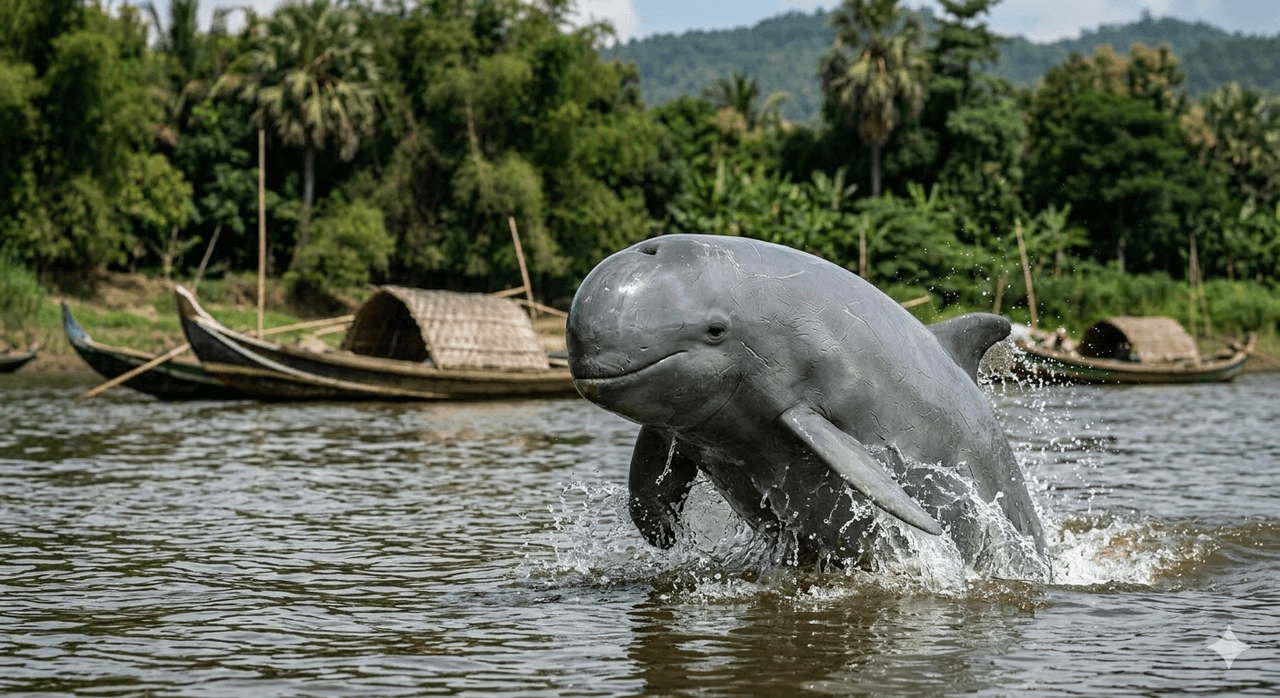
Irrawady Yunusu (Orcaella brevirostris) (Yapay Zeka Tarafından Oluşturuldu)
Irrawaddy dolphin (Orcaella brevirostris) is a euryhaline dolphin species that inhabits both marine and freshwater ecosystems in South and Southeast Asia. First described from the Ayeyarwady River in Myanmar, this species today occurs in small and isolated populations in coastal areas, estuaries, and particularly in river systems such as the Mekong, Mahakam, and Ayeyarwady. Although the species as a whole is generally considered threatened, its freshwater populations are at critical risk of extinction due to their extremely limited numbers.【1】
The Irrawaddy dolphin belongs to the kingdom Animalia, phylum Chordata, class Mammalia, and order Cetacea, which includes whales and dolphins. Within Cetacea, it is classified under the suborder Odontoceti, which comprises toothed whales, and the family Delphinidae. This species, scientifically named Orcaella brevirostris, is one of the known members of the genus Orcaella.【2】
Taxonomically, the Irrawaddy dolphin differs morphologically from many open-ocean dolphins. Notably, its skull structure, short rostrum, and fin morphology are key features distinguishing it from other delphinid species.【3】
The Irrawaddy dolphin exhibits distinctive features in its body and head morphology. Its head is prominently rounded, with a slightly bulging forehead. Unlike most dolphin species, it has a very short or nearly absent rostrum.【4】
The dorsal fin is small, triangular, and positioned toward the posterior part of the body; it is less developed compared to those of other oceanic dolphins. The pectoral flippers are broad and spatula-shaped, enhancing maneuverability. The tail flukes are broad and powerful in the horizontal plane. Skin color is typically gray, with a darker back and lighter belly.【5】
The body structure of this species reflects an adaptation to life in shallow coastal waters and river mouths.【6】

Image of the Irrawaddy dolphin at the water surface (Generated by Artificial Intelligence)
The geographic range of the Irrawaddy dolphin is confined to Southeast Asia. The species primarily inhabits shallow coastal waters, estuaries, and certain river systems. Known populations occur in coastal and inland water systems around Myanmar, Cambodia, Laos, Vietnam, Thailand, Malaysia, Indonesia, and the Philippines. These dolphins predominantly live in river deltas, lagoons, and turbid coastal environments.【7】
The Irrawaddy dolphin (Orcaella brevirostris) has a broad but fragmented geographic distribution across South and Southeast Asia. It occurs along coastal zones extending from the Bay of Bengal through the Andaman Sea, the Gulf of Thailand, and the South China Sea. However, its most notable feature is its ability to live not only in marine environments but also in major river systems. Distinct freshwater populations exist in the Ayeyarwady River in Myanmar, the Mekong River flowing through Cambodia and Laos, and the Mahakam River in Indonesia. These riverine populations are typically isolated and numerically small.【8】
Some populations of the Irrawaddy dolphin live exclusively in river ecosystems. These populations are found primarily in major river systems of Southeast Asia and are geographically separated from marine populations. Known riverine populations occur in limited water systems such as the Mekong River, the Ayeyarwady River, and the Mahakam River in Indonesia. Communities in these rivers tend to concentrate in specific river sections and have restricted distribution ranges.【9】
The restricted distribution of riverine populations makes them more vulnerable to environmental changes and human activities. As a result, various conservation initiatives have been implemented to protect these groups.【10】

Small-beaked dolphin with a rounded head (Generated by Artificial Intelligence)
Irrawaddy dolphins feed on a variety of fish species, crustaceans, and mollusks. They use echolocation, a system common among toothed whales, to locate prey.【11】
This species typically moves in small groups. Its surfacing behavior is generally calmer and slower compared to most other dolphin species. It has also been noted that Irrawaddy dolphins exhibit less frequent and lower breaches than some other dolphin species.【12】
The Irrawaddy dolphin is considered a threatened species in certain regions due to environmental pressures. Habitat loss, human activities in coastal zones, and fishing practices significantly impact the species.【13】
The limited distribution of riverine populations renders them particularly vulnerable. Consequently, various conservation efforts and monitoring programs have been initiated to protect the species.【14】
[1]
River Dolphins. “Irrawaddy Dolphin” Access Date: 16 March 2026.
https://www.riverdolphins.org/river-dolphins-worldwide/irrawaddy-dolphin/
[2]
Animal Diversity Web. “Orcaella brevirostris” Access Date: 16 March 2026.
[3]
Animal Diversity Web. “Orcaella brevirostris” Access Date: 16 March 2026.
[4]
Animal Diversity Web. “Orcaella brevirostris” Access Date: 16 March 2026.
[5]
River Dolphins. “Irrawaddy Dolphin” Access Date: 16 March 2026.
https://www.riverdolphins.org/river-dolphins-worldwide/irrawaddy-dolphin/
[6]
Animal Diversity Web. “Orcaella brevirostris” Access Date: 16 March 2026.
[7]
World Wide Fund for Nature (WWF). “Defending the Irrawaddy Dolphin” Access Date: 16 March 2026.
https://marine-flagships.panda.org/defending-the-irrawaddy-dolphin.html
[8]
River Dolphins. “Irrawaddy Dolphin” Access Date: 16 March 2026.
https://www.riverdolphins.org/river-dolphins-worldwide/irrawaddy-dolphin/
[9]
World Wide Fund for Nature (WWF). “Defending the Irrawaddy Dolphin” Access Date: 16 March 2026.
https://marine-flagships.panda.org/defending-the-irrawaddy-dolphin.html
[10]
World Wide Fund for Nature (WWF). “Defending the Irrawaddy Dolphin” Access Date: 16 March 2026.
https://marine-flagships.panda.org/defending-the-irrawaddy-dolphin.html
[11]
Animal Diversity Web. “Orcaella brevirostris” Access Date: 16 March 2026.
[12]
Animal Diversity Web. “Orcaella brevirostris” Access Date: 16 March 2026.
[13]
World Wide Fund for Nature (WWF). “Defending the Irrawaddy Dolphin” Access Date: 16 March 2026.
https://marine-flagships.panda.org/defending-the-irrawaddy-dolphin.html
[14]
World Wide Fund for Nature (WWF). “Defending the Irrawaddy Dolphin” Access Date: 16 March 2026.
https://marine-flagships.panda.org/defending-the-irrawaddy-dolphin.html

Irrawady Yunusu (Orcaella brevirostris) (Yapay Zeka Tarafından Oluşturuldu)
No Discussion Added Yet
Start discussion for "Irrawaddy dolphin (Orcaella brevirostris)" article
Taxonomic Classification and Systematic Position
Morphological and Anatomical Characteristics
Geographic Distribution and Habitat Characteristics
Populations in River Ecosystems
Feeding Ecology and Foraging Behavior
Conservation Status and Threats