


This article was automatically translated from the original Turkish version.
+2 More
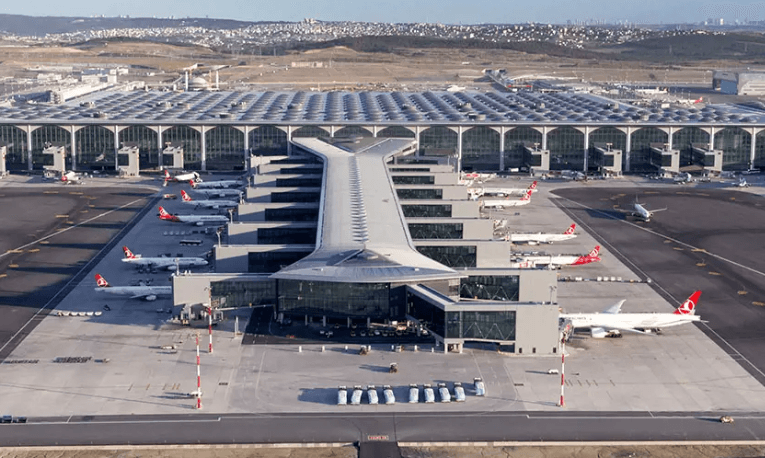
Istanbul Airport
Location | Istanbul Türkiye | ||||||||
|---|---|---|---|---|---|---|---|---|---|
Opening Date(s) | 29 October 2018 | ||||||||
ICAO Code | LTFM | ||||||||
IATA Code | IST | ||||||||
Passenger Capacity | Currently 90 million passengers annually, 200 million when completed | ||||||||
Geographic Coordinates | 41°16'31"N - 28°45'07"E | ||||||||
Istanbul Airport, opened in 2018, is the largest airport in Türkiye and one of the largest in the world. The airport operates under civil status with ICAO code LTFM and IATA code IST.
Istanbul Airport has been planned in four phases. The first phase was completed with 3 independent runways and a terminal building with a capacity of 90 million passengers. When all phases are completed, it will reach an annual capacity of 200 million passengers and serve over 300 destinations.
Main structures and systems include:
Istanbul Airport is operated by IGA (Istanbul Grand Airport) company. IGA was established in 2013 by the Cengiz-MAPA-Limak-Kolin-Kalyon common consortium and as of 2022 is managed under a partnership structure of 55% Kalyon Holding and 45% Cengiz Holding.
The airport project was implemented under the Build-Operate-Transfer (BOT) model. In the tender held on 13 May 2013, a 25-year lease fee of €22.152 billion was offered, rising to €26.142 billion when VAT was included.
The area where Istanbul Airport was built covers 76.5 square kilometres and previously consisted of forest and mining lands. Numerous discussion have occurred regarding the environmental impacts of the project.
Istanbul Airport has become a major hub in international aviation and has received numerous awards:
The airport’s complete capacity will be achieved by 2028, with full capacity expected upon completion of the sixth runway in 2028.
Anadolu Ajansı. "Dünyanın yeni kavşağı İstanbul Havalimanı açıldı." Accessed March 19, 2025. https://www.aa.com.tr.
BBC Türkçe. "İstanbul Havalimanı: A'dan Z'ye Cumhuriyet tarihinin en büyük altyapı yatırımı." Accessed March 19, 2025. https://www.bbc.com/turkce.
Devlet Hava Meydanları İşletmesi (DHMİ). "İstanbul Havalimanı Genel Bilgiler." Accessed March 19, 2025. https://www.dhmi.gov.tr.
Istanbul Airport Official Website. "Istanbul Airport Opened." Accessed March 19, 2025. https://www.istanbulhavalimani.gov.tr.
İGA İstanbul Airport. "Hakkımızda." Accessed March 19, 2025. https://www.istairport.com/kurumsal/hakkimizda.

Istanbul Airport
Location | Istanbul Türkiye | ||||||||
|---|---|---|---|---|---|---|---|---|---|
Opening Date(s) | 29 October 2018 | ||||||||
ICAO Code | LTFM | ||||||||
IATA Code | IST | ||||||||
Passenger Capacity | Currently 90 million passengers annually, 200 million when completed | ||||||||
Geographic Coordinates | 41°16'31"N - 28°45'07"E | ||||||||
Construction and Structure
Operation and Management
Financing and Tender Process
Environmental and Social Impacts
Global Significance of Istanbul Airport
Future Plans and Expansion