
This article was automatically translated from the original Turkish version.
+2 More
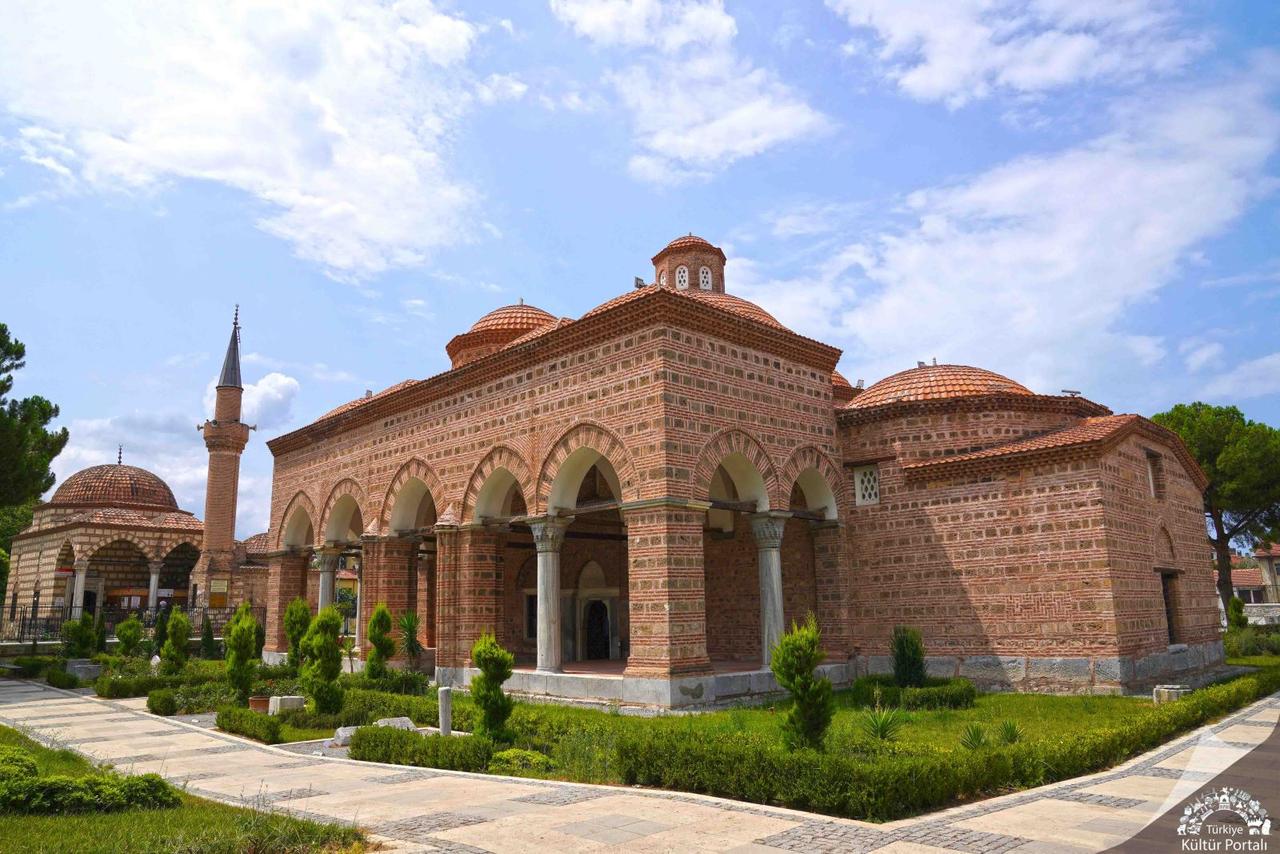
Nilüfer Hatun Imaret, Museum of Turkish and Islamic Art, is located in the İznik district of Bursa. This structure was commissioned in the late 14th century, in 1388 (H. 790), by Ottoman Sultan Murad I in memory of his mother, Nilüfer Hatun, as an imaret and zawiya.

Nilüfer Hatun Imaret, Museum of Turkish and Islamic Art (Route Bursa)
This building belongs to the early Ottoman architectural type of zawiya-integrated mosque complexes and features an inverted "T" plan, one of the earliest examples of this plan type in Ottoman architecture. The walls are constructed using a technique alternating one course of cut stone with three courses of brick. On the southern façade, radial decorative patterns are created using brick and ceramic tiles. Inside the spaces, apart from a horizontal palmette sequence executed in malakari technique along the walls of the two units on the entrance axis, no other prominent ornamentation is evident.
During the Republican period, the building was used as a storage facility for various purposes. It was opened to the public as a museum in 1960. From the 1960s until 2012, it served as an Archaeology Museum displaying artifacts from the Hellenistic, Roman, Byzantine, Seljuk, and Ottoman periods. After approximately eight years of restoration and exhibition reorganization, the Nilüfer Hatun Imaret reopened to the public on 3 July 2020 under the name Museum of Turkish and Islamic Art.

Nilüfer Hatun Imaret, Museum of Turkish and Islamic Art (Route Bursa)
To the left of the square-plan entrance space is a model of İznik. The right side has been arranged as an open exhibition area, illustrating Ottoman culinary culture through wax figures. Items on the table include embossed copper trays, covered serving dishes, spoons, and towels.

Nilüfer Hatun Imaret, Museum of Turkish and Islamic Art (Route Bursa)
Opposite the entrance section and elevated on a platform, this unit features a simple mihrab on its southern wall. This space was used as a mosque for daily prayers other than Friday and holiday congregations, and also served as a venue for religious instruction and scholarly discussions. Artifacts selected for this area reflect its function. In some display cases, a single artifact is highlighted, such as the ceramic inscription and associated verse from the Eşrefoğlu Rumi Mosque.

Nilüfer Hatun Imaret, Museum of Turkish and Islamic Art (Route Bursa)
The southern section of the building displays reconstructions and artifacts related to İznik’s distinctive ceramic and pottery production. General information is provided on the ceramic and pottery research that initiated the medieval excavation tradition in Turkey. The museum houses Ottoman ceramics and wall tiles known by names such as Milet Work, Haliç Work, Şam Work, and Rhodes Work, as well as ceramics made from red and white clay bodies. Production of utilitarian ceramics began from the 14th century onward. From the 15th century, examples of white-glazed, blue-and-white Milet Work ceramics appear; Haliç Work blue-and-white ceramics decorated with fine spiral motifs; Şam Work ceramics from the second quarter of the 16th century, which introduced manganese purple and hazy green to the blue-and-white decoration; and from the middle of the same century, examples incorporating emerald green and coral red.

Nilüfer Hatun Imaret, Museum of Turkish and Islamic Art (Culture Portal)
The museum also displays ceramics produced in İznik workshops during the 16th century and ceramic fragments uncovered through excavations. From the 17th century onward, economic difficulties and increased imports of Chinese porcelain led to a decline in quality at İznik workshops, marked by the transformation of red pigment into brown and the emergence of glaze imperfections; these transitional examples are also exhibited. One distinctive feature of this section is the three-dimensional, life-size models of İznik ceramic kilns uncovered during excavations. In the exhibition area, a model of a kiln’s fire chamber is displayed, showing cross-sections of the loading opening sealed during firing and the observation holes.

Nilüfer Hatun Imaret, Museum of Turkish and Islamic Art (Route Bursa)
The northern section of the museum displays artifacts used in daily Ottoman life, including seals, coins, hookahs, coffee equipment, writing instruments, lighting tools, and scent apparatuses. Coffee equipment occupies a prominent place, featuring tools used from roasting coffee beans to brewing, as well as artifacts such as the güğüm, ibrik, fincan, and fincan zarf used in coffee presentation. Examples of buhurdan (incense burners) and gülabdan (rosewater bottles), which held significant social importance in Ottoman life, are also exhibited in this section. Notable examples of buhurdan and gülabdan dated to the 19th century are displayed in the exhibition hall.

Nilüfer Hatun Imaret, Museum of Turkish and Islamic Art (Route Bursa)
Among the important artifact groups in this section are Islamic-era coins, particularly those minted by Orhan Gazi after the conquest of İznik in 1331. Due to the importance of books and calligraphy in Ottoman culture, tools used in their preparation—such as hokkas, pens, inkwells, scissors, and pen knives—are also exhibited. Additionally, ceramic hookahs produced as tobacco use became widespread in the 19th century, along with coin or tobacco storage pouches, scent and enfiye boxes, towels, and lighting devices are on display.
In the museum’s garden, Islamic tombstones are also exhibited.

Nilüfer Hatun Imaret, Museum of Turkish and Islamic Art (Culture Portal)

No Discussion Added Yet
Start discussion for "İznik Nilüfer Hatun Imareti Turkish Islamic Works Museum" article
Architectural Features
Sections
Entrance Section
Qibla Chamber
İznik Ceramic and Pottery Production Section
Ottoman Daily Life Section