


This article was automatically translated from the original Turkish version.
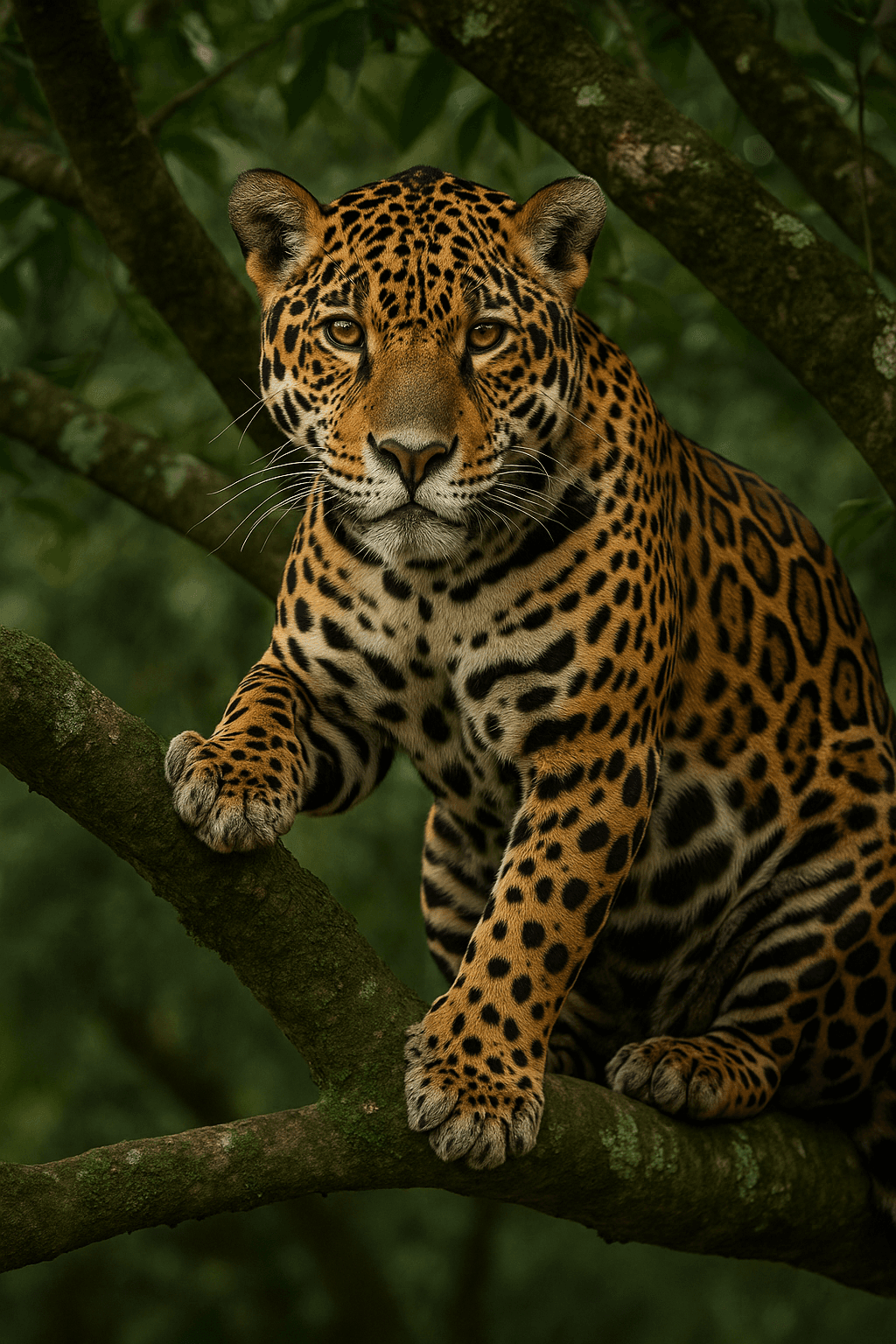
Jaguar (Panthera onca)
Family | Felidae (Cat family) Felidae | ||||||||
|---|---|---|---|---|---|---|---|---|---|
Genus | Panthera | ||||||||
Specie(s) | Panthera onca | ||||||||
Habitat | South America Mexico | ||||||||
Conservation Status | Nearly Threatened | ||||||||
Jaguar (Panthera onca) is the only Panthera species native to the New World (the Americas). It is the third-largest cat after the tiger (Panthera tigris) and the lion (Panthera leo) in terms of size. Although its historical range extended from the southwestern United States to northern Argentina, today it is primarily concentrated in tropical wetland areas such as the Amazon rainforest and the Pantanal.
The jaguar is a large predatory mammal within the genus Panthera. The body length of an adult, including the head and torso, can reach 170 to 185 cm, while the tail can extend up to 70 cm. Weight varies among individuals and by region; males typically weigh between 100 and 158 kg, while females range from 45 to 90 kg.
Jaguars have short, robust limbs. This body structure provides significant advantages in climbing, swimming, and stealthy stalking. Given their strong association with aquatic environments, their powerful and sturdy build enhances the species’ ecological adaptability.
The coat color is predominantly shades of yellowish-brown, but individuals can exhibit variation ranging from reddish-brown to nearly black. Variations such as albinism and melanism have been observed in this species. The characteristic black rosette markings on the fur form a unique pattern for each individual, enabling identification.
The skull is exceptionally robust, and the jaw muscles are highly developed. These features explain the jaguar’s powerful bite capable of crushing bone. Large lower molars allow it to disable prey by biting through hard structures such as the skull or shell.
The ears are small and rounded, while the eyes are large and adapted for night vision. These traits enable the jaguar to navigate effectively in darkness and dense vegetation during hunting. Its claws are retractable, aiding in silent approach.
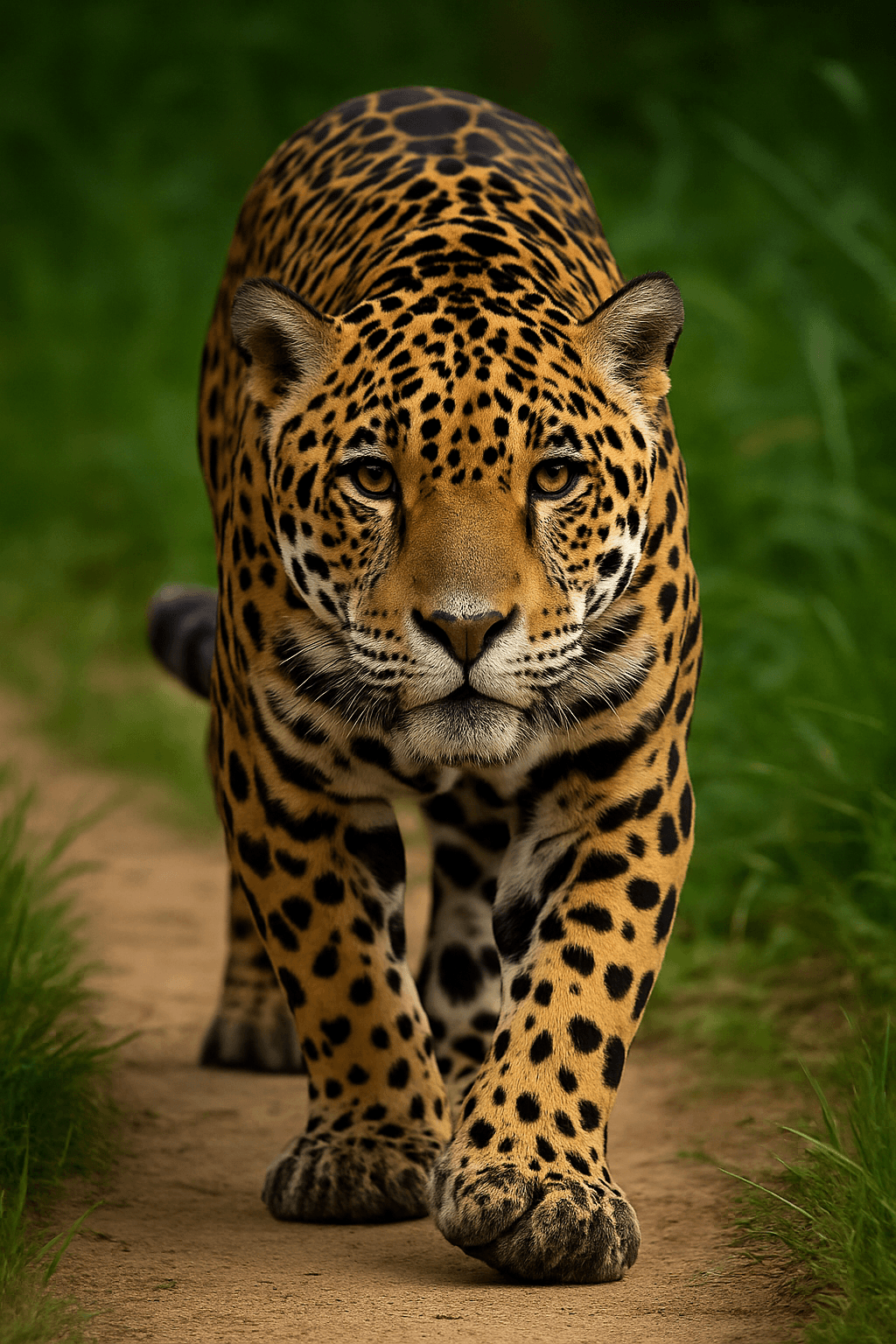
Jaguar (Generated by Artificial Intelligence.)
The word “jaguar” derives from the indigenous American term “yaguara,” meaning “one that kills with a single leap,” describing the animal’s hunting technique.
Historically, jaguars ranged widely from the southwestern United States to northern Argentina. Today, their distribution has significantly contracted, with the majority concentrated in the Amazon rainforest and the Pantanal, the world’s largest tropical wetland.
Jaguars are adapted to moist environments such as forests, riverbanks, and wetlands. They are highly aquatic, capable of swimming across rivers and traversing large bodies of water. Their willingness to enter water is a key ecological distinction from other large cats.
Strictly carnivorous, jaguars prey on a variety of animals including large mammals such as deer, tapirs, peccaries, dogs, and caimans, as well as reptiles. Their diet may also include frogs, fish, birds, and rodents. Jaguars typically capture prey through short-range ambush attacks and often kill by biting through the skull, leveraging their powerful jaws to immobilize their prey.
Jaguars are solitary animals and spend most of the year alone. Females continue hunting during pregnancy and while raising cubs, a necessity to meet the energy demands of both themselves and their offspring. In the wild, the average lifespan of a jaguar is 12 years, though under favorable conditions it can reach up to 15 years.
The jaguar (Panthera onca) is classified as “Near Threatened” by the International Union for Conservation of Nature (IUCN). This status indicates that while the species is not currently at critical risk of extinction, it faces a high probability of becoming threatened in the near future. Overall jaguar populations are declining, and the species is at risk of local extinction across many parts of its range.
The primary threats to jaguars are habitat loss and habitat fragmentation. Human activities such as deforestation for agriculture, road construction, and mining hinder the jaguar’s ability to roam widely and find prey. The disruption of forest corridors leads to reduced genetic diversity and isolation of local populations.
Illegal hunting has historically been a major threat, with large numbers of jaguars killed during the 20th century for their pelts. Although illegal trade has declined, it has not been fully eradicated. Additionally, jaguars are often killed by farmers in retaliation for attacks on cattle and other livestock, posing a persistent conservation challenge.

Generated by Artificial Intelligence.
International Union for Conservation of Nature (IUCN). “Betta splendens.” The IUCN Red List of Threatened Species. Accessed July 6, 2025. https://www.iucnredlist.org/species/15953/123791436
Seymour, Kevin L. "Panthera onca." *Mammalian Species*, no. 340 (1989): 1–9. Accessed July 6, 2025.
TÜBİTAK. "Jaguarlar: Amerika’nın En Büyük Kedisi." *Bilim ve Teknik Dergisi* 56, no. 1145 (2023): 82–85. Accessed July 6, 2025. https://e-dergi.tubitak.gov.tr/edergi/yazi.pdf?dergiKodu=4&cilt=56&sayi=1145&sayfa=82&yaziid=47136

Jaguar (Panthera onca)
Family | Felidae (Cat family) Felidae | ||||||||
|---|---|---|---|---|---|---|---|---|---|
Genus | Panthera | ||||||||
Specie(s) | Panthera onca | ||||||||
Habitat | South America Mexico | ||||||||
Conservation Status | Nearly Threatened | ||||||||
No Discussion Added Yet
Start discussion for "Jaguar (Panthera onca)" article
Morphological Characteristics
Etiology
Geographic Distribution and Habitat
Feeding Ecology
Reproduction and Lifespan
Conservation Status and Threats