


This article was automatically translated from the original Turkish version.
+2 More
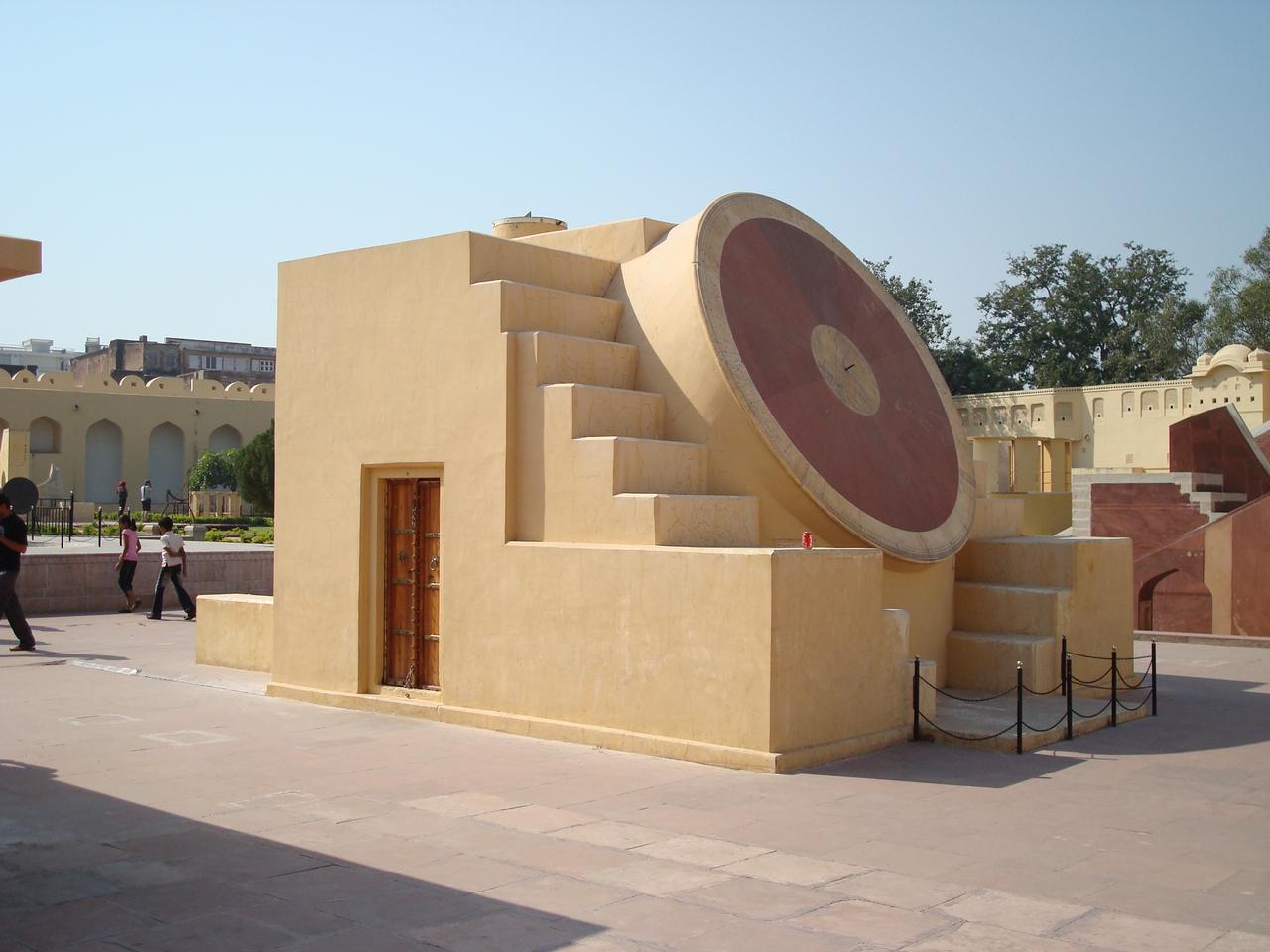
Architectural Style(s) | Monumental Open-Air Astronomical Observatory | ||||||||
|---|---|---|---|---|---|---|---|---|---|
Founder(s) | Maharaja Sawai Jai Singh | ||||||||
UNESCO World Heritage Status | On the List of Outstanding Universal Value | ||||||||
Number of Main Instruments | Approximately 20 main fixed instruments (Yantras) | ||||||||
Primary Function | Observation of astronomical positions with the naked eye, Timekeeping, Understanding planetary and cosmic motions, Contribution to the completion of zij astronomical tables | ||||||||
Year of Establishment | Construction start: 1724, Completion: 1734 | ||||||||
Location | Jaipur India Rajasthan | ||||||||
The Jantar Mantar Observatory in Jaipur is a complex of monumental astronomical instruments constructed in the early 18th century. It is the most comprehensive and best-preserved historical observatory in India, reflecting both the scientific expertise and cosmological understanding of its time. During the later years of the Mughal Empire, it emerged as the center for astronomical and astrological practices within the court of an enlightened prince.
The historical context of the Jantar Mantar in Jaipur is linked to the development of a scientific program in the first half of the 18th century aimed at reevaluating and standardizing astronomical observation methods across India. The construction of the observatory coincided with a period in which astronomy, cosmology, time measurement and astrological calculations held both scientific and social significance.
The primary catalyst for the observatory’s establishment was the inconsistency Jai Singh II identified in existing astronomical instruments. The brass instruments commonly used at the time were too small, contained moving parts and were prone to wear, making it impossible to achieve the required stability and accuracy in measurements. To resolve this issue, Jai Singh II dispatched research teams to scientific centers in Central Asia and Europe. Based on the knowledge gained, he concluded that greater precision in astronomical observations could be achieved by increasing the size of instruments, fixing them in place and using durable materials. This led to the conceptualization of monumental instruments constructed from stone and marble, a design approach that defined the architectural form of the Jaipur complex.
The period during which Jantar Mantar was built also marked the early development of Jaipur as a new capital. In planning the city, Jai Singh II adopted a layout based on Vastu Shastra principles integrating nature, astronomy and cosmology, establishing a functional unity between the city and the observatory. The observatory’s location was chosen near the administrative center of the city to reinforce the role of astronomical observations in governance, timekeeping and social rituals.
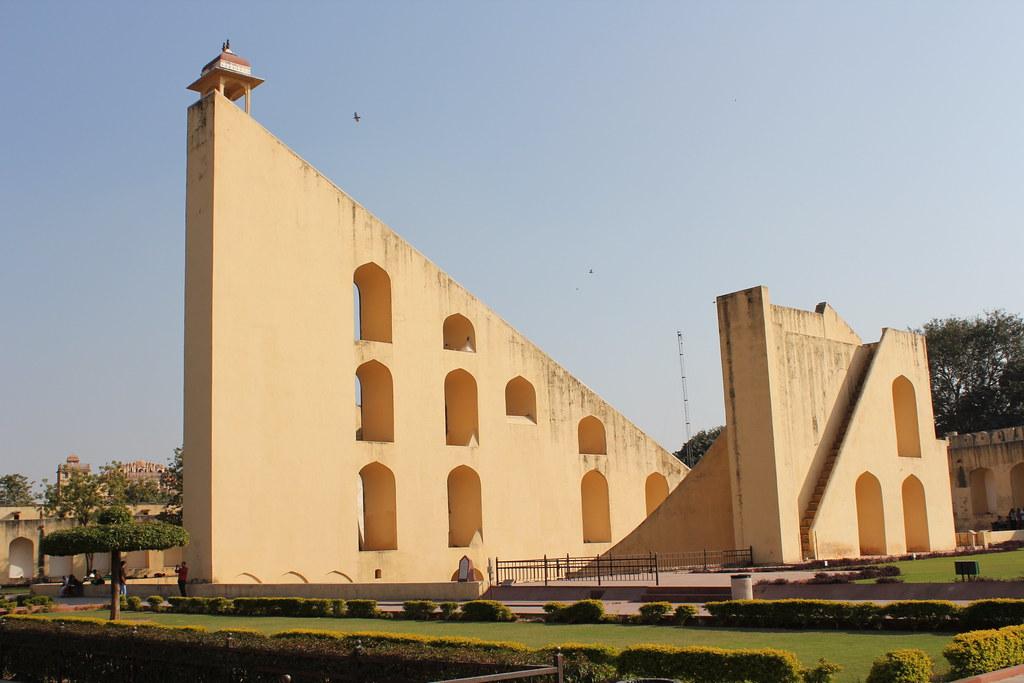
Jantar Mantar Observatory (Flickr)
Construction of the complex was completed around 1724, and the Jaipur observatory is the most extensive of the five observatories Jai Singh II commissioned for the same purpose. However, shortly after completion, the observatory began to deteriorate due to lack of regular maintenance; exposure to open-air conditions accelerated the erosion of materials. By the end of the 19th century, the structures had worn down and some instruments had lost their functionality, initiating a process that threatened the historical integrity of the site.
In 1901, a restoration initiative launched by Maharaja Ram Singh aimed to halt this decay and restore the observatory to operational condition.【1】 These efforts included structural repairs to the instruments, renewal of calibration markings and reinforcement of architectural surfaces. Ram Singh’s interventions laid the foundation for the observatory’s present form, enabling its survival into the modern era.
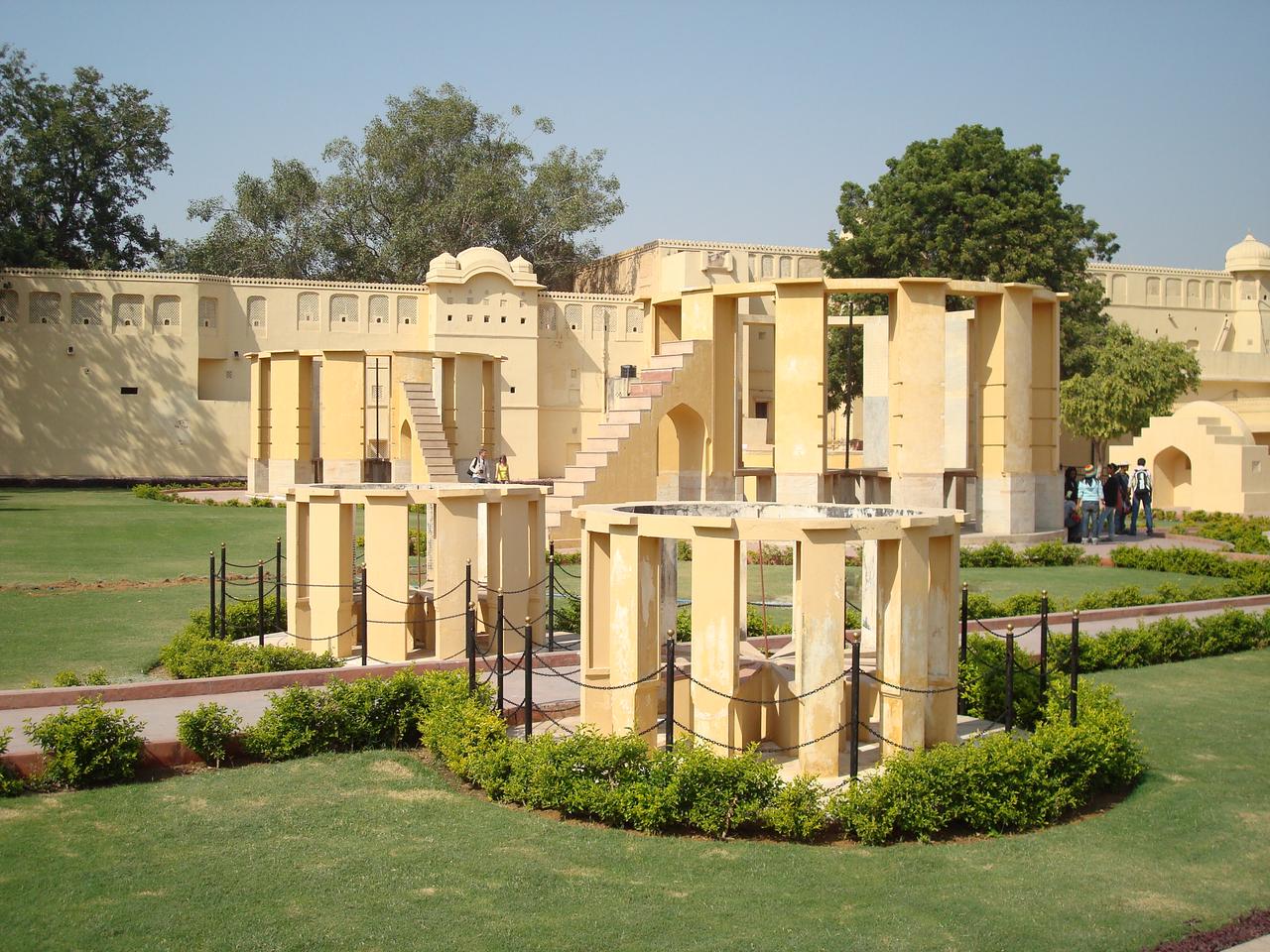
Jantar Mantar Observatory in Jaipur (Flickr)
During the British colonial period in the first half of the 20th century, various maintenance efforts were undertaken.【2】 However, due to the observatory’s open-air location, surface erosion, fading of scale markings and deterioration of architectural details reemerged over time. As a result, the complex became a cultural heritage site requiring long-term, consistent conservation.
The inclusion of Jantar Mantar on the UNESCO World Heritage Watch List in 2008 generated new awareness for its preservation and accelerated restoration efforts. These initiatives focused particularly on renewing fine scale markings critical to its astronomical function and enhancing material durability. Following these works, Jantar Mantar was inscribed on the UNESCO World Heritage List in 2010.【3】
The structures at the observatory consist of combinations of triangular walls, semicircular ramps, cylindrical voids, recesses, vertical projections and large stone platforms. These forms are designed to measure the position of celestial bodies along the local meridian, their angular elevation, the direction of shadows or the points of solar illumination. The fact that all instruments are constructed from fixed stone structures eliminates errors caused by moving parts. Jai Singh II’s decision to use stone and marble to enhance observational accuracy was the primary driver behind this architectural choice.
One distinctive feature of the architecture is the monumental scale of the instruments. Their large dimensions are based on the principle that increasing scale reduces measurement error, particularly in sundials and star position calculations. As a result, instruments such as the Samrat Yantra represent the largest examples of their kind in history.
Although geometric precision was the primary design criterion, Hindu-style roof overhangs, the use of local stone and marble, and the preference for arched openings to reinforce voids contributed to the complex’s aesthetic harmony with regional architectural traditions.
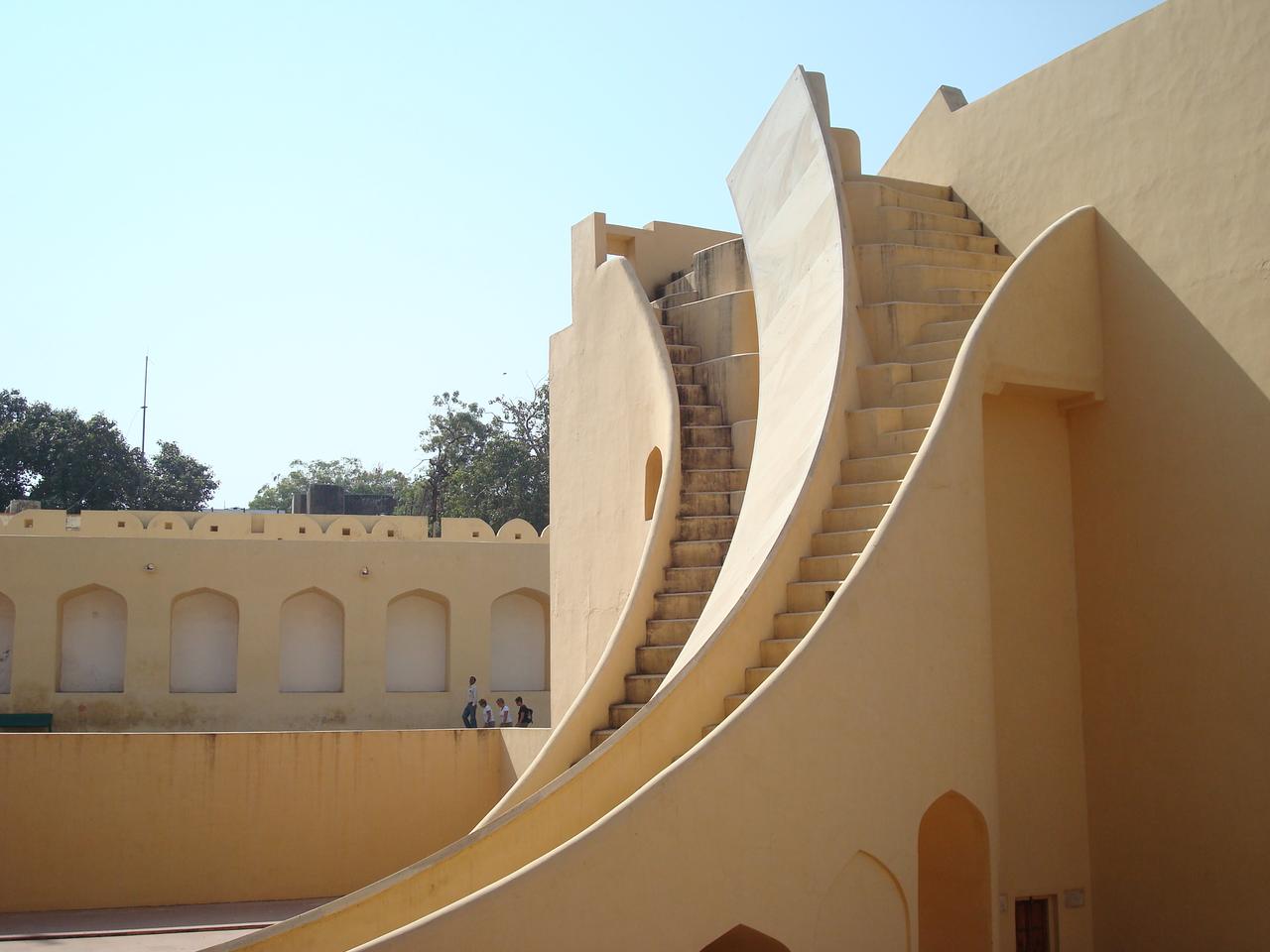
Architecture of the Jantar Mantar Observatory in Jaipur (Flickr)
The observatory functions as an open-air complex, presenting a holistic arrangement of independent units designed for specific calculations rather than a single enclosed structure. Each yantra is positioned to perform a particular astronomical function; some are aligned north-south for meridian observations, while others are oriented at specific angles to track the Sun’s position along the ecliptic. The spatial relationships and alignments between instruments are also carefully arranged to minimize calculation errors.
Another significant dimension of the complex’s architecture lies in the calibration markings on the instrument surfaces. Although these markings have been affected over time by open-air conditions, they remain essential to the observatory’s primary astronomical function. Fine graduations have been meticulously carved into the stone surfaces, providing the necessary reference points for measuring specific shadow or light projections.
The Jantar Mantar in Jaipur is an open-air complex housing approximately twenty major fixed instruments designed for astronomical observation. All instruments are large-scale, fixed stone structures developed to determine the positions of celestial bodies with the naked eye. Their architecture follows a design philosophy that eliminates moving parts to maximize measurement accuracy. Each yantra is configured with a unique function to track specific positions and movements of the Sun, stars or planets. The main instruments and their functional characteristics are as follows:
The largest instrument in the complex, this structure stands approximately 27 meters high and consists of a triangular wall with wide semicircular ramps on either side, functioning as a giant sundial.【4】 The Samrat Yantra measures the time of equinoxes and local time with exceptional precision; due to the shadow’s movement of about one millimeter per second, it can indicate time with an accuracy of two seconds.【5】 The position of the shadow on the ramps serves as the primary reference for determining the Sun’s altitude and the hour of the day.
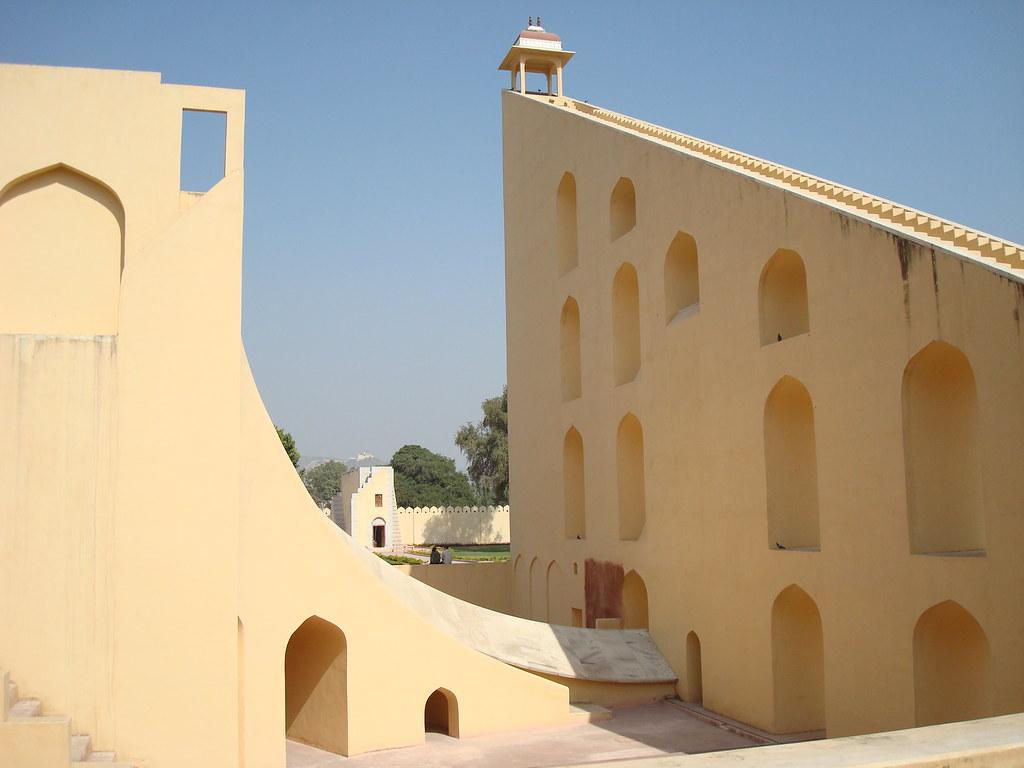
Samrat Yantra (Flickr)
Composed of two large semicircular structures set at ground level, their surfaces are marked with divisions used to determine the positions of stars and planets. A crosswise wire stretched across the top holds a small metal disc that casts the shadow of the Sun or a designated star, enabling position determination.【6】 This instrument is one of the fundamental tools for identifying Vedic zodiac signs and tracking the movement of celestial bodies along the ecliptic.
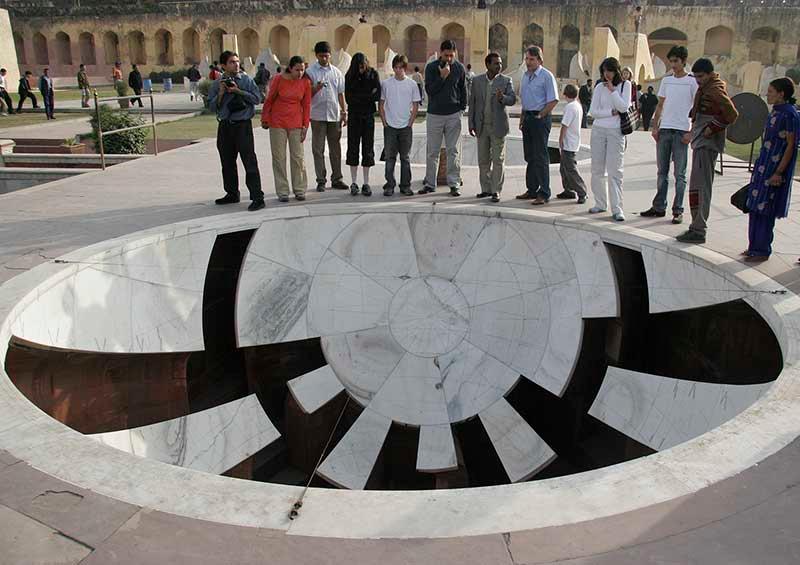
Jai Prakash Yantra (Jantar Mantar)
This instrument consists of cylindrical structures designed to measure altitude and azimuth angles. The Ram Yantra features a vertical pillar at its center with graduated markings inscribed on the inner surfaces of the cylindrical walls. The shadow cast by sunlight or a specific celestial body onto the pillar and the wall surfaces is used for positional calculations.【7】 This design was specifically developed to determine the altitude of celestial bodies above the horizon.
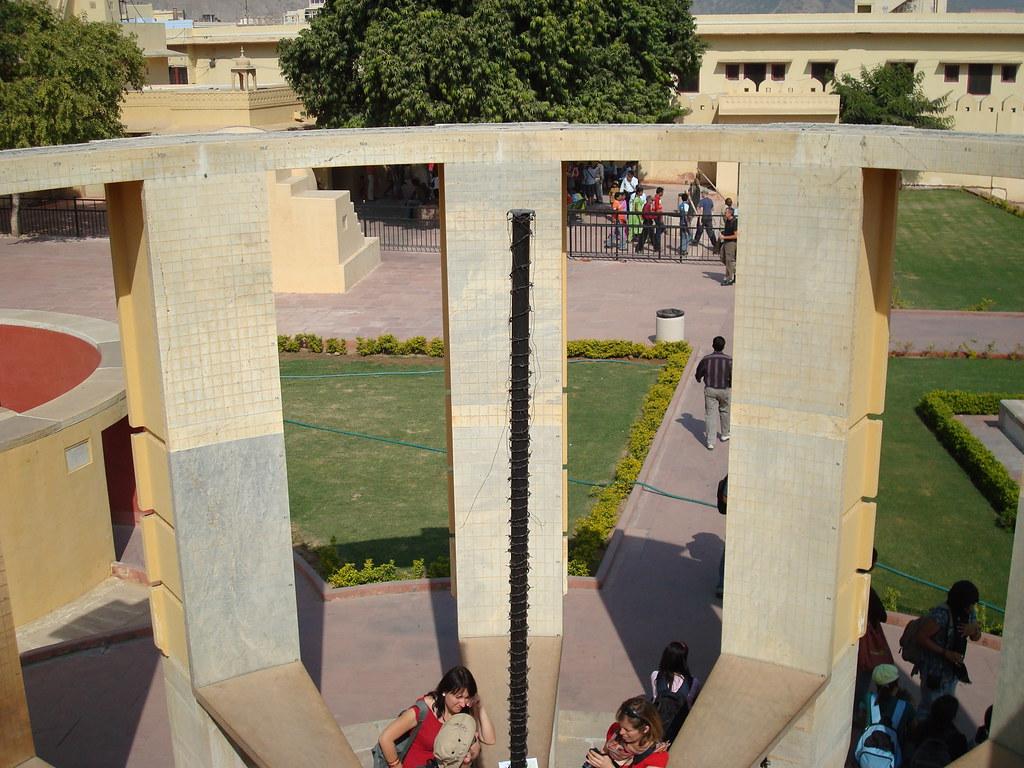
Ram Yantra (Flickr)
A composite instrument integrating five different methods of time measurement. The purpose of the Misra Yantra is to enable comparisons between local time calculations used in various geographic regions. Unlike other instruments in the observatory, it has the capacity to correlate Jaipur’s time measurements with those of distant regions.
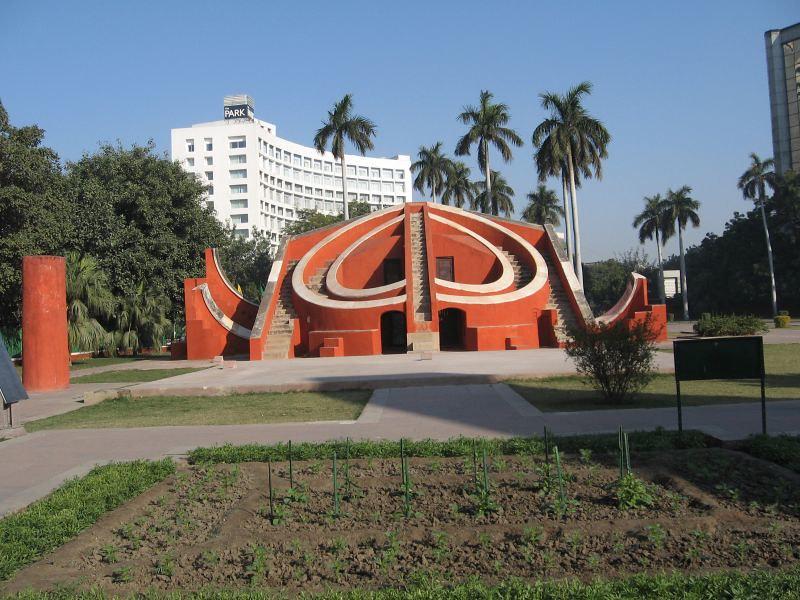
Misra Yantra (Flickr)
The complex contains numerous yantras designed to determine the Sun’s position, star movements, meridian transits, ecliptic angles and specific astrological calculations. These include:
Some of these yantras historically served concrete functions in astrological practices, while others were used in meteorological forecasting. One of Jai Singh II’s objectives in designing the instruments was to improve the accuracy of the city’s agricultural calendar, ritual calendar and administrative scheduling. Consequently, many instruments in the observatory served not only astronomical but also social and administrative functions.
The Jantar Mantar in Jaipur represents the most advanced achievement of pre-modern astronomy in the form of a monumental observational complex. Its value extends beyond the individual size and technical innovations of its instruments; the integrated system formed by their arrangement provided a highly accurate practical application of 18th-century astronomical theory and methodology.
Jantar Mantar constitutes one of the last monumental expressions of a continuous scientific tradition rooted in ancient and medieval astronomy, particularly the Ptolemaic tradition of positional astronomy. Its observational results were applied in areas such as validating calendar calculations, determining zodiac positions, comparing timekeeping techniques and evaluating meteorological indicators.
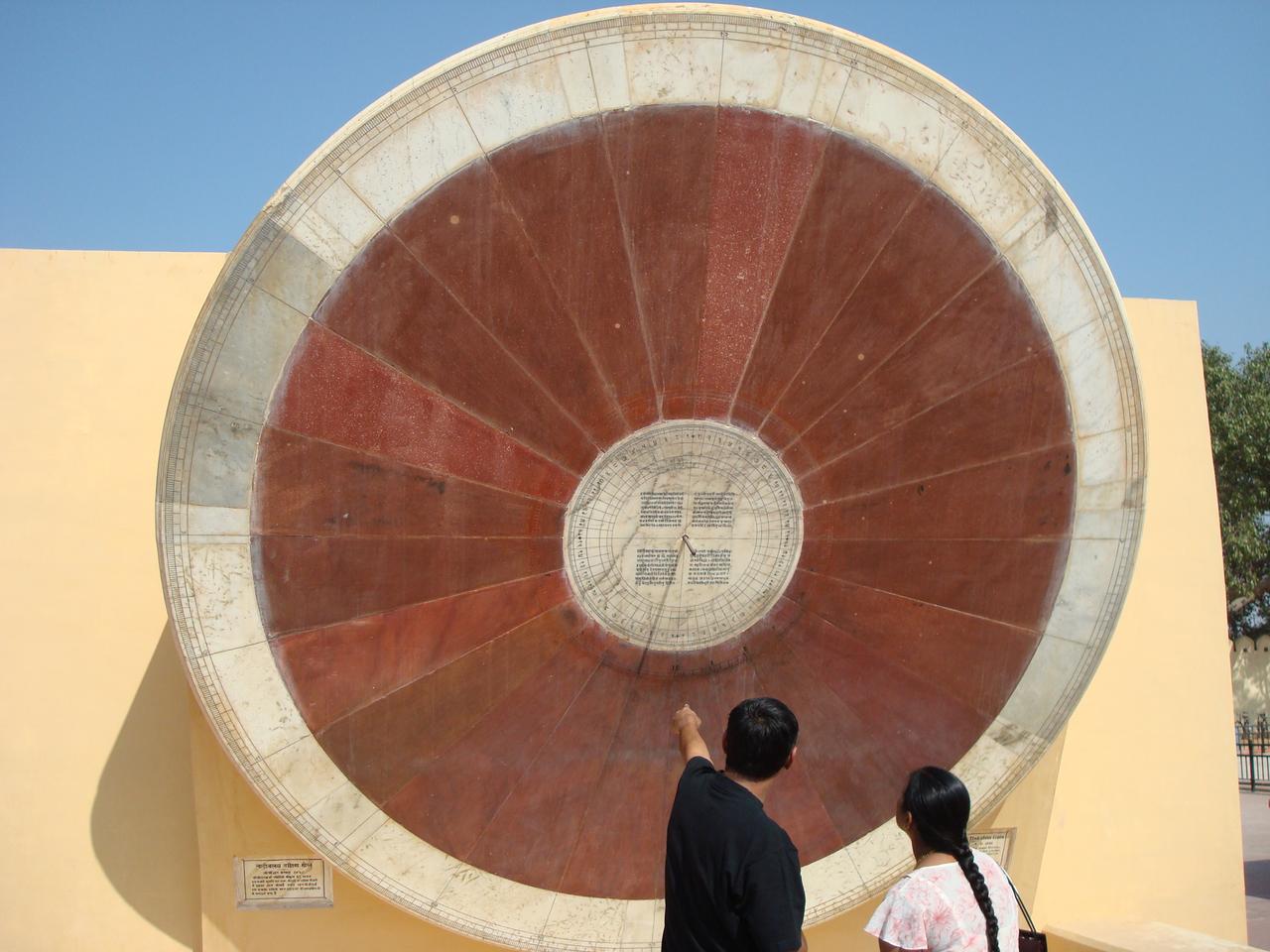
Jantar Mantar, Narivalaya Dakshin Gola (Flickr)
Another factor enhancing the scientific importance of the observatory is the synthesis of astronomical knowledge from different cultures. Feedback from Jai Singh II’s delegations to scientific centers in Central Asia and Europe led to a synthesis in instrument design that incorporated both the Islamic astronomical tradition and emerging European observational techniques.
The observatory also assumed a social function through its integration of astrology, time measurement and cosmological practices. Measurements used to determine time, identify auspicious dates, calculate zodiac signs and predict weather events demonstrate that the observatory was not merely a scientific center but also a tool shaping the rhythm of social life.
The astronomical significance of the observatory has been rerecognized in the modern era. In the 20th and 21st centuries, various scholars have emphasized that the structures still provide valid measurement systems and have encouraged their use for educational purposes, enabling students to experience positional astronomy through hands-on observation.
In 2010, the Jantar Mantar in Jaipur was inscribed on the UNESCO World Heritage List, affirming its recognition as a cultural heritage site of “Outstanding Universal Value.” Its inclusion formally acknowledges its significance in architectural, scientific and cultural terms. UNESCO’s evaluation considers Jantar Mantar not merely as a collection of large-scale astronomical instruments but as a synthesis of diverse scientific traditions and one of the last monumental expressions of historical astronomical understanding. The World Heritage status obliges the implementation of conservation and management plans. UNESCO emphasizes the need for a long-term management system due to potential threats from urban development around the site, tourism pressure and risks to the buffer zone. It is stipulated that Jaipur’s new master plan must include provisions for protecting the observatory’s buffer zone. Additionally, strengthening the scientific expertise of management authorities is considered essential for the sustainability of conservation policies.
The observatory began to deteriorate due to its open-air location in a tropical region and its temporary abandonment during the 19th century. In 1901, Maharaja Ram Singh initiated restoration and reconstruction efforts to revive the decaying site; much of its current form is the result of these reconstruction works. Although conservation efforts have been completed, the numerous interventions have made it uncertain to determine the originality of the instruments’ plaster coatings, graduations and architectural interpretations.
The Jantar Mantar in Jaipur is used as a public park and open-air museum. The complex continues to serve as a learning center for students, scientists and tourists from around the world seeking practical experience in astronomy and astrology.
Arian Zwegers. "Jaipur, Jantar Mantar, Brihat Samrat Yantra." Flickr. Accessed December 5, 2025. https://www.flickr.com/photos/azwegers/9713595658/in/photostream/
BBC. "India’s mysterious gateway to the stars." BBC Travel. Accessed December 5, 2025. https://www.bbc.com/travel/article/20220530-jantar-mantar-indias-mysterious-gateway-to-the-stars
Güler, Büşra. "Fuat Sezgin’in İslâm Bilimlerine Bakış Projelerinde Astronomi." *I. Ulusal Genç Akademisyenler Sempozyumu: Prof. Dr. Fuat Sezgin ve İslâmî İlimler.*, edited by Feyza Betül Köse, KSÜ Siyer-i Nebi Araştırmaları Uygulama ve Araştırma Merkezi SAMER Yayınları, 2019, pp. 159-171. Accessed December 5, 2025. https://siyerinebi.ksu.edu.tr/depo/belgeler/Fuad%20Sezgin%20Sempozyumu-470%20s_2501140747206584.pdf#page=136
Jane Ellen. "Jantar Mantar, Delhi." Flickr. Accessed December 5, 2025. https://www.flickr.com/photos/jane-ellen/378100996/
Jantar Mantar. "Jai Prakash Yantra." Accessed December 5, 2025. https://www.jantarmantar.org/learn/observatories/instruments/jaiPrakash/index.html
Jantar Mantar. "Samrat Yantra." Accessed December 5, 2025. https://www.jantarmantar.org/learn/observatories/instruments/samrat/index.html
Penn State University. "Jantar Mantar: Narivalaya Dakshin Gola (close from northeast)." Flickr. Accessed December 5, 2025. https://www.flickr.com/photos/psulibscollections/5881408450/in/photostream/
Penn State University. "Jantar Mantar: RamaYantra: detail from south." Flickr. Accessed December 5, 2025. https://www.flickr.com/photos/psulibscollections/5881633344/
Penn State University. "Jantar Mantar: RamaYantra: middle distant view from southeast." Flickr. Accessed December 5, 2025. https://www.flickr.com/photos/psulibscollections/5881633110/in/photostream/
Penn State University. "Jantar Mantar: Samrat Yantra: close view from southwest." Flickr. Accessed December 5, 2025. https://www.flickr.com/photos/psulibscollections/5881522978/in/photostream/
UNESCO World Heritage Centre. "The Jantar Mantar, Jaipur." Accessed December 5, 2025. https://whc.unesco.org/en/list/1338/
Unat, Yavuz. "On Sekizinci Yüzyılda Hindistan'da Türkler Tarafından Kurulan Bir Gözlemevi: Jantar Mantar." Kastamonu Üniversitesi (Bildiri). Accessed December 5, 2025. https://www.academia.edu/6280820/On_Sekizinci_Y%C3%BCzy%C4%B1lda_Hindistanda_T%C3%BCrkler_Taraf%C4%B1ndan_Kurulan_Bir_G%C3%B6zlemevi_Jantar_Mantar
World Monuments Fund. "Jantar Mantar." Accessed December 5, 2025. https://www.wmf.org/monuments/jantar-mantar
[1]
World Monuments Fund, "Jantar Mantar." World Monuments Fund, erişim tarihi: 5 Aralık 2025, https://www.wmf.org/monuments/jantar-mantar
[2]
World Monuments Fund, "Jantar Mantar." World Monuments Fund, erişim tarihi: 5 Aralık 2025
[3]
World Monuments Fund, "Jantar Mantar." World Monuments Fund, erişim tarihi: 5 Aralık 2025
[4]
BBC, "India’s mysterious gateway to the stars." BBC Travel, erişim tarihi: 5 Aralık 2025, https://www.bbc.com/travel/article/20220530-jantar-mantar-indias-mysterious-gateway-to-the-stars
[5]
BBC, "India’s mysterious gateway to the stars." BBC Travel, erişim tarihi: 5 Aralık 2025
[6]
Unat, Yavuz, "On Sekizinci Yüzyılda Hindistan'da Türkler Tarafından Kurulan Bir Gözlemevi: Jantar Mantar," Kastamonu Üniversitesi (Bildiri), sayfa 7, erişim tarihi: 5 Aralık 2025, https://www.academia.edu/6280820/On_Sekizinci_Y%C3%BCzy%C4%B1lda_Hindistanda_T%C3%BCrkler_Taraf%C4%B1ndan_Kurulan_Bir_G%C3%B6zlemevi_Jantar_Mantar
[7]
Unat, Yavuz, "On Sekizinci Yüzyılda Hindistan'da Türkler Tarafından Kurulan Bir Gözlemevi: Jantar Mantar," Kastamonu Üniversitesi (Bildiri), sayfa 8, erişim tarihi: 5 Aralık 2025,

Architectural Style(s) | Monumental Open-Air Astronomical Observatory | ||||||||
|---|---|---|---|---|---|---|---|---|---|
Founder(s) | Maharaja Sawai Jai Singh | ||||||||
UNESCO World Heritage Status | On the List of Outstanding Universal Value | ||||||||
Number of Main Instruments | Approximately 20 main fixed instruments (Yantras) | ||||||||
Primary Function | Observation of astronomical positions with the naked eye, Timekeeping, Understanding planetary and cosmic motions, Contribution to the completion of zij astronomical tables | ||||||||
Year of Establishment | Construction start: 1724, Completion: 1734 | ||||||||
Location | Jaipur India Rajasthan | ||||||||
No Discussion Added Yet
Start discussion for "Jantar Mantar Observatory" article
Historical Background and Establishment Process
Architectural Features
Instruments and Their Functions
Samrat Yantra
Jai Prakash Yantra
Ram Yantra
Misra Yantra
Other Measurement Structures
Astronomical and Scientific Significance
UNESCO World Heritage Status
Conservation and Restoration Efforts
Current Use