



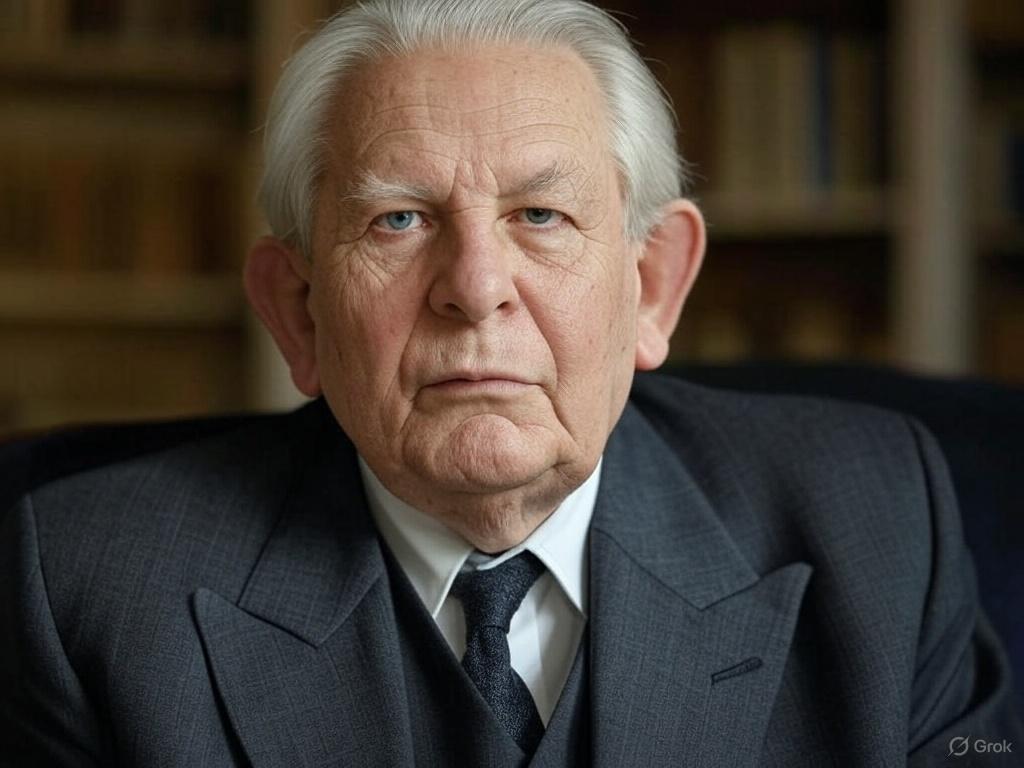
Jean William Fritz Piaget
Doğum tarihi | 1896-08-09 | ||||||||
|---|---|---|---|---|---|---|---|---|---|
Ölüm tarihi | 1980-09-16 | ||||||||
Jean Piaget (9 August 1896, Neuchâtel, Switzerland – 16 September 1980, Geneva, Switzerland) is renowned for his research in psychology and holds a foundational place in the field through his theory of cognitive development. Piaget developed theories of cognitive development by studying children’s mental growth and processes. His theories have profoundly influenced psychology and education and formed the basis of educational psychology.
Piaget was known from an early age for his scientific curiosity, particularly his interest in biology and the natural sciences. During his childhood, he strengthened his interest in the natural sciences by observing birds.
Piaget studied biology at the University of Neuchâtel and later earned a doctorate in psychology. His interest in psychology marked the beginning of his professional career. His education enabled him to develop deep insights into developmental psychology.
In the 1920s, Piaget began studying children’s cognitive development, observing how children interacted with their environment during this period. From 1920 to 1930, he worked at the International Bureau of Educational Research in Geneva.
Piaget’s theories became a central part of developmental psychology and enhanced our understanding of children’s cognitive development in educational contexts. His insights into how children’s perspectives and logical reasoning change with age are particularly significant.
In addition to his research on children and development, Piaget maintained a strong interest in children’s literature and educational materials. His fascination with the natural sciences continued throughout his life.
In 1923, Piaget married Valentine Châtenay, and the couple had three children. His observations of his family and his children’s development provided inspiration for his work.
In the later years of his life, Piaget conducted research on the social influences on children’s learning processes and established foundational theories in developmental psychology.
Jean Piaget died on 16 September 1980 in Geneva, Switzerland, at the age of 84.
Piaget’s theories of cognitive development have shaped educational psychology and had a global impact. Much of the research on child development has been conducted within the framework of his theories.
Beyond his contributions to modern psychology, Piaget has left a broad influence in education and remains a fundamental source of inspiration for educators and psychologists alike.
The Language and Thought of the Child. London: Routledge & Kegan Paul, 1923.
The Origins of Intelligence in Children. New York: International Universities Press, 1952.
Inhelder, Bärbel, and Jean Piaget. The Growth of Logical Thinking from Childhood to Adolescence. New York: Basic Books, 1958.
Lourenço, Orlando, and Armando Machado. "The Concept of Developmental Stage: A Critical Review of Its Meaning and Use." Psychological Review 103, no. 3 (1996): 385–401.
Piaget, Jean. Psychology and Epistemology: Towards a Theory of Knowledge. New York: Viking Press, 1970.

Jean William Fritz Piaget
Doğum tarihi | 1896-08-09 | ||||||||
|---|---|---|---|---|---|---|---|---|---|
Ölüm tarihi | 1980-09-16 | ||||||||
No Discussion Added Yet
Start discussion for "Jean William Fritz Piaget" article
Early Life and Education
Childhood and Youth
Educational Background
Career and Achievements
Career Path
Key Achievements
Key Works and Contributions
Contributions
Major Works and Projects
Personal Life
Hobbies and Interests
Private Life
Later Years and Death
Final Years
Death
Legacy and Influence
Aftermath
Source of Inspiration