


This article was automatically translated from the original Turkish version.
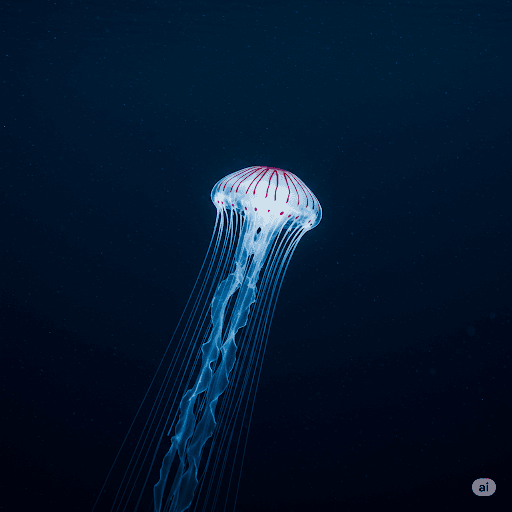
Jellyfish
Scientific Classification | Phylum Cnidaria, Class Scyphozoa | ||||||||
|---|---|---|---|---|---|---|---|---|---|
Body Structure | Jelly-like mesoglea, central mouth and tentacles | ||||||||
Life Cycle | Metagenesis: Planula, Polyp, Ephyra, Medusa | ||||||||
Reproduction(s) | Asexual (budding strobilation) and sexual reproduction | ||||||||
Feeding | Zooplankton, small fish, symbiotic relationships | ||||||||
Ecological Role | Predator and prey in marine ecosystems | ||||||||
Population Dynamics | Variable | ||||||||
Jellyfish are members of the class Scyphozoa within the phylum Cnidaria, exclusively marine organisms commonly referred to as “true jellyfish.” These organisms hold an important place in scientific research due to the complexity of their life cycle, their morphological features, and their ecological roles.
Jellyfish possess a bell-shaped body, typically filled with a gelatinous substance called mesoglea. The mesoglea provides structural integrity and contains a large proportion of water. Along the margin of the body, tentacles are equipped with specialized cells called nematocysts, used for capturing prey and defense. The mouth is generally located on the underside of the body, and the digestive system consists of a central stomach and radial canals. The nervous system lacks a central brain and instead comprises a network of nerves and sensory structures known as rhopalia. Rhopalia contain ocelli for light detection and statoliths for balance.

Jellyfish (Generated by Artificial Intelligence.)
The life cycle of the jellyfish involves both sexual and asexual stages through a process known as metagenesis. The planula larvae produced by sexual reproduction settle on the seafloor and develop into polyps. Under favorable environmental conditions, polyps undergo a process called strobilation to produce ephyrae, which are juvenile medusae. These ephyrae grow and mature into adult medusae.
Jellyfish are found in various regions of the world’s oceans. Some species inhabit coastal areas, while others live in open seas or deep waters. Jellyfish feed on planktonic organisms and serve as prey for a variety of marine animals. Certain species, by consuming fish eggs and larvae, can impact fish stocks.

Jellyfish Habitat (Generated by Artificial Intelligence.)
Jellyfish secrete toxins through specialized cells called nematocysts. These toxins are used to paralyze prey and for defense. When humans come into contact with them, the toxins can cause skin burning, redness, and pain. The toxins of some species may trigger allergic reactions or more serious health issues. First aid measures for jellyfish stings include rinsing the affected area with vinegar and applying hot water.
Jellyfish can impact human activities such as fishing, tourism, and energy production. Dense jellyfish populations can clog fishing nets, negatively affect beach tourism, and obstruct cooling systems in power plants. Additionally, increases in jellyfish populations may indicate disruptions in marine ecosystem balance.
Ceh, J., Gonzalez, J., Pacheco, A. S., & Riascos, J. M. "The Elusive Life Cycle Of Scyphozoan Jellyfish – Metagenesis Revisited." *Scientific Reports*, 5 (1) (2015). https://doi.org/10.1038/srep12037
Condon, R. H., Duarte, C. M., Pitt, K. A., Robinson, K. L., Lucas, C. H., Sutherland, K. R., Mianzan, H. W., Bogeberg, M., Purcell, J. E., Decker, M. B., Uye, S., Madin, L. P., Brodeur, R. D., Haddock, S. H. D., Malej, A., Parry, G. D., Eriksen, E., Quiñones, J., Acha, M., . . . Graham, W. M. "Recurrent Jellyfish Blooms Are A Consequence Of Global Oscillations." *Proceedings of the National Academy of Sciences*, 110, no. 3 (2012): 1000–1005. https://doi.org/10.1073/pnas.1210920110
Fernández-Alías, A., Marcos, C., and Pérez-Ruzafa, A. "The Unpredictability Of Scyphozoan Jellyfish Blooms." Frontiers in Marine Science 11. (2024). https://doi.org/10.3389/fmars.2024.1349956
Helm, R. R. "Evolution And Development Of Scyphozoan Jellyfish." *Biological Reviews/Biological Reviews of the Cambridge Philosophical Society*, 93, no. 2 (2018): 1228–1250. https://doi.org/10.1111/brv.12393
Lucas, C. H., Graham, W. M., and Widmer, C. "Jellyfish Life Histories: Role Of Polyps In Forming And Maintaining Scyphomedusa Populations." *Advances in Marine Biology.* (2012): 133–196. https://doi.org/10.1016/b978-0-12-394282-1.00003-x
Morandini, A. C., & Marques, A. C. "Revision Of The Genus Chrysaora Péron & Amp; Lesueur, 1810 (Cnidaria: Scyphozoa)." *Zootaxa*, 2464 (1). (2010). https://doi.org/10.11646/zootaxa.2464.1.1
Purcell, J., Uye, S., & Lo, W. "Anthropogenic Causes Of Jellyfish Blooms And Their Direct Consequences For Humans: A Review." *Marine Ecology Progress Series*, 350 (2007): 153–174. https://doi.org/10.3354/meps07093

Jellyfish
Scientific Classification | Phylum Cnidaria, Class Scyphozoa | ||||||||
|---|---|---|---|---|---|---|---|---|---|
Body Structure | Jelly-like mesoglea, central mouth and tentacles | ||||||||
Life Cycle | Metagenesis: Planula, Polyp, Ephyra, Medusa | ||||||||
Reproduction(s) | Asexual (budding strobilation) and sexual reproduction | ||||||||
Feeding | Zooplankton, small fish, symbiotic relationships | ||||||||
Ecological Role | Predator and prey in marine ecosystems | ||||||||
Population Dynamics | Variable | ||||||||
Morphology and Physiology
Life Cycle and Reproduction
Ecology and Distribution
Toxins and Effects on Human Health
Human Activities and Jellyfish