

This article was automatically translated from the original Turkish version.
Juno is a space probe launched by NASA as part of its New Frontiers program to study the planet Jupiter. Launched on 5 August 2011 and entering Jupiter’s orbit on 5 July 2016, Juno’s primary objective is to understand the planet’s formation, structure, atmosphere and magnetosphere. Juno stands out as the first spacecraft to operate in a unique polar orbit passing over Jupiter’s poles and to use solar panels as its main power source in the outer Solar System.

Juno Spacecraft - Anadolu Agency
Juno’s scientific goals are focused on answering fundamental questions about Jupiter’s origin and evolution:
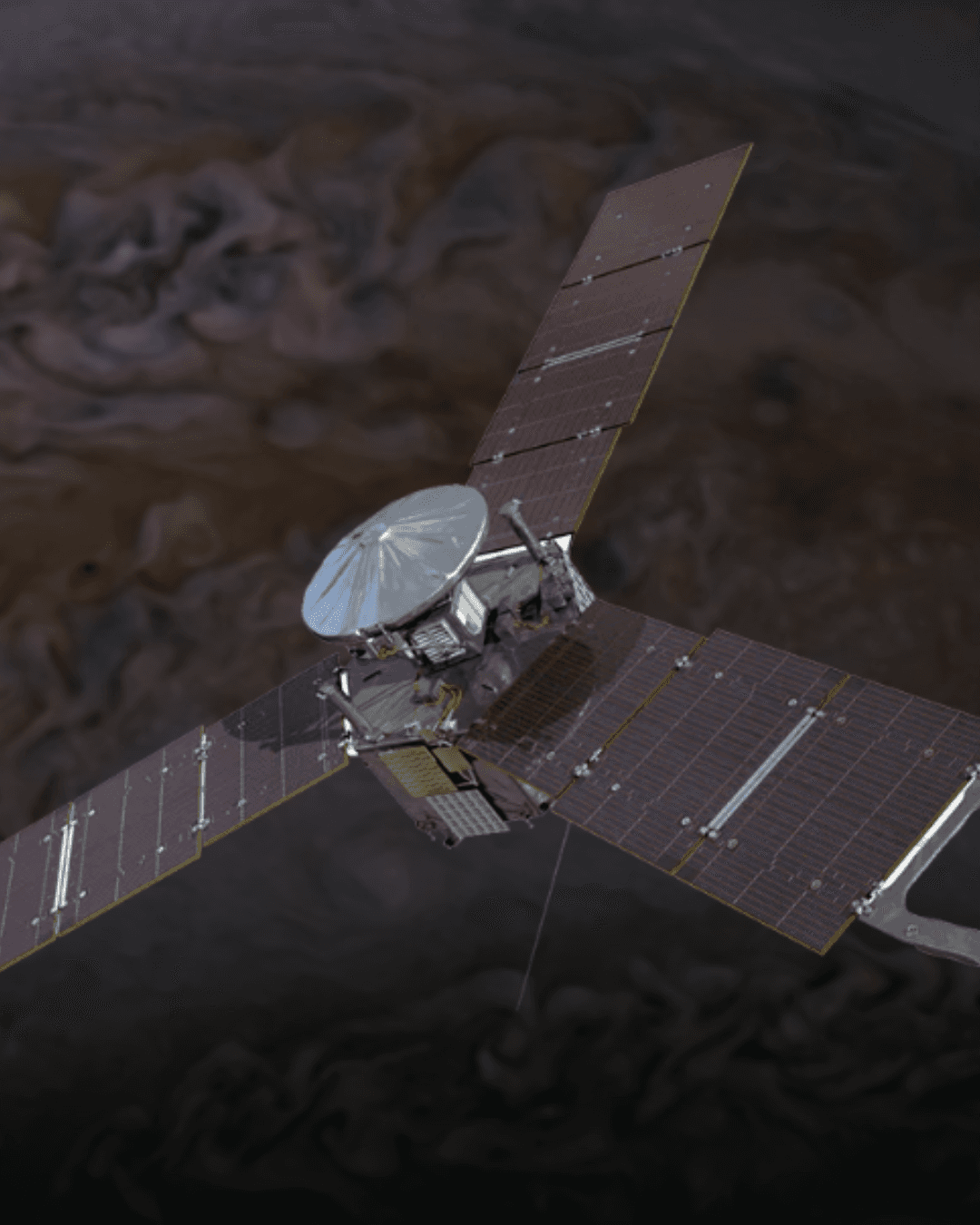
Juno has a hexagonal main body that rotates around its own axis to maintain stability during the mission. A titanium radiation shield (Juno Radiation Vault) protects the probe’s sensitive electronic components from Jupiter’s intense radiation belts.
The most distinctive feature of Juno compared to previous outer planet missions is its use of massive solar panels instead of radioisotope thermoelectric generators (RTGs) for power. Three large solar panels, each approximately nine meters long, are designed to provide sufficient power to the spacecraft despite receiving less than 4 percent of the sunlight available at Earth’s orbit. This represents a major achievement in spacecraft engineering.
Juno is equipped with nine primary scientific instruments to achieve its mission objectives:
Juno (NasaJuno)
Juno was launched on 5 August 2011 from Cape Canaveral Space Force Station in Florida aboard a Atlas V rocket. It undertook a five-year journey to reach Jupiter, during which it performed a gravity assist maneuver around Earth in October 2013 to gain speed.
On 5 July 2016, Juno successfully executed a critical maneuver by firing its main engine for 35 minutes to enter orbit around Jupiter. The spacecraft settled into a highly elliptical polar orbit with a 53-day period. This orbit allows Juno to approach within about 4,200 kilometers of Jupiter’s cloud tops during each “perijove” (closest approach), while simultaneously avoiding the planet’s most hazardous radiation belts.
Having successfully completed its primary mission, Juno’s operations have been extended by NASA. This extended mission not only continues studying Jupiter but also includes close flybys of its moons Ganymede, Europa and Io.
Anadolu Ajansı. "NASA Juno'nun faaliyet süresini uzattı." Accessed July 5, 2025.
Mission Juno. "JunoCam." Accessed July 5, 2025.
NASA Jet Propulsion Laboratory. "NASA's Juno Mission Expands Into the Solar System." Accessed July 5, 2025.
NASA. "Juno." Accessed July 5, 2025.
Southwest Research Institute. "Mission Juno." Accessed July 5, 2025.

Mission Objectives
Design and Hardware
Overall Structure
Power Source
Scientific Instruments
Mission Timeline
Launch and Cruise
Jupiter Orbit Insertion and Science Operations
Mission Extension
Key Discoveries