


This article was automatically translated from the original Turkish version.
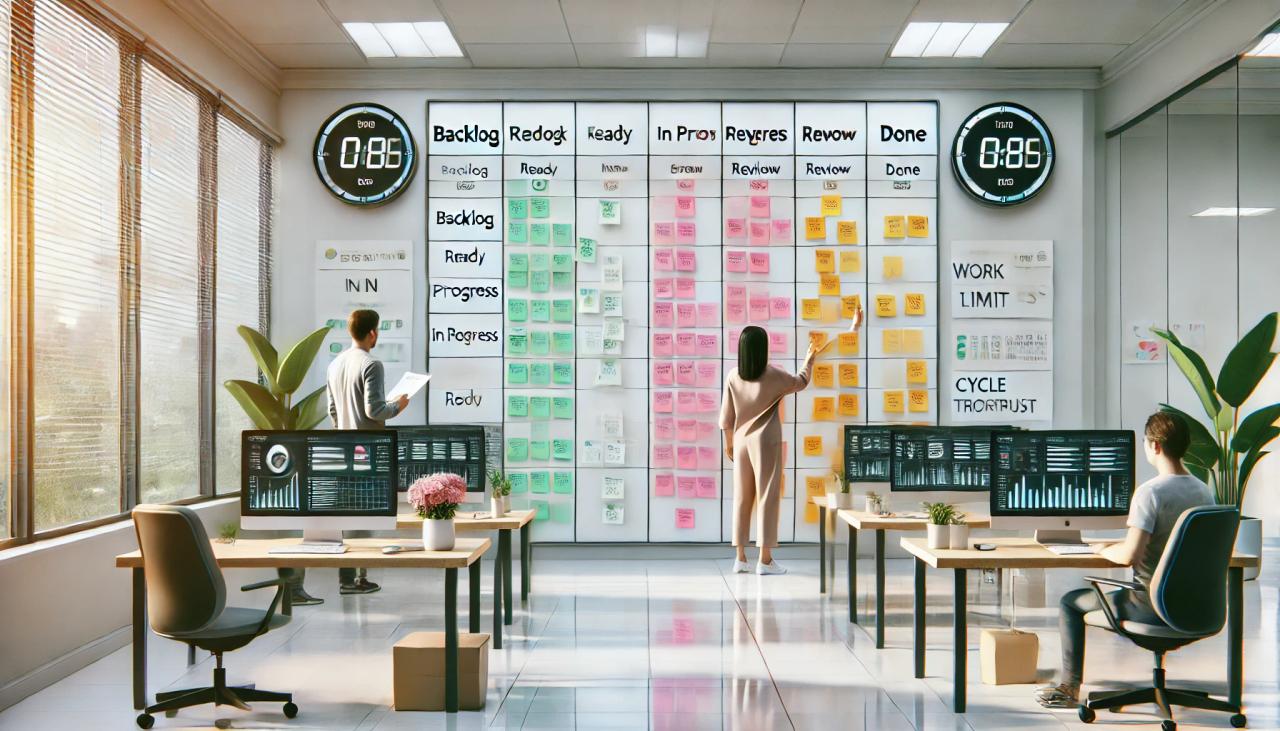
Definition(s) | Kanban is an agile method that visualizes software development processes to optimize workflow emphasizing continuous delivery and process improvement. | ||||||||
|---|---|---|---|---|---|---|---|---|---|
Purpose(s) | Visualizing work and ensuring continuous improvement. increasing efficiency identifying bottlenecks | ||||||||
Basic Principle(s) | and continuously improve (Kaizen approach). manage and measure flow apply WIP limits (Work In Progress — limit what is in progress) Visualize the process (Kanban board) | ||||||||
Application Area(s) | Software development service management. manufacturing marketing IT management | ||||||||
Advantage(s) | measurable delivery time. increases team collaboration provides transparency flexible planning Easily adaptable | ||||||||
Challenge(s) | incorrect WIP limits can cause bottlenecks. there is no clear rhythm Disciplined application is required | ||||||||
Kanban is a visualization-based method used in software development and business management. The term "kanban," meaning "visual card" in Japanese, was first implemented within the Toyota Production System. In the software world, it was adapted and popularized in the early 2000s by David J. Anderson.
Kanban aims to make workflow visible in order to identify bottlenecks, delays, and inefficiencies in processes. Unlike Scrum, like Kanban is not iterative but is based on a continuous delivery model.
Agile Alliance. "Kanban Definition." Accessed April 10, 2025. https://www.agilealliance.org
Anderson, David J. Kanban: Successful Evolutionary Change for Your Technology Business. Blue Hole Press, 2010.
Kniberg, Henrik. Kanban vs. Scrum – A Practical Guide. InfoQ, 2010.
Leopold, Klaus, and Siegfried Kaltenecker. Kanban in der IT. dpunkt.verlag, 2015.
Pressman, Roger S. Software Engineering: A Practitioner’s Approach. 8th ed. McGraw-Hill, 2014.

Definition(s) | Kanban is an agile method that visualizes software development processes to optimize workflow emphasizing continuous delivery and process improvement. | ||||||||
|---|---|---|---|---|---|---|---|---|---|
Purpose(s) | Visualizing work and ensuring continuous improvement. increasing efficiency identifying bottlenecks | ||||||||
Basic Principle(s) | and continuously improve (Kaizen approach). manage and measure flow apply WIP limits (Work In Progress — limit what is in progress) Visualize the process (Kanban board) | ||||||||
Application Area(s) | Software development service management. manufacturing marketing IT management | ||||||||
Advantage(s) | measurable delivery time. increases team collaboration provides transparency flexible planning Easily adaptable | ||||||||
Challenge(s) | incorrect WIP limits can cause bottlenecks. there is no clear rhythm Disciplined application is required | ||||||||
Core Principles
Use of Kanban in Software Development
Advantages
Limitations and Challenges