

This article was automatically translated from the original Turkish version.
+2 More
Location | Türkiye Gümüşhane Torul | ||||||||
|---|---|---|---|---|---|---|---|---|---|
Elevation(s) | 1550 m | ||||||||
Direction of Development | Horizontal | ||||||||
Total Length | 105 m | ||||||||
Interior Area | Approximately 1500 m² | ||||||||
Average Ceiling Height | 18 m | ||||||||
Scientific İntroduction | 1990 (Şükrü Eroz) | ||||||||
Opening to Tourism | 1996 | ||||||||
Karaca Cave is a cave of high geological, aesthetic, and touristic value located within the boundaries of Karaca Village in the Torul District of Gümüşhane Province in Türkiye’s Black Sea Region. It is situated approximately 17 kilometers northwest of the city center of Gümüşhane, at the Kırantaş locality, at an elevation of 1550 meters above sea level, on the southeast-facing slope of the Korum Creek valley.

Karaca Cave (Gümüşhane Governorate)
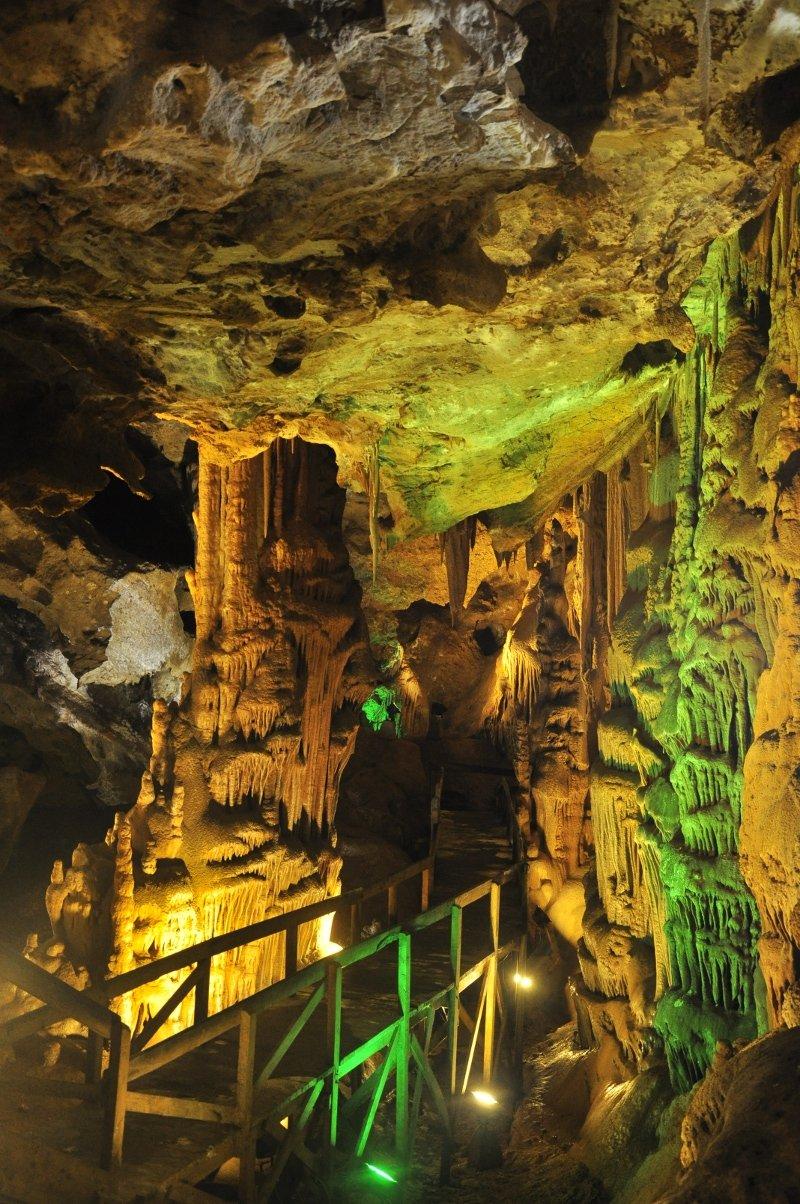
The cave developed within massive limestone formations of the Upper Cretaceous period and is surrounded by volcanic rocks with andesitic characteristics. As a karstic structure, Karaca Cave was shaped by water seeping through fractured limestone. The cave, which extends horizontally, consists of the union of four large chambers of approximately elliptical shape; two of these chambers are divided by stalactite formations, resulting in a total of six chambers.
The total length of the cave measures 105 meters, with an internal area of approximately 1500 square meters. The average ceiling height is around 18 meters. The interior of the cave begins with a narrow funnel-shaped entrance and widens as it extends inward. The cave is exceptionally rich in stalactite formations, featuring numerous geomorphological structures such as stalactites, stalagmites, columns, organ pipe walls, flag-like formations, elephant ear shapes, curtain stalactites, cave roses, cave pearls, travertine pools, and terraces.

Karaca Cave (Culture Portal)
The formation of the cave occurred in two stages. In the first stage, surface water dissolved the limestone, creating voids; in the second stage, a drop in the regional base level caused the cave to enter the vadose zone. During this phase, active growth ceased, but stalactite formation continued and persists to this day. The range of colors in the travertines within various parts of the cave, from white to dark blue, indicates the presence of dissolved iron and magnesium minerals in the water.
Karaca Cave does not have a significant air current. As a result, humidity increases as one moves deeper inside; for example, humidity at the entrance is 65%, rising to as much as 75% in the inner sections. The internal temperature of the cave remains constant between 12–17 °C, creating a small microclimate independent of external environmental conditions.

Karaca Cave (Culture Portal)
Only a few small species of winged flies have been observed inside the cave. No larger animal species or archaeological artifacts have been found. There is no evidence to suggest the cave was ever used for human habitation, due to its narrow, dark, and inhospitable entrance.
Karaca Cave was scientifically documented in 1990 by geologist Şükrü Eroz and opened to tourism in 1996. Facilities around the cave meet basic visitor needs including access, rest areas, food and beverage services, and souvenir shops.

Karaca Cave (Culture Portal)
Accessed November 26, 2025.
T.C. Gümüşhane University. "Gümüşhane’de Turizm: Karaca Mağarası." *T.C. Gümüşhane Üniversitesi Turizm Web Sitesi.* Accessed June 28, 2025. https://turizm.gumushane.edu.tr/tr/sayfa/g%C3%BCm%C3%BC%C5%9Fhanede-turizm/karaca-ma%C4%9Faras%C4%B1/.
T.C.Gümüşhane Valiliği. "Karaca Mağarası." T.C. Gümüşhane Governorship. Accessed June 28, 2025. http://www.gumushane.gov.tr/karacamagara.
Türkiye Kültür Portalı. "Karaca Mağarası." Türkiye Kültür Portalı. Accessed June 28, 2025. https://www.kulturportali.gov.tr/turkiye/gumushane/gezilecekyer/karaca-magarasi-1.
Uzun, Ali. "Karaca Mağarası (Torul–Gümüşhane)." Atatürk Kültür, Dil ve Tarih Yüksek Kurumu, Coğrafya Bilim ve Uygulama Kolu, Coğrafya Araştırmaları Dergisi.

Location | Türkiye Gümüşhane Torul | ||||||||
|---|---|---|---|---|---|---|---|---|---|
Elevation(s) | 1550 m | ||||||||
Direction of Development | Horizontal | ||||||||
Total Length | 105 m | ||||||||
Interior Area | Approximately 1500 m² | ||||||||
Average Ceiling Height | 18 m | ||||||||
Scientific İntroduction | 1990 (Şükrü Eroz) | ||||||||
Opening to Tourism | 1996 | ||||||||
Geographical and Geological Position
Physical Characteristics
Formation Process and Geomorphology
Internal Air and Climate Conditions
Biological and Archaeological Features
Tourism and Conservation Status