This article was automatically translated from the original Turkish version.
+2 More
Karacahisar Castle
Location | The hill southwest of the Porsuk River in the Odunpazarı district of Eskişehir | ||||||||
|---|---|---|---|---|---|---|---|---|---|
Elevation(s) | Approximately 60 meters high | ||||||||
Period(s) | Byzantine period | ||||||||
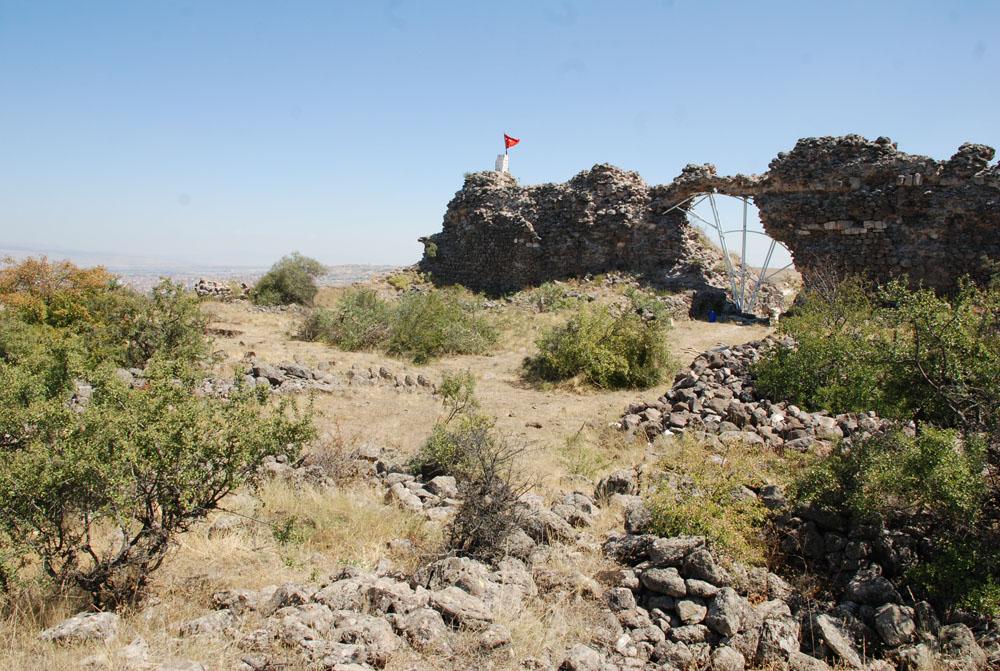
Karacahisar Castle is located on a hill southwest of the Porsuk River within the boundaries of the Odunpazarı district of Eskişehir Province, Türkiye. Due to its strategic position, it has served as an important defensive and settlement site throughout history. The castle is situated on a rocky terrain approximately 60 meters high, commanding views over the surrounding plains.

Karacahisar Castle (Culture Portal)
The castle was used for military purposes during the Byzantine period, although its name does not appear explicitly in written sources from that era. However, archaeological excavations have uncovered Byzantine coins dating from the 7th century to the end of the 11th century, indicating intermittent Byzantine settlement in the region.
In 1288, Karacahisar Castle was captured by Osman Gazi and incorporated into Ottoman territory, becoming the first castle conquered by the Ottoman Beylik according to historical records.
Initial surface surveys were launched in 1999 under the leadership of Professor Dr. Halil İnalcık. Excavations were conducted between 2002 and 2005 under Professor Dr. Ebru Parman, and again between 2011 and 2018 under Professor Dr. Erol Altınsapan. Since 2019, excavations have continued under the leadership of Assistant Professor Dr. Hasan Yılmazyaşar.
Among the findings were coins from the Byzantine Empire, the Lordship of Gattilusio (Lesbos), the Wallachian Principality, and Nuremberg.
Byzantine Coins: Seven coins have been identified, including those from the reigns of Phocas (602–610), Michael II (820–829), Constantine VII (913–959), and Constantine X (1059–1067). These coins demonstrate that the castle was in use during the Byzantine period and held strategic importance.
Gattilusio (Lesbos) Coins: Four coins dated 1396–1400 belonging to Francesco Gattilusio II were discovered. These findings indicate that the castle was actively used during the reign of Bayezid I and reflect commercial and political ties with the Gattilusio family.
Wallachian Principality Coin: A single silver coin belonging to Prince Mircea I has been identified. This coin is regarded as an archaeological testament to Ottoman-Balkan relations.
Nuremberg Tokens: Two bronze tokens produced in Nuremberg, dated to the 16th and 17th centuries, have been found. These provide insight into the social and economic interactions of the period.
During the Byzantine period, Karacahisar Castle served as a military garrison and defensive outpost as part of Dorylaion. In the late 13th century, it functioned as a strategic fortress on the frontier between the Byzantine and Seljuk territories. Under Ottoman rule, it became a political and administrative center where the first qadi was appointed, the Friday sermon was delivered, and coins were minted. The castle remained in active use until the time of Fatih Sultan Mehmed.
Anadolu Ajansı. 2023. “Karacahisar Kalesi’nde I. Murad Döneminde Ramazan Ayı İçin Bastırılmış Bronz Sikkeler Bulundu.” Accessed July 1, 2025. https://www.aa.com.tr/tr/kultur/karacahisar-kalesinde-i-murad-doneminde-ramazan-ayi-icin-bastirilmis-bronz-sikkeler-bulundu/3363708.
Eskişehir İl Directorate of Culture and Tourism. 2020. “Karacahisar Kalesi.” Accessed July 1, 2025. https://eskisehir.ktb.gov.tr/TR-156588/karacahisar-kalesi-kazilari.html.
Eskişehir İl Kültür ve Turizm Müdürlüğü. 2023. “Karacahisar Kalesi - Osmanlı’nın İlk Fethettiği Kale.” Accessed July 1, 2025. https://eskisehir.ktb.gov.tr/EN-234339/karacahisar-kalesi--osmanlinin-ilk-fethettigi-kale.html.
Türkiye Kültür Portalı. "Karacahisar Kalesi Duvar Kalıntıları." Accessed July 1, 2025. https://www.kulturportali.gov.tr/contents/images/20170126112455155_Karacahisar(9).JPG.
Türkiye Kültür Portalı. "Karacahisar Kalesi." Accessed July 1, 2025. https://www.kulturportali.gov.tr/turkiye/eskisehir/gezilecekyer/karacahisar-kalesi.
Türkiye Kültür Portalı. "Karacahisar Kalesi’nden Görünüm." Accessed July 1, 2025. https://www.kulturportali.gov.tr/contents/images/20170126112432613_Karacahisar(8)(1).JPG.
Yılmazyaşar, Hasan, and Zeliha Demirel Gökalp. “Tarihsel Bağlamda Karacahisar Kalesi’nde Bulunan Bizans ve Avrupa Sikkeleri.” *Anadolu Araştırmaları* 27 (2022): 305–335. .

Karacahisar Castle
Location | The hill southwest of the Porsuk River in the Odunpazarı district of Eskişehir | ||||||||
|---|---|---|---|---|---|---|---|---|---|
Elevation(s) | Approximately 60 meters high | ||||||||
Period(s) | Byzantine period | ||||||||
History
Archaeological Excavations
Coin Discoveries
Historical Significance and Use