
This article was automatically translated from the original Turkish version.
+2 More
Karain Cave
Location | Yağca Mahallesi Antalya Döşemealtı | ||||||||
|---|---|---|---|---|---|---|---|---|---|
Elevation(s) | 430–450 m | ||||||||
Distance(s) | 27 km from Antalya center | ||||||||
Findings | Neanderthal human remains, hand axe, stone tools, bone tools, beads, portable art objects, burned bones, charcoal | ||||||||
Protection Status | UNESCO World Heritage Tentative List | ||||||||
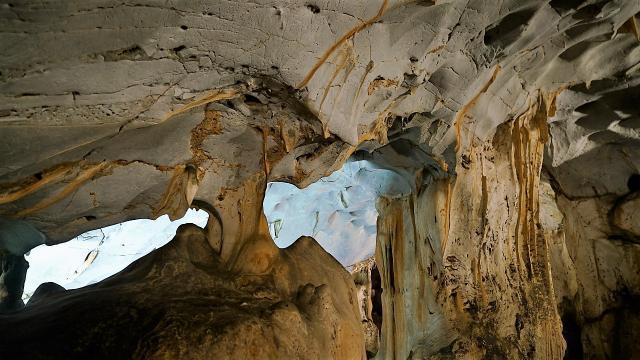
Karain Cave is located within the boundaries of Yağca Village, in the Döşemealtı district of Antalya Province, in southern Türkiye. It lies approximately 27–30 kilometers northwest of the city center of Antalya, about 5–6 kilometers from the old Antalya–Burdur highway. The cave is situated at an elevation of 430–450 meters above sea level and approximately 150 meters above the travertine plain in front of it. The cave formed within limestone deposits from the Mesozoic Era, on the Mediterranean-facing slopes of Şam (Katran) Mountain. It consists of three main chambers connected by narrow passages. The first chamber has five openings. The depth of the cave exceeds 50 meters and contains stalactite and stalagmite formations.

Karain Cave.(TRT News)
Karain Cave was discovered in 1946 by Professor Dr. Kılıç Kökten, and excavation work began in the same year. These initial excavations continued until 1973. Archaeological excavations restarted in 1985 and are still ongoing today. Karain Cave is one of the sites in Türkiye where Paleolithic period excavations have been conducted over the longest continuous period.

Karain Cave Restoration Work.(TRT News)
Karain Cave is one of the oldest sites in Anatolia with uninterrupted evidence of human settlement, spanning from the Lower Paleolithic to the Roman period. As a result of this continuous occupation, a cultural deposit approximately 11 meters thick has accumulated within the cave. Unlike many other Paleolithic caves, Karain preserves a continuous stratigraphic record of the Lower, Middle and Upper Paleolithic periods.
Excavations in the cave have uncovered bifacial “hand axes” and various stone tools dating to the Lower Paleolithic. Tools from the Middle and Upper Paleolithic periods are also part of this collection. Most of these tools were used for bone working. Human remains found in the cave are regarded as the oldest known human traces in Anatolia. A child’s molar and a fragment of a skull from the Middle Paleolithic layers provide evidence that Neanderthals lived in Anatolia. Among the artifacts associated with the Mousterian culture are a Neanderthal tooth and teeth from cave bears and cave lions.

Karain Cave Elephant and Hippopotamus Remains.
The animal remains recovered from Karain Cave demonstrate its significance not only for cultural history but also for environmental and ecological studies. These remains include animals now extinct in Anatolia, such as elephants, hippopotamuses, lions and giraffes, as well as mammals like hyenas, bears, aurochs, horses, deer, wild sheep and wild goats, along with various rodents and mollusks. Plant remains include samples of wild fig, wheat and olive. The presence of burned bone and charcoal fragments in all layers indicates that the cave’s inhabitants used fire from the earliest periods of occupation.
Following the Prehistoric Ages, the cave was also used during the Classical Period. In Greek and Roman times, Karain Cave was regarded as a place of worship. Inscriptions in Ancient Greek, votive niches and fragments of lamps found on the cave walls provide evidence of this use.
Among the excavated items, beads and ornaments made of stone and bone are considered portable works of art and among the earliest examples of art in Anatolia. These finds are exhibited both at the Karain Museum located immediately beside the cave and at the Antalya Museum.
Karain Cave is the largest natural cave in Türkiye to have contained evidence of human habitation. Due to its archaeological and natural features, it has been included on UNESCO’s Tentative List of World Heritage Sites together with the nearby Öküzini and Çakırini caves. The cave is open to visitors daily, from 08:00 to 19:30.
Antalya Kültür and Tourism Provincial Directorate. "Karain Mağarası." Ministry of Culture and Tourism of the Republic of Turkey. Accessed May 31, 2025. https://antalya.ktb.gov.tr/TR-67529/karain-magarasi.html.
Döşemealtı Belediyesi. "Karain Mağarası." Döşemealtı Municipality Official Website. Accessed May 31, 2025. https://www.dosemealti.bel.tr/tr/m/tarihi-yerler/karain-magrasi.html.
Döşemealtı İlçe Milli Eğitim Müdürlüğü. "Karain Mağarası." T.C. Millî Eğitim Bakanlığı Döşemealtı İlçe MEM. Accessed May 31, 2025. https://dosemealti.meb.gov.tr/www/karain-magarasi/icerik/50.
General Directorate of Cultural Heritage and Museums. "Karain Mağarası (Antalya)." Ministry of Culture and Tourism of the Republic of Türkiye. Accessed May 31, 2025. https://kvmgm.ktb.gov.tr/TR-44407/karain-magarasi-antalya.html.
MüzeKart Resmî Web Sitesi. "Karain Mağarası." T.C. Kültür ve Turizm Bakanlığı. Accessed May 31, 2025. https://muze.gov.tr/muze-detay?sectionId=KRM01&distId=MRK.
TRT Haber. “Hem Turizmin Hem Bilim Dünyasının Gözbebeği: Karain Mağarası.” TRT Haber Foto Galeri, 2023. Accessed May 31, 2025. https://www.trthaber.com/foto-galeri/hem-turizmin-hem-bilim-dunyasinin-gozbebegi-karain-magarasi/58421/sayfa-1.html.

Karain Cave
Location | Yağca Mahallesi Antalya Döşemealtı | ||||||||
|---|---|---|---|---|---|---|---|---|---|
Elevation(s) | 430–450 m | ||||||||
Distance(s) | 27 km from Antalya center | ||||||||
Findings | Neanderthal human remains, hand axe, stone tools, bone tools, beads, portable art objects, burned bones, charcoal | ||||||||
Protection Status | UNESCO World Heritage Tentative List | ||||||||
Excavation and Research History
Historical Continuity and Stratification
Archaeological Findings
Faunal and Floral Remains
Use During the Cult and Classical Periods
Art and Cultural Artifacts
Visit Information