
This article was automatically translated from the original Turkish version.
+2 More
Length(s) | 1.17 M | ||||||||
|---|---|---|---|---|---|---|---|---|---|
Weight(s) | 25 KG | ||||||||
Developer(s) | ROKETSAN | ||||||||
Missile Diameter | 125 mm | ||||||||
Effective Range | 2.5 KM | ||||||||
Usage Principle | Lock-On Before Launch and Lock-On After Launch | ||||||||
System Class | Short-Range, Man-Portable Anti-Tank Guided Missile (ATGM) | ||||||||
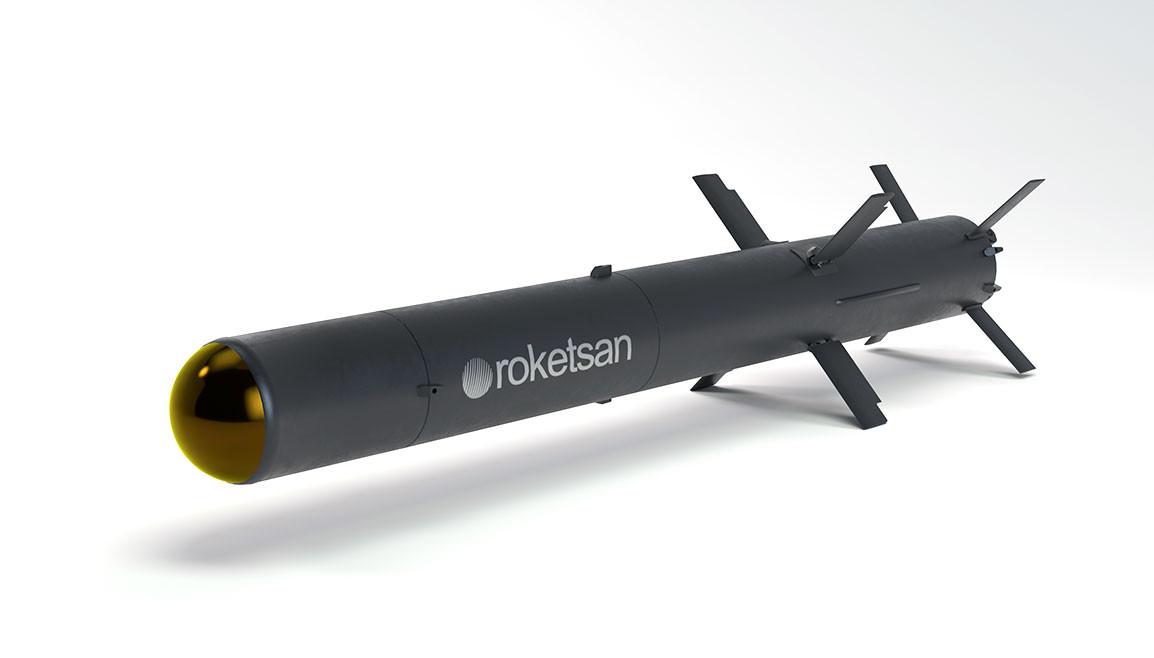
KARAOK is a next-generation short-range anti-tank guided missile system developed by ROKETSAN, designed to be shoulder-launched by a single soldier and featuring a 2.5 km range with a fire-and-forget capability.
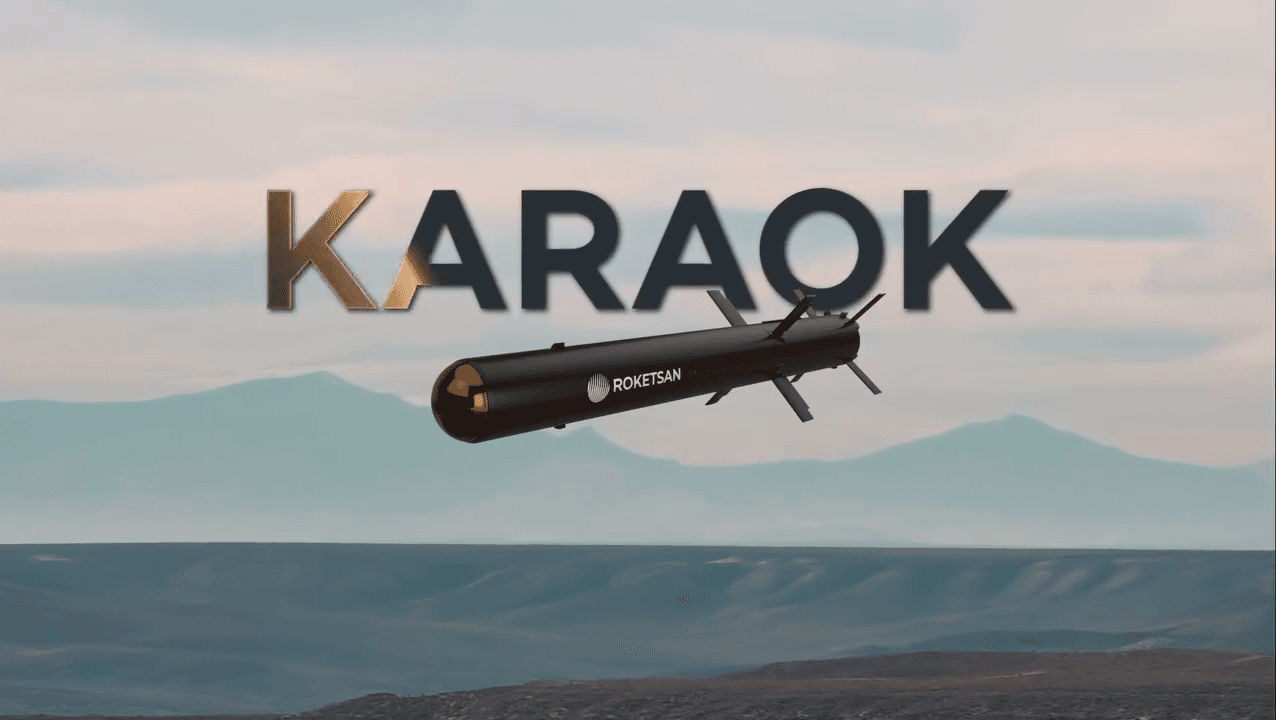
KARAOK Short-Range Anti-Tank Weapon (ROKETSAN)
The KARAOK project was initiated in 2010 under the decision of the Defence Industry Executive Committee (SSİK), with ROKETSAN as the prime contractor.【1】 The system was developed based on the knowledge and infrastructure gained from Türkiye’s UMTAS and OMTAS missiles, with the goal of eliminating dependence on foreign anti-tank systems such as the BGM-71 TOW, MILAN, and ERYX. Optimized to address the challenges of shoulder-launched platforms, the system achieved its initial operational capability (IOC) in 2020 and was formally inducted into the Turkish Land Forces inventory in 2022.【2】
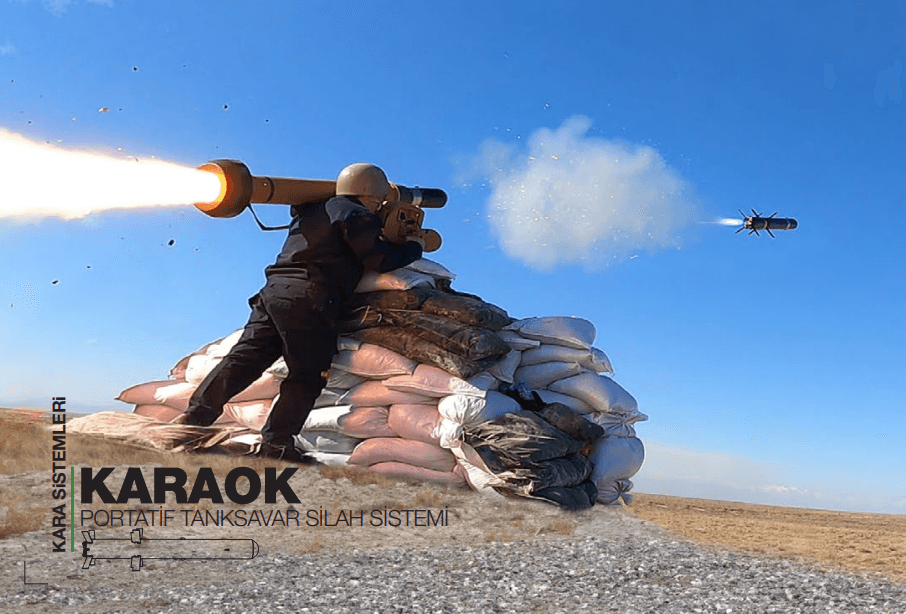
KARAOK Test Launch (ROKETSAN)
The KARAOK missile, including its launcher, weighs less than 25 kilograms and has a diameter of 125 mm.【3】 The system operates effectively in all weather conditions, day or night, and is equipped with an Imaging Infrared (IIR) seeker head and an Inertial Measurement Unit (IMU) developed by ASELSAN. It allows for lock-on before and after launch, and its hybrid two-stage rocket motor (launch and flight phases) enables safe firing from enclosed spaces.
KARAOK Test Launches (ROKETSAN)
The primary mission of the system is to destroy modern main battle tanks, armored personnel carriers, and concrete bunkers. The "top attack" mode, which targets the thinner roof armor of tanks, grants the system the capability to penetrate heavy armor. Its lightweight design provides high mobility for infantry units, border security forces, and special operations teams operating in mountainous terrain, urban combat zones, and airborne or amphibious operations.
Integration with unmanned ground vehicles (PUSU, PALEM) via the KMC-U under the AGMOSS architecture indicates that KARAOK will be extensively used in future urban and narrow-street operations for remote autonomous "first contact" missions, minimizing personnel exposure to risk.
The KARAOK missile underwent four distinct operational user scenarios during acceptance and integration tests, successfully engaging all targets with direct hits. These tests confirmed its effectiveness against reactive armor.【6】
KARAOK Missile (ROKETSAN)
User feedback highlights the fire-and-forget principle as a key advantage. Once launched, the missile requires no further target updates, allowing soldiers to immediately change position or take cover. Its motor’s capability to enable firing from enclosed spaces enhances safety during infiltration operations.
The project, which ended Türkiye’s dependency on foreign short-range anti-tank systems, achieved its first export success by outperforming South Korea’s LIG Nex1 Raybolt and China’s Norinco HJ-12 systems in a Malaysian procurement competition.
Globally, KARAOK’s primary competitors include the U.S.-made FGM-148 Javelin and the Israeli-made Spike-SR missiles.【8】
The global market for anti-tank guided missiles is expanding due to declining unit costs and the broadening scope of targets beyond tanks. KARAOK’s selection over South Korea’s Raybolt and China’s HJ-12 in Malaysia’s procurement confirms its position as a viable global alternative to U.S. (Javelin) and Russian (Kornet) systems in the short-range missile segment.【9】
Akarsu, Ozan. "Kısa Menzilli Tanksavar Sistemi Karaok Özellikleri Nelerdir?" SavunmaTR. Accessed April 17, 2026. https://www.savunmatr.com/kisa-menzilli-tanksavar-sila-karaok-ozellikleri-nelerdir/
Altaş, Batıkan. "İsrail basını KARAOK'u yazdı! 'Erdoğan'ın yeni füzesi ABD ve Rusya'yı geride bıraktı'." *Milliyet*. Accessed April 17, 2026. https://www.milliyet.com.tr/dunya/son-dakika-israil-basini-karaoku-yazdi-erdoganin-yeni-fuzesi-abd-ve-rusyayi-geride-birakti-7571891
Anadolu Ajansı. "Kısa menzilli tanksavar silahı KARAOK'tan test atışlarında tam isabet." Accessed April 17, 2026. https://www.aa.com.tr/tr/vg/video-galeri/kisa-menzilli-tanksavar-silahi-karaoktan-test-atislarinda-tam-isabet/147479
Haber Tanık. "ROKETSAN'dan KARAOK başarısı... Test atışları tam isabet." Accessed April 17, 2026. https://www.habertanik.com/haber/roketsandan-karaok-basarisi-test-atislari-tam-isabet-49823
Millisavunma. "KARAOK Kısa Menzilli Tanksavar Füzesi (ATGM)." Millisavunma. Accessed April 17, 2026. https://www.millisavunma.com/karaok-kisa-menzilli-tanksavar-fuzesi-atgm/
ROKETSAN. "KARAOK Kısa Menzilli Tanksavar Silah Sistemi." Accessed April 17, 2026. https://www.roketsan.com.tr/tr/urunler/karaok-kisa-menzilli-tanksavar-silah-sistemi
ROKETSAN. "ÜRÜN KATALOĞU." ROKETSAN. Accessed April 17, 2026. https://roketsan.com.tr/uploads/docs/kataloglar/TR/2024/1726595836_roketsan-katalog-2024.pdf
ROKETSAN. “KARAOK 🏹🎯.” YouTube. Accessed April 17, 2026. https://www.youtube.com/watch?v=Na0Fyf1bgG8
ROKETSAN. “Zırh delici performans, sahada sarsılmaz operasyonel güç: #KARAOK! 🏹🚀.” YouTube. Accessed April 17, 2026. https://www.youtube.com/watch?v=ZXhM2xC8jUE
SavunmaSanayiST. "KARAOK Omuzdan Atılan Tanksavar Füzesi." SavunmaSanayiST. Accessed April 17, 2026. https://www.savunmasanayist.com/karaok-omuzdan-atilan-tanksavar-fuzesi/
SavunmaSanayiST. "Malezya'nın KARAOK füzelerini teslim alacağı tarih netleşti." Accessed April 17, 2026. https://www.savunmasanayist.com/malezyanin-karaok-fuzelerini-teslim-alacagi-tarih-netlesti/
Times Of Defence. "Roketsan KARAOK Tanksavar Füzesi." Times Of Defence. Accessed April 17, 2026. https://www.timesofdefence.com.tr/roketsan-karaok-tanksavar-fuzesi/
Türk Silahlı Kuvvetlerini Güçlendirme Vakfı. "ROKETSAN'ın KARAOK Füzesi Test Atışlarında Tam İsabet Sağladı." TSKGV. Accessed April 17, 2026. https://tskgv.org.tr/savunma-sanayii-gundem/roketsanin-karaok-fuzesi-test-atislarinda-tam-isabet-sagladi
Yolal, Burhan. "KARAOK'tan tam isabet ROKETSAN'ın kısa menzilli tanksavar sistemi testleri başarıyla geçti." GDH Digital. Accessed April 17, 2026. https://gdh.digital/haber/karaoktan-tam-isabet-roketsanin-kisa-menzilli-tanksavar-sistemi-testleri-basariyla-gecti-cpwq0e1vfwg
Şahin, Anıl. "Türkiye'nin Tanksavar Füzeleri: UMTAS, L-UMTAS, OMTAS, KARAOK ve TANOK." *SavunmaSanayiST*. Accessed April 17, 2026. https://www.savunmasanayist.com/turkiyenin-tanksavar-fuzeleri-umtas-l-umtas-omtas-karaok-ve-tanok/
[1]
Anıl Şahin. "Türkiye’s Anti-Tank Missiles: UMTAS, L-UMTAS, OMTAS, KARAOK and TANOK. " SavunmaSanayiST. Access date: 17 April 2026. https://www.savunmasanayist.com/turkiyenin-tanksavar-fuzeleri-umtas-l-umtas-omtas-karaok-ve-tanok/
[2]
Ozan Akarsu. "What Are the Features of the Short-Range Anti-Tank System KARAOK?." SavunmaTR. Access date: 17 April 2026. https://www.savunmatr.com/kisa-menzilli-tanksavar-sila-karaok-ozellikleri-nelerdir/
[3]
ROKETSAN. "KARAOK Short-Range Anti-Tank Weapon." ROKETSAN. Access date: 17 April 2026. https://www.roketsan.com.tr/uploads/docs/kataloglar/TR/2024/1726595579_karaok.pdf
[4]
MilliSavunma. "KARAOK Short-Range Anti-Tank Missile (ATGM)." MilliSavunma. Access date: 17 April 2026. https://www.millisavunma.com/karaok-kisa-menzilli-tanksavar-fuzesi-atgm/
[5]
MilliSavunma. "KARAOK Short-Range Anti-Tank Missile (ATGM)." MilliSavunma. Access date: 17 April 2026. https://www.millisavunma.com/karaok-kisa-menzilli-tanksavar-fuzesi-atgm/
[6]
Burhan Yolal. "KARAOK Achieves Direct Hit: ROKETSAN’s Short-Range Anti-Tank System Passes Tests Successfully." GDH Digital. Access date: 17 April 2026. https://gdh.digital/haber/karaoktan-tam-isabet-roketsanin-kisa-menzilli-tanksavar-sistemi-testleri-basariyla-gecti-cpwq0e1vfwg
[7]
Anıl Şahin "Türkiye’s Anti-Tank Missiles: UMTAS, L-UMTAS, OMTAS, KARAOK and TANOK"." SavunmaTR. Access date: 17 April 2026. https://www.savunmasanayist.com/turkiyenin-tanksavar-fuzeleri-umtas-l-umtas-omtas-karaok-ve-tanok/
[8]
Batıkan Altaş. "Israeli Press Writes About KARAOK! 'Erdoğan’s New Missile Leaves the U.S. and Russia Behind. 'Milliyet. Access date: 17 April 2026. https://www.milliyet.com.tr/dunya/son-dakika-israil-basini-karaoku-yazdi-erdoganin-yeni-fuzesi-abd-ve-rusyayi-geride-birakti-7571891
[9]
Batıkan Altaş. "Israeli Press Writes About KARAOK! 'Erdoğan’s New Missile Leaves the U.S. and Russia Behind. ' Milliyet. Access date: 17 April 2026. https://www.milliyet.com.tr/dunya/son-dakika-israil-basini-karaoku-yazdi-erdoganin-yeni-fuzesi-abd-ve-rusyayi-geride-birakti-7571891

Length(s) | 1.17 M | ||||||||
|---|---|---|---|---|---|---|---|---|---|
Weight(s) | 25 KG | ||||||||
Developer(s) | ROKETSAN | ||||||||
Missile Diameter | 125 mm | ||||||||
Effective Range | 2.5 KM | ||||||||
Usage Principle | Lock-On Before Launch and Lock-On After Launch | ||||||||
System Class | Short-Range, Man-Portable Anti-Tank Guided Missile (ATGM) | ||||||||
No Discussion Added Yet
Start discussion for "KARAOK Short-Range Tank Destroyer Weapon" article
Development Process
Technical Specifications and Variants
Technical Specifications Table
Compatible Munitions
Military Applications
Future Potential Applications
Operational Missions Conducted
Operational Experience
Success Stories
Current Users and Orders
Performance Advantages and Limitations
Global Market Analysis and Competitive Position