This article was automatically translated from the original Turkish version.
Type of Geographical İndication | Mahreç Sign | ||||||||
|---|---|---|---|---|---|---|---|---|---|
Registration Number | 36 | ||||||||
Registration Date | 25.06.2002 | ||||||||
Product / Product Group(s) | Processed and unprocessed meat products | ||||||||
Province(s) | Kayseri | ||||||||
Applicant/Registrant(s) | Kayseri Chamber of Commerce | ||||||||
Kayseri pastırma is a traditional meat product produced in the province of Kayseri, made from beef that undergoes curing, washing, pressing, drying, and coating with çemen. It is officially registered with a geographical indication mark. The application for this registration was submitted by the Kayseri Chamber of Commerce on 13 September 2000, and the product was officially registered as a geographical indication on 25 June 2002, with the announcement published in the Official Gazette on 28 January 2001.
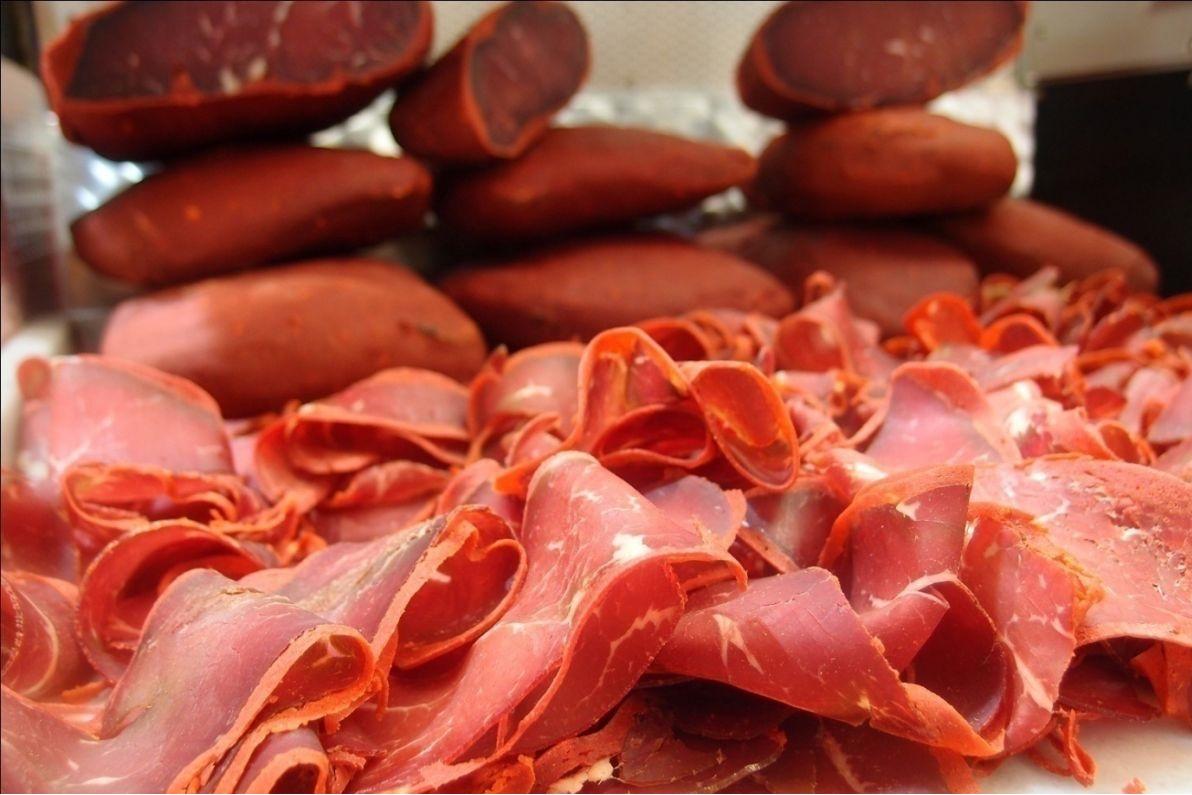
Kayseri pastırma is prepared using large cuts of meat from the back, hind leg, and foreleg of healthy male calves aged 2 to 5 years, weighing at least 250 kg. It has a flat shape and is sold whole or sliced, either with or without the çemen coating. When covered with çemen, the outer surface appears brownish, while the interior is reddish. In sliced pastırma, white areas may be visible due to the fat content.
The çemen used in production consists of a mixture of fennel seed flour, vetch, and wheat (%45), spices (%5), garlic (%5), and water (%45). Due to the high proportion of cumin in the çemen, the dominant flavor of the product is cumin. The amount of fresh çemen applied does not exceed 15% of the meat’s weight, and after drying, this ratio does not exceed 10%.
The curing process is carried out using nitrite salt prepared by adding 5 grams of nitrite per kilogram of salt. Between 60 and 80 kilograms of this salt are used per ton of meat. Known locally as “karıncabaş,” this salt enhances the color, flavor, and texture of the meat while also preventing microbial and oxidative spoilage.
The production of Kayseri pastırma involves a series of skilled procedures that are specific to its geographical region:
Pastırma can be stored for 3 to 4 months at 0–4 °C, and for 4 to 6 months when packaged in modified atmosphere packaging.
Kayseri’s location along the Silk Road and its widespread livestock farming have fostered the tradition of preserving meat with spices. Particularly during autumn, the dry air and winds blowing from Mount Erciyes create ideal conditions for open-air drying. The daily temperature variation—ranging from 25–30 °C during the day to 0–5 °C at night—defines the period known as “pastırma summer,” which is optimal for production.
Moisture content by mass (excluding çemen): Maximum 50%
pH: Maximum 6
Salt content by mass in dry matter (excluding çemen): Maximum 10%
Dry çemen content by mass: Maximum 10%
Kayseri pastırma is mentioned in historical sources such as Evliya Çelebi’s Seyahatname and the Askerî Tıbbi Baytarî Mecmûası. 【1】 It holds an important place in Kayseri’s cuisine and economy. It is promoted at events such as the Sucuk and Pastırma Bread Festival held at the Erciyes Ski Center. The production process is based on traditional knowledge and skills bound to its geographical boundaries.
The production and marketing of the product are monitored at least once a year under the coordination of the Kayseri Chamber of Commerce. The monitoring body consists of representatives from the Kayseri Metropolitan Municipality, the Provincial Directorate of Agriculture and Forestry, the Provincial Directorate of Health, and the Chamber of Food Engineers (TMMOB). Monitoring criteria include compliance with ingredients, adherence to production methods, physical and chemical properties, packaging, and correct use of the geographical indication mark.
Turkish Patent and Trademark Office. "Kayseri Pastırması Coğrafi İşaret Sicil Belgesi (No: 36)." June 25, 2002. Accessed October 24, 2025. https://ci.turkpatent.gov.tr/Files/GeographicalSigns/b344d02f-ab5e-4a1f-a720-ac490273d9f1.pdf.
Turkish Patent and Trademark Office. "Kayseri Pastırması." *Coğrafi İşaretler Portalı*. Accessed October 24, 2025. https://ci.turkpatent.gov.tr/cografi-isaretler/detay/37898
[1]
Türk Patent ve Marka Kurumu, "Kayseri Pastırması Coğrafi İşaret Sicil Belgesi (No: 36)," 25 Haziran 2002, 3. https://ci.turkpatent.gov.tr/Files/GeographicalSigns/b344d02f-ab5e-4a1f-a720-ac490273d9f1.pdf,

Type of Geographical İndication | Mahreç Sign | ||||||||
|---|---|---|---|---|---|---|---|---|---|
Registration Number | 36 | ||||||||
Registration Date | 25.06.2002 | ||||||||
Product / Product Group(s) | Processed and unprocessed meat products | ||||||||
Province(s) | Kayseri | ||||||||
Applicant/Registrant(s) | Kayseri Chamber of Commerce | ||||||||
Definition and Distinguishing Characteristics
Production Method
Geographical and Climatic Characteristics
Physical and Chemical Properties
Cultural and Economic Value
Monitoring