


This article was automatically translated from the original Turkish version.
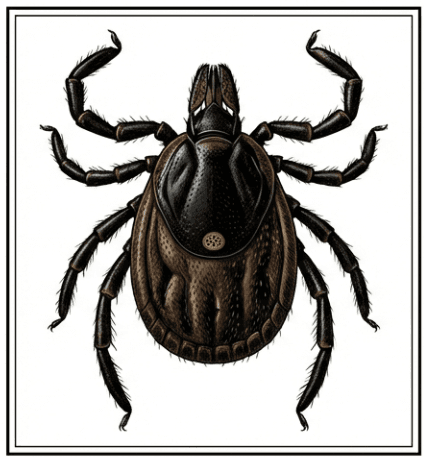
Adult Flea
(Generated by Artificial Intelligence)
Kene (Ixodida)
Team(s) | Ixodida | ||||||||
|---|---|---|---|---|---|---|---|---|---|
Habitat | Forest areas Moist grasslands | ||||||||
Guests | Reptiles Birds Mammals | ||||||||
Nutrition | Hematophagous (Feeds on blood) | ||||||||
Superfamily | Ixodoidea | ||||||||
Subclass | Acari (Mites and Ticks) | ||||||||
Class | Arachnida (Arachnids) | ||||||||
Branch | Arthropoda (Arthropods) | ||||||||
World | Animalia (Animals) | ||||||||
Ticks (Ixodida) are small arthropods belonging to the class Arachnida, closely related to spiders. They are obligate blood-feeders that can parasitize mammals, including humans, birds, and reptiles.
Ticks are obligate hematophagous ectoparasites classified within the phylum Arthropoda and the class Arachnida. Due to their close relationship with mites, they are grouped under the subclass Acari and the order Ixodida. Over 900 species have been identified worldwide, and they are primarily divided into three families:

Morphological Features and Anatomy of Ticks (Generated by Artificial Intelligence)
Unlike other arachnids, ticks do not exhibit distinct body segmentation; their bodies consist of two main parts: the gnathosoma (mouth region) and the idiosoma (body). The anterior portion of the body contains the gnathosoma (also called capitulum), which houses the feeding structures.
Ticks have a complex life cycle, typically lasting two to three years, involving a process called metamorphosis in biology. This cycle consists of four main stages: egg, larva, nymph, and adult. To progress to the next stage (molt), ticks must feed on blood at least once during each phase.

Stages of the Tick Life Cycle (Generated by Artificial Intelligence)
After becoming fully engorged, the female tick drops off the host onto the ground and lays thousands of eggs (between 3,000 and 18,000 in some species). The female dies after laying eggs. The time required for eggs to hatch varies from several weeks to several months depending on temperature and humidity.
Larvae hatching from eggs have only three pairs of legs, unlike adults. These very small larvae (about the size of a pinhead) typically prefer small hosts such as rodents or birds. Known as "seed ticks," after their first blood meal, they detach from the host, drop to the ground, and prepare to molt into the nymph stage.
After molting, the larva becomes a nymph. At this stage, the tick has four pairs of legs but has not yet developed sexual organs. Nymphs are larger than larvae and can attack larger hosts such as rabbits, cats, dogs, or humans. This is one of the most dangerous stages for disease transmission because their small size makes them hard to detect and they can feed for extended periods.
After its final molt, the nymph becomes an adult. Sexual dimorphism becomes evident at this stage. Male ticks typically feed briefly on hosts to locate females, while females consume many times their body weight in blood to produce eggs.
Ticks are classified based on the number of hosts they require to complete their life cycle:
When unable to find a suitable host, ticks can slow their metabolism (diapause) and survive for months, even years, without feeding in humid environments.
Tick survival and reproductive success depend heavily on microclimate conditions. These parasites spend over 90% of their life cycle outside the host, in the environment; thus, habitat selection is critical.

Tick Habitats and Seasonal Distribution (Generated by Artificial Intelligence)
Ticks prefer areas with high relative humidity to prevent desiccation. Common habitats include:
Tick activity is directly correlated with air temperature and humidity.
Ticks cannot fly or jump. Their entry into human habitats typically occurs through passive transport:
In Türkiye, ticks are found in particularly high densities in regions known as the "Tick Belt," encompassing northern Central Anatolia, the central Black Sea region, and western Eastern Anatolia. More than 30 tick species have been identified nationwide, with the Hyalomma genus, which transmits the Crimean-Congo Hemorrhagic Fever (CCHF) virus, posing the greatest threat to public health. Since 2002, CCHF has become endemic in provinces such as Tokat, Çorum, Yozgat, and Sivas, positioning Türkiye as a global leader in research and control of this disease.
Meanwhile, in the humid forested areas of the Black Sea region, Ixodes species, which transmit Lyme disease and Tick-Borne Encephalitis, predominate. Tick activity in Türkiye typically begins in March–April, peaks in July, and continues until the end of September. Recent climate change and livestock movements have led to the expansion of tick populations into western regions such as Marmara and the Aegean.
The feeding process of ticks is a complex biological operation rather than a simple bite. With limited mobility, these parasites have evolved specialized behaviors to reach hosts and feed undetected.
Rather than actively hunting, ticks climb to the tips of grasses and shrubs and adopt a "questing" strategy. They raise their front legs and wait, using the Haller’s Organ to detect the heat, vibrations, and carbon dioxide emitted by approaching animals. Upon contact with a suitable host, the tick rapidly grasps onto it using its hooked legs.
After attaching to the host, ticks do not immediately bite. Instead, they may spend hours searching the body for suitable, thin-skinned, moist, and protected areas such as the armpits, groin, or behind the ears. Once a suitable site is found:

Preferred Feeding Sites of Ticks (Generated by Artificial Intelligence)
The reason tick bites are often undetected is due to a complex chemical mixture secreted from their salivary glands:
The feeding process lasts between three and ten days, depending on the tick species and life stage. During this time, ticks feed in two phases:
Tick bites are typically painless at the onset due to anesthetic compounds secreted by the parasite. This allows ticks to remain undetected for days, increasing the risk of pathogen transmission. Clinical signs are generally categorized as either "local reactions" or "systemic symptoms."
Physical reactions observed immediately after the bite:
If the tick is infected (carrying pathogens), symptoms may appear after the incubation period and affect the entire body:
The period following a tick bite is not passive waiting but an active monitoring phase. Considering the incubation periods of pathogens (viruses, bacteria, or parasites), the first 10–14 days after exposure are medically considered the "golden window" for intervention.
The bitten individual should monitor themselves as if keeping a health diary. Key factors to observe include:
The progression of tick-borne illnesses changes dramatically depending on the stage at which diagnosis is made:
If fever, severe headache, or rash appear during the monitoring period, immediate consultation with an Infectious Diseases Specialist is essential. Critical information to provide includes:
Due to their biological structure and feeding habits, ticks are among the most effective disease vectors in nature. During blood feeding, they can acquire pathogens from the host and transmit pathogens stored in their salivary glands to another host.
A severe viral infection caused by viruses of the genus Nairovirus, primarily observed in Eurasia and Africa.
The most common tick-borne bacterial infection worldwide, caused by the bacterium Borrelia burgdorferi.

Tick-Borne Diseases (Generated by Artificial Intelligence)
Rickettsia bacteria cause a group of diseases. The most well-known are Rocky Mountain Spotted Fever and Mediterranean Spotted Fever.
These diseases are often transmitted by the same tick species as Lyme disease and may occur as co-infections.
The duration of tick attachment is critical for disease transmission:
Tick prevention strategies consist of a three-phase process: personal preparation, environmental awareness, and post-exposure body checks, beginning before entering tick habitats and continuing for hours after leaving them.

Prevention Methods (Generated by Artificial Intelligence)
Physical barriers should be used to prevent ticks from reaching the skin during outdoor activities:
When moving through high-risk areas, avoid areas where ticks quest:
Post-outdoor inspections prevent ticks from remaining on the body long enough (24–48 hours) to transmit disease:
Domestic animals carry ticks both as a health risk to themselves and as vectors into human habitats. Regular use of tick preventatives such as topical drops, collars, or oral medications is recommended, and fur should be combed after every outdoor excursion.
When a tick is found, the primary principle is to remove it promptly and without compromising its biological integrity. The longer a tick remains attached, the higher the risk of transmitting bacterial pathogens such as Lyme disease.

Intervention: Tick Removal Protocol (Generated by Artificial Intelligence)
During removal, avoid any physical pressure that could cause the tick to regurgitate its stomach contents into the host.
After removal, hygiene of the area is critical to prevent secondary infection:
Common folk methods, which are extremely dangerous from a medical standpoint, must be avoided:
After successful removal, the bite area should be monitored for about a month. If a circular, expanding red rash appears or symptoms such as fever, severe headache, or joint pain occur within the first two weeks, consult an infectious diseases specialist.
Warning: The content in this article is provided solely for general encyclopedic informational purposes. These details are not intended for diagnosis, treatment, or medical advice. Always consult a physician or qualified healthcare professional before making health-related decisions. The author and KÜRE Encyclopedia assume no responsibility for any consequences arising from the use of this information for diagnostic or therapeutic purposes.
Ahrabi, S. *İstanbul’da kene populasyonlarının güncel durumu, KKKA ve halk sağlığı açısından oluşturdukları biyoriskler*. Master's thesis, Marmara Üniversitesi, 2022. Accessed February 10, 2026. https://www.liebertpub.com/doi/abs/10.1089/vbz.2023.0023
Altay, K., and Ö. F. Şahin. "Kene Felci (Etiyoloji, Epidemiyoloji, Patofizyoloji, Klinik Tablo, Teşhis, Tedavi ve Korunma)." Turkish Veterinary Journal 2, no. 1 (2020): 17–23. Accessed February 10, 2026.
Arıkan, İ., Ü. Tıraş, D. Saraçoğlu, M. A. Taşar, and Y. Dallar. “Kene Isırığı Nedeniyle Başvuran Olguların Değerlendirilmesi.” *Ege Tıp Dergisi* 48, no. 1 (2009): 29–31. Accessed February 10, 2026. http://egetipdergisi.com.tr/tr/pub/article/343782
Aydın, L., O. Girişgin, M. Özüiçli, A. O. Girişgin, and G. Coşkunserçe. “Potential Risk in Public Parks: Investigation of the Tick Species (Acari: Ixodida) in Bursa Metropolitan Area, Türkiye.” *Ankara Üniversitesi Veteriner Fakültesi Dergisi* 67, no. 4 (2020): 393–397. Accessed February 10, 2026. https://dergipark.org.tr/en/pub/auvfd/article/658135
Balcı, K., and G. Akyıldız. "İstanbul Keneleri ve Kene Kaynaklı Biyotehlikeleri: Metropoldeki Risk." Journal of Health Sciences and Management 5, no. 3 (2025): 96–106. Accessed February 10, 2026.
Derviş, E. “Keneler ve Dermatoloji.” *Turkderm – Archives of the Turkish Dermatology and Venerology* 43, no. 4 (2009). Accessed February 10, 2026. https://journal.turkderm.org.tr/docs/v59i4.pdf
Dumanlı, N., K. Altay, and M. Aktaş. “Ticks and Tick-Borne Diseases.” *Manas Journal of Agriculture Veterinary and Life Sciences* 6, no. 2 (2016): 45–54. Accessed February 10, 2026. https://dergipark.org.tr/tr/pub/mjavl/article/484850
Eren, G. “Türkiye’de Karayollarında Ölü Bulunan Bazı Yabani Kuşlarda Tespit Edilen Çiğneyici Bit (Insecta: Phthiraptera) ve Sert Kene (Acari: Ixodida) Türleri.” *Etlik Veteriner Mikrobiyoloji Dergisi* 36, no. 1 (2025): 38–50. Accessed February 10, 2026. https://doi.org/10.35864/evmd.1511433
Koç, S. Antalya Kenti Kene (Acari: Ixodida) Türlerinin Tespiti, Mevsimsel ve Bölgesel Dağılımlarının Belirlenmesi. PhD thesis, Akdeniz Üniversitesi, 2013.
Ministry of Agriculture and Forestry of the Republic of Türkiye. "Kenenin Vücuttan Erken Çıkarılması Riski Azaltıyor." *Türk Tarım*. Accessed February 10, 2026. https://www.turktarim.gov.tr/Haber/259/kenenin-vucuttan-erken-cikarilmasi-riski-azaltiyor
Nuhoğlu, İ., M. Aydın, S. Türedi, A. Gündüz, and M. Topbaş. “Kene ile Bulaşan Hastalıklar.” *TAF Preventive Medicine Bulletin* 7, no. 5 (2008): 461–468. Accessed February 10, 2026. https://search.trdizin.gov.tr/en/yayin/detay/84730
Terminix. "Tick Life Cycle." University of Maine Extension. Accessed February 10, 2026. https://extension.umaine.edu/ticks/tick-biology/
Yücesan, B., C. Babür, F. Sezen, and S. Nalbantoğlu. “Ankara’da İnsana Tutunan Kene Türleri: Tür Çeşitliliği, Konak Özellikleri ve Coğrafi Dağılım.” *Türk Hijyen ve Deneysel Biyoloji Dergisi* 76, no. 1 (2019): 3–14. Accessed February 10, 2026. https://dergipark.org.tr/tr/pub/thdbd/article/968549
Yılmaz, A. B. *Sağlık Bilimlerinde Akademik Gelişmeler I*. Bölüm IV. Ankara, 2022. Accessed February 10, 2026. https://iksadyayinevi.com/wp-content/uploads/2022/12/SAGLIK-BILIMLERINDE-AKADEMIK-GELISMELER-I.pdf
Yılmaz, A. B., Ö. Adızel, E. Azizoğlu, Ö. Gebeş, Y. Göz, Ö. O. Ayan, and A. Ayan. “Sahipli Kedi ve Köpeklerdeki Kene ve Pire Prevalansı.” *Turkish Journal of Agriculture–Food Science and Technology* 12, no. 3 (2024): 382–385. Accessed February 10, 2026. Turkish Journal of Agriculture–Food Science and Technology – Prevalence of Ticks and Fleas in Owned Cats and Dogs (PDF)

Adult Flea
(Generated by Artificial Intelligence)
Kene (Ixodida)
Team(s) | Ixodida | ||||||||
|---|---|---|---|---|---|---|---|---|---|
Habitat | Forest areas Moist grasslands | ||||||||
Guests | Reptiles Birds Mammals | ||||||||
Nutrition | Hematophagous (Feeds on blood) | ||||||||
Superfamily | Ixodoidea | ||||||||
Subclass | Acari (Mites and Ticks) | ||||||||
Class | Arachnida (Arachnids) | ||||||||
Branch | Arthropoda (Arthropods) | ||||||||
World | Animalia (Animals) | ||||||||
Classification and General Characteristics
Morphological Features
Life Cycle
Developmental Stages (Ontogeny)
Egg Stage
Larval Stage (Six-Legged Phase)
Nymph Stage (Eight-Legged Phase)
Adult Stage (Maturity)
Survival Strategies and Host Switching
Habitats and Seasonal Distribution
Habitat Preferences and Ecological Niches
Seasonal Dynamics and Activity Periods
Mechanisms of Dispersal into Human Settlements
Ecological and Epidemiological Status of Ticks in Türkiye
Host Attachment and Feeding Mechanisms
Questing Behavior
Skin Penetration and Anchoring
Biochemical Cocktail and Painless Bite
Engorgement
Tick Bites and Clinical Manifestations
Local (Cutaneous) Findings
Systemic (General) Symptoms
Clinical Monitoring and Critical Period
Symptom Monitoring and Daily Observation
Importance of Early Diagnosis
Healthcare Facility Visit Protocol
Tick-Borne Diseases and Pathogenicity
Crimean-Congo Hemorrhagic Fever (CCHF)
Lyme Disease (Borreliosis)
Spotted Fevers (Rickettsioses)
Babesiosis and Anaplasmosis
Pathogen Transmission Mechanisms
Prevention Methods and Risk Management
Personal Measures and Clothing
Environmental Awareness and Habitat Management
Critical Body Inspection and Decontamination
Protecting Domestic Animals
Actions to Take Upon Finding a Tick
Correct Tick Removal Technique
Disinfection of the Bite Site
Incorrect Interventions to Avoid
Post-Removal Monitoring