


This article was automatically translated from the original Turkish version.
+1 More
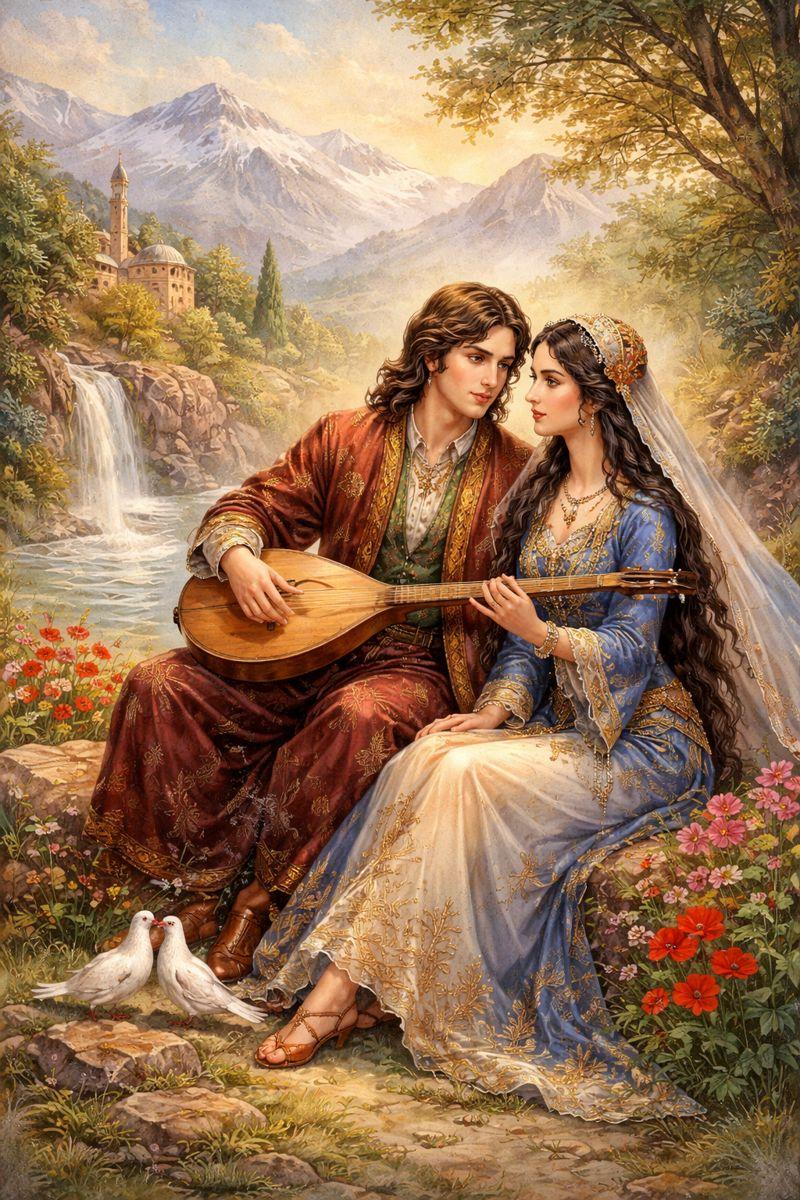
Kerem and Aslı (Generated by Artificial Intelligence.)
Theme(s) | Longing Separation Love | ||||||||
|---|---|---|---|---|---|---|---|---|---|
Type(s) | Folk tale | ||||||||
Subject(s) | The love of Kerem and Aslı which cannot be fulfilled due to obstacles | ||||||||
Transmission Method | Oral and written | ||||||||
Narrative Style | Mixed prose and verse | ||||||||
Kerem ile Aslı is an anonymous folk tale from the tradition of Turkish folk literature. The story revolves around the love between two young people, Kerem ile Aslı, and the obstacles that stand in the way of this love. The narrative has a mixed nazım–nesir structure and has been transmitted in both oral and written forms across various regions.
The tale of Kerem ile Aslı belongs to the tradition of anonymous folk stories and has reached the present day through the transition from oral to written culture. The earliest written versions appear in manuscripts and cönks, with evidence dating back to the sixteenth century and later. Its transmission in both oral and written forms among Turkish communities in Anatolia, Azerbaijan, the Caucasus, Iran and the Balkans has led to a wide geographical spread and the emergence of multiple variants. While these transmission forms introduced minor variations in plot and characters, they preserved the core structure of the tale. In written versions, poetic sections and detailed narratives dominate, whereas oral variants tend to be summarized and abbreviated; this has enabled Kerem ile Aslı to endure for centuries and be embraced across diverse regions.
The development of the plot in Kerem ile Aslı is shaped by its principal and supporting characters, who contribute to both the dramatic and cultural context of the narrative.

Kerem ile Aslı (Generated by Artificial Intelligence.)
Kerem ile Aslı belongs to the genre of anonymous folk tales and exhibits a structure combining prose and poetry. The narrative is conveyed through alternating sections of prose and poetic verses. The poetic sections typically express Kerem’s emotions and thoughts. In written versions, these poetic passages are more extensive, while in oral renditions they are often limited. Both written and oral variants feature recurring expressive patterns in certain narrative segments.
The tale of Kerem ile Aslı is a tragic folk narrative centered on a love that begins when Kerem sees Aslı but never achieves union. In most variants, Kerem encounters Aslı through a dream or chance meeting and falls deeply in love with her. Aslı reciprocates his feelings, but her family—especially her father—strongly opposes the relationship. To prevent their union, Aslı’s father relocates the family to distant lands, forcing Kerem and Aslı apart.
Upon learning of his beloved’s disappearance, Kerem embarks on a long and arduous journey to find her. This journey constitutes the core of the narrative. As he travels from town to village, Kerem inquires after Aslı, follows her trail, and recites poetic verses expressing his love in every place he visits. These poems reflect the enduring nature of his affection and the deep longing he endures throughout his travels. Along the way, Kerem confronts natural obstacles such as mountains, rivers and distant roads, and in some locations he must also battle hostile individuals or those colluding with Aslı’s family.
Kerem’s journey is not limited to physical challenges. Aslı’s father employs various deceptions and delays to discourage Kerem and dissuade him from pursuing marriage. In some variants, Aslı’s marriage is perpetually postponed, Kerem is sent to unrelated places, or his path to her is deliberately obstructed. Yet Kerem persists through all these obstacles, refusing to abandon his love. Along the way, he is aided by figures who guide and assist him, enabling him to continue his quest.
The ending of the tale varies across versions; however, in most narratives, Kerem and Aslı never reunite. In some variants, Kerem dies before reaching Aslı; in others, Aslı dies, or both lovers perish simultaneously. This tragic conclusion emphasizes not the futility of love, but the nobility of love sustained in the face of insurmountable obstacles. Separation, journey, obstacles and death are the fundamental elements that dominate the entire narrative of Kerem ile Aslı.
The tale of Kerem ile Aslı has been transmitted through oral and written traditions across diverse geographical regions, resulting in regional variations. These variants differ in the manner of plot delivery, the scope of the journey, and the use of poetic passages.
Eastern Anatolia Variants: In the Eastern Anatolia variants, Kerem’s journey to reunite with Aslı forms the central axis of the narrative. These versions emphasize the obstacles Kerem faces and the process of separation. Poetic sections are integrated into the storytelling.
Kahramanmaraş Variants: The Kerem ile Aslı variants identified in the Kahramanmaraş region are shorter and more summarized. Here, the family’s opposition to the marriage forms the core of the plot. Kerem’s journey is mentioned only briefly, and the narrative typically concludes with the lovers’ failure to unite.
Azerbaijan Variants: In the Azerbaijani variants, events are framed within local cultural elements. Kerem’s journey may extend to different regions, and additional characters may appear. The ending varies depending on the specific variant.

Kerem ile Aslı Exhibition (Kayseri Municipality)
The tale of Kerem ile Aslı holds an important place in folk culture and literature. It has been transmitted across Anatolia, Azerbaijan, the Caucasus and the Balkans. Kerem’s poetic verses have been incorporated into the repertoire of Turkish folk music and songs, and in some regions the narrative has been supported by folk performances. The tale has been staged in theater and meddah shows and has been traditionally revived at local festivals and cultural events.
Ağrı Valiliği Kültür ve Turizm Müdürlüğü. "Kerem ile Aslı Hikayesi." Accessed January 20, 2026. https://agri.ktb.gov.tr/TR-122235/kerem-ile-asli-hikayesi.html
Duymaz, Ali. “Kerem.” TEİS – Türk Edebiyatı İsimler Sözlüğü. Accessed January 20, 2026. https://teis.yesevi.edu.tr/madde-detay/kerem-mdbir
Kayseri Büyükşehir Municipality. “Erciyes’te Bir Sevda Masalı; Kerem ile Aslı.” 2026. Accessed January 20, 2026. https://kayseri.bel.tr/haberler/erciyeste-bir-sevda-masali-kerem-ile-asli7184
Poyrazoğlu, Ahmet. “Yeni Bir Kerem ile Aslı Hikâyesi Kolu: Âşık Kerem’in Ercişli Emrah’ın Mezarını Ziyareti.” *Türk Dili* (2012): 17–22. Accessed January 20, 2026.
Saygılı Savaş, Yeliz, and Salahaddin Bekki. “Radyo’da Bir Hikâye: Yeniden Yazım Penceresinden Kerem ile Aslı’ya Bir Bakış.” *Avrasya Uluslararası Araştırmalar Dergisi* 12, no. 38 (2024): 342–367. Accessed January 20, 2026. https://dergipark.org.tr/tr/pub/avrasyad/article/1390541
Tozlu, Necdet. “Kerem ile Aslı Hikâyesinin İki Eş Metninin Karşılaştırılması.” *E-Journal of New World Sciences Academy, Humanities* 6, no. 2 (2011): 356–372. Accessed January 20, 2026.
Türkmen, Fikret. “Kerem ile Aslı.” *TDV İslâm Ansiklopedisi.* Accessed January 20, 2026.
[1]
Poyrazoğlu, Ahmet. “Yeni Bir Kerem ile Aslı Hikâyesi Kolu: Âşık Kerem’in Ercişli Emrah’ın Mezarını Ziyareti.” Türk Dili (2012): 17–22. Erişim tarihi 20 Ocak 2026.https://tdk.gov.tr/wp-content/uploads/2012/09/06-Ahmet%20POYRAZO%C4%9ELU.pdf
[2]
Poyrazoğlu, Ahmet. “Yeni Bir Kerem ile Aslı Hikâyesi Kolu: Âşık Kerem’in Ercişli Emrah’ın Mezarını Ziyareti.” Türk Dili (2012): 17–22. Erişim tarihi 20 Ocak 2026.https://tdk.gov.tr/wp-content/uploads/2012/09/06-Ahmet%20POYRAZO%C4%9ELU.pdf

Kerem and Aslı (Generated by Artificial Intelligence.)
Theme(s) | Longing Separation Love | ||||||||
|---|---|---|---|---|---|---|---|---|---|
Type(s) | Folk tale | ||||||||
Subject(s) | The love of Kerem and Aslı which cannot be fulfilled due to obstacles | ||||||||
Transmission Method | Oral and written | ||||||||
Narrative Style | Mixed prose and verse | ||||||||
Origin and History
Cast of Characters
Genre, Form and Narrative Features
Theme
Tale Variants【2】
Cultural Significance