

+1 More


Khokhloma is a traditional wood painting art that originated in Russia’s Nizhny Novgorod region. This decorative art, applied to wooden plates, spoons, bowls, and various kitchen utensils, is known for its plant motifs adorned with red, black, and green colors featuring a metallic shine reminiscent of gold.
The Khokhloma painting art is particularly an important part of Russian folk culture and is also connected with ancient iconography traditions. The origin of the art is based on the accumulations of icon painters and masters of wood craftsmanship. Since the 19th century, interest in this handicraft has increased, and Khokhloma products have attracted attention in international exhibitions. Today, especially in regions such as Semyonov and Kovernino, the production of this art continues. Khokhloma designs are generally kept alive on souvenirs and decorative products.
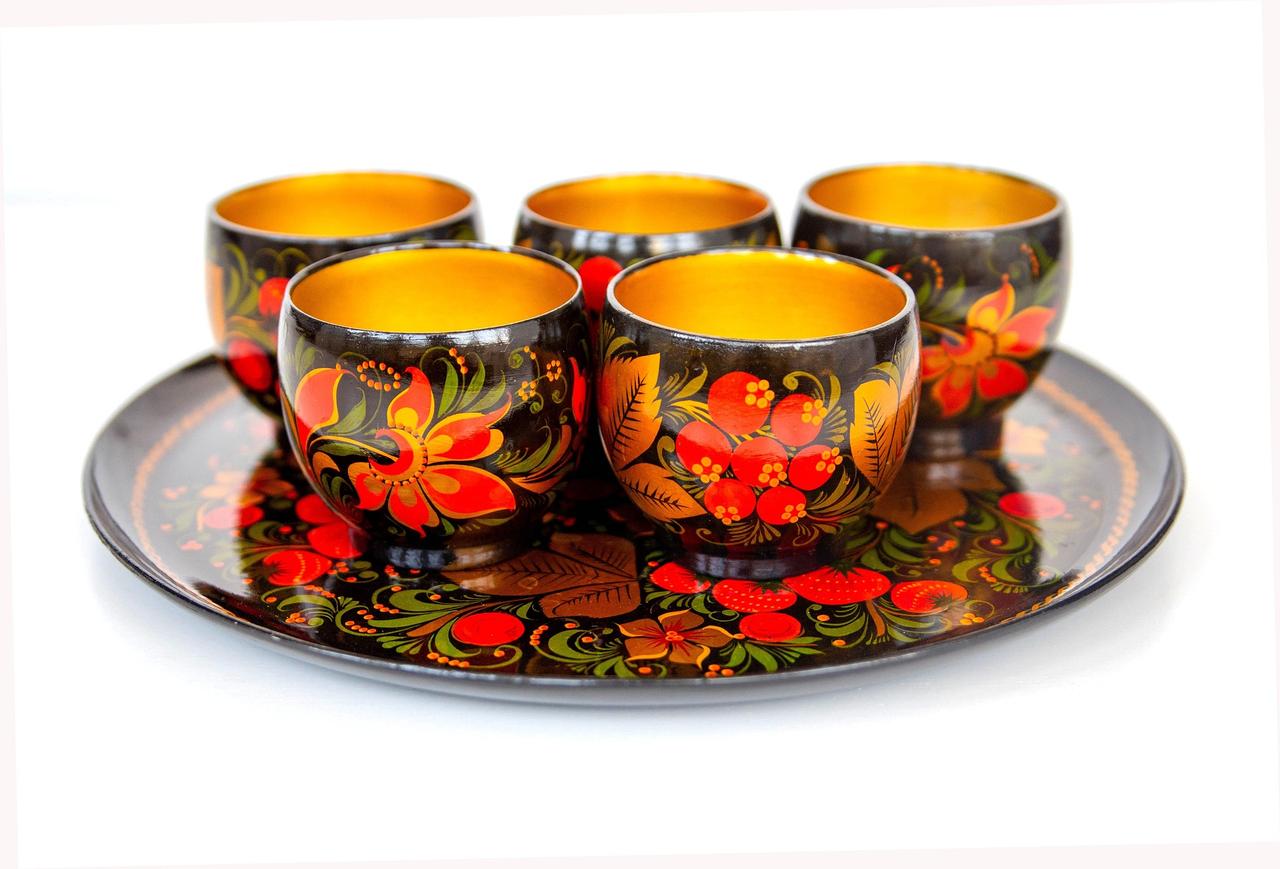
Khokhloma Glass Set (Photograph: Irina_kukuts, pixabay.com)
Khokhloma emerged in the second half of the 17th century in Russia’s Nizhny Novgorod region. This technique, used in decorating wooden kitchen utensils and furniture, was embellished with characteristic red and black tones that provided a shiny, golden appearance. The beginning of the art is especially associated with groups known as the Old Believers, who migrated to different parts of Russia following religious reforms. These communities laid the foundations of Khokhloma art by using icon painting and oklad decoration techniques.
The village that gave Khokhloma its name is the town of Khokhloma in the Nizhny Novgorod region. However, the true birthplace of the art is in the Zavolzhye region, in villages such as Bolshiye Bezdeli, Malyye Bezdeli, Mokushino, Kovernino, and Khryashchi. The craftsmen in these areas were talented in woodwork and took their production to the Khokhloma market for sale.
One of the key factors contributing to the development of Khokhloma was trade routes. Since the 17th century, the Nizhny Novgorod Fair became one of the trade centers in Russia, and Khokhloma products attracted attention there. The products reached markets via the Volga River to Kazan, Astrakhan, and even European markets. In this way, Khokhloma art became recognized not only within Russia but also internationally.
The 18th century is considered the golden age of Khokhloma art. During this period, interest in the art increased, and the aristocratic class in Russia began to show great interest in Khokhloma products. Historical documents indicate that the craftsmen in Nizhny Novgorod developed painting techniques that provided a golden appearance in the 1640s. This technique was further developed by icon painters and woodworkers and became an important part of traditional Russian art.
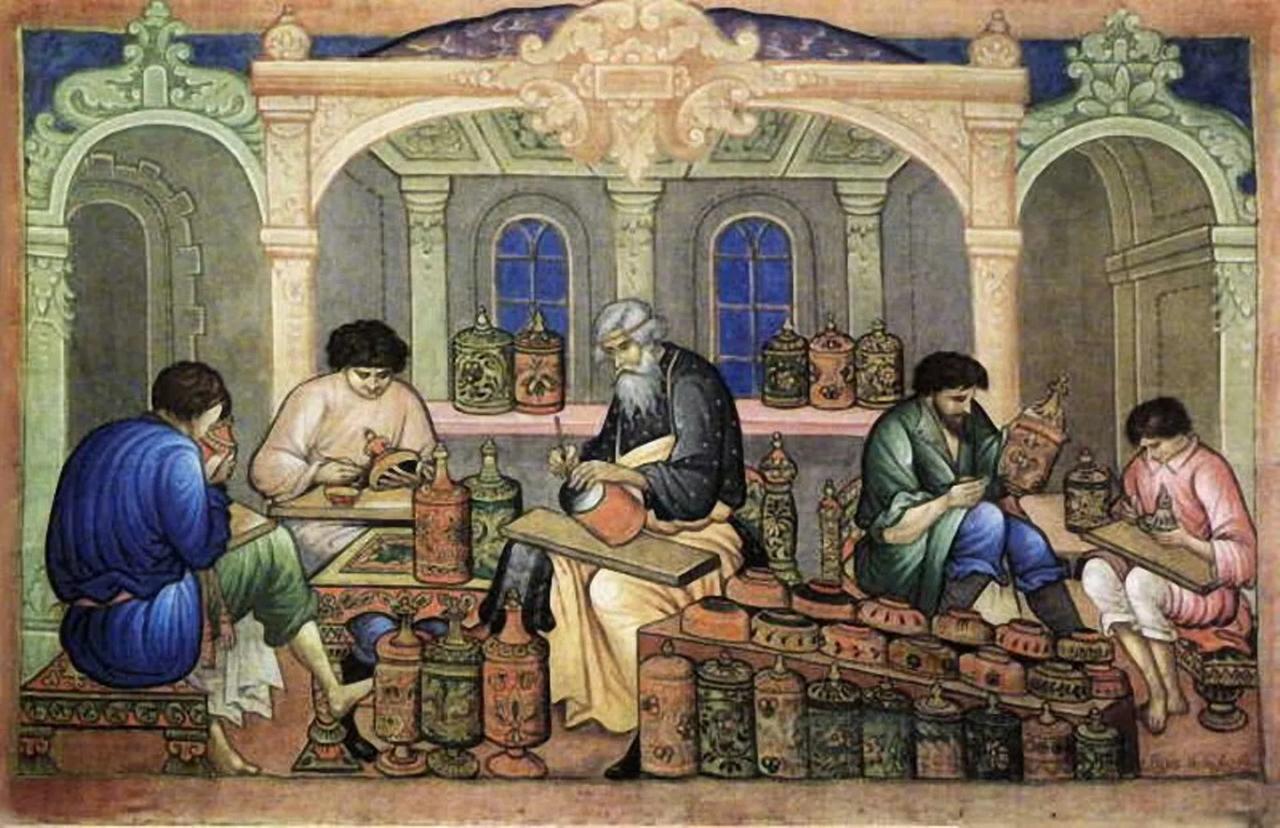
Khokhloma Artists Miniature (Photograph: culture.ru)
In the 19th century, Khokhloma art was introduced at national and international art exhibitions in Moscow and St. Petersburg. In 1853, Khokhloma products exhibited at the Russia Industrial and Art Exhibition in Moscow attracted attention, and this success continued at the 1889 Paris World Fair. The “Grand Prix” awarded to Khokhloma art at the Paris Fair increased its international recognition and facilitated its entry into the European market.
In the 20th century, within the framework of the Soviet Union’s art and culture policies, traditional handicrafts were aimed to be protected and developed. Since the 1920s, state factories supporting Khokhloma production were established in the Semenov and Kovernino regions. During this period, handicraft was combined with industrial production to enable large-scale manufacturing. Notably, the Semyonov Factory became the center of Khokhloma production in the Soviet Union.
In modern times, the art of Khokhloma continues to be preserved using traditional production techniques and is produced as souvenirs, decorative objects, and kitchen utensils. Today, this art is recognized as one of the cultural values supported by UNESCO and stands as an important heritage of Russian culture.
The art of Khokhloma is applied to wooden kitchen utensils, decorative items, and furniture produced using traditional techniques. The production process consists of several stages, with each stage involving handcrafting and the creation of unique patterns.
Production begins with processing the raw wood. Lightweight and durable woods such as linden, birch, and poplar are preferred. The wooden pieces are prepared in blocks using a technique called “bakluşi dövme” (баклуши бить) and then shaped on a lathe to achieve their final form. Since items like spoons, bowls, plates, and jugs are generally round in shape, lathe work is of great importance. The processed pieces are dried for 3 to 20 days at a temperature of 22-28°C. This drying process reduces the moisture within the wood, preventing surface deterioration.
The shaped wooden surface is then prepared for painting. Initially, a primer (грунтовка) is applied. This primer, a mixture of clay, chalk, and linseed oil, is spread over the surface to fill the pores. Afterwards, the wood is coated with several layers of linseed oil (олифа) and left to dry. This process increases the durability of the wood and creates a suitable base for achieving the metallic effect.
The golden effect on the wooden surface is achieved using a technique called lüjiniye (лужение). In traditional methods, tin powder was used, but nowadays aluminum powder is preferred for this process. The metal powder is applied to the primed surface with a cloth using linseed oil and then lightly polished. This stage ensures that the wood acquires a bright and metallic appearance.
Two main methods are used in Khokhloma decoration. In the method of overpainting (верховая роспись), motifs are directly drawn onto the golden background. Fine patterns in shades of red, black, and green are applied with a brush. Artists create plant motifs resembling strawberries, currants, or ivy through freehand movements. In the background painting (под фон) method, while the motifs are preserved, the surrounding area is entirely painted black or red. This technique ensures that the golden color remains only in the motifs, creating a strong contrast.
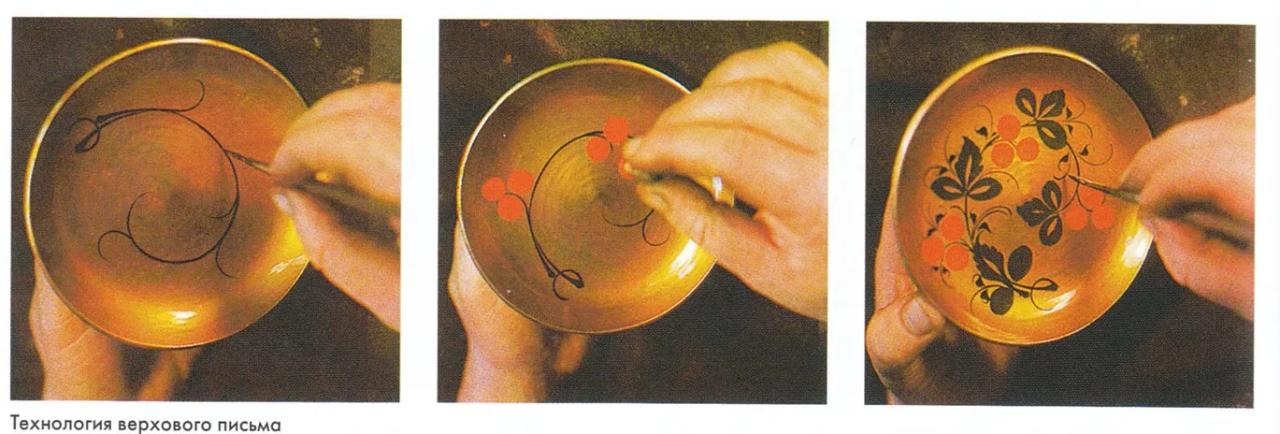
Overpainting Technique (Photograph: culture.ru)
Special brushes are used to apply traditional motifs in the drawing stage. With brush strokes, fine and thick lines are created to form plant motifs. Motifs such as trawka (grass patterns), jagodka (fruit decorations), and kudrina (curved embellishments) constitute the characteristic elements of this art. The natural bristles of the brushes allow the artists to apply detailed patterns in a single stroke.
After the painting is completed, the products are coated with a special varnish based on linseed oil. The varnishing process is repeated 3-4 times with a drying period between each coat. In the final stage, the products are baked at a temperature of 150-160°C to harden them. This baking process makes the varnish more transparent, accentuating the patterns and rendering the surface resistant to heat, moisture, and abrasion.
Культура.РФ. “ХОХЛОМÁ.” Culture.ru Web sitesi. Son erişim: 19 Mart 2025. https://www.culture.ru/s/slovo-dnya/hohloma/
Культура.РФ. “Традиционная технология хохломской росписи по дереву.” Culture.ru Web sitesi. Son erişim: 19 Mart 2025. Erişim adresi.
Культура.РФ. “Загадки узоров русских росписей.” Culture.ru Web sitesi. Son erişim: 19 Mart 2025. https://www.culture.ru/materials/139105/zagadki-uzorov-russkikh-rospisei
Setdikova, Dina. “Khokhloma: All you need to know about the ‘gold’ painted tableware.” Gateway to Russia Web sitesi. Son erişim: 19 Mart 2025. https://www.gw2ru.com/arts/3174-khokhloma-russian-handicraft

History
Design Process and Production