



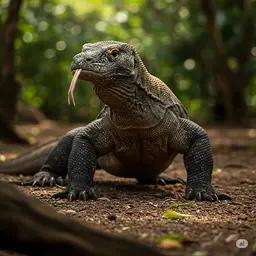
Komodo Dragon (Varanus komodoensis) is the largest lizard species in the world and is a predatory reptile that lives exclusively on specific islands of Indonesia. This species belongs to the family Varanidae and is studied in modern herpetological research in terms of its biogeographical, ecological, morphological, and behavioral characteristics. The evolutionary history, feeding behavior, habitat preferences, and reproductive strategies of the Komodo dragon have been scientifically examined, contributing to our understanding of both its role within ecosystems and its conservation status.
The Komodo dragon is a large-bodied lizard that can reach an average length of 2 to 3 meters and a weight of 70 to 90 kilograms. The largest individuals have been documented to exceed 3 meters in length and 100 kilograms in weight. It has a muscular body, a thick tail, and strong limbs. Its skin is tough, scaly, and keratinized, which protects the individual from mechanical injuries and harmful effects of sunlight.
Komodo dragons interact with their environment through the effective use of visual, thermal, and chemical senses. By using their bifurcated tongues, they transfer airborne molecules to the Jacobson's organ, which plays a role in locating prey. To regulate their body temperature, they exhibit sun-basking behavior throughout the day. Due to their ectothermic physiology, their activity levels are directly influenced by ambient temperatures.
An essential component of their predatory strategy is the presence of toxic proteins in their oral secretions. These toxins have hypotensive and anticoagulant effects, which contribute to rapidly weakening the prey. Their teeth are sharp and serrated, resembling a saw, which facilitates the tearing of the prey’s tissues.
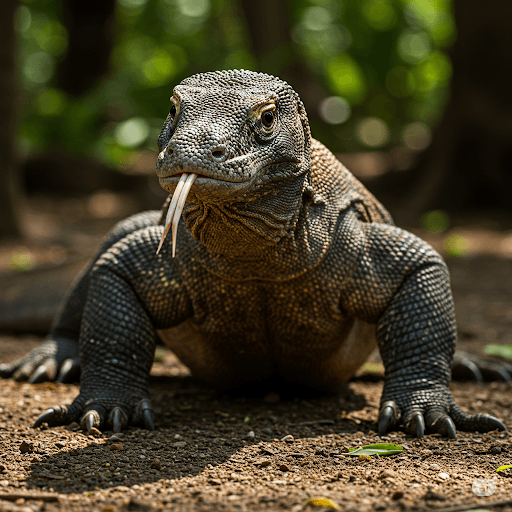
Komodo Dragon (Generated by Artificial Intelligence)
Komodo dragons are naturally found only on several Indonesian islands, including Komodo, Rinca, Gili Motang, Gili Dasami, and western Flores. The species’ distribution is limited due to habitat fragmentation and human influence. These islands are located within a dry tropical climate zone and host a variety of habitats such as savannas, open woodlands, and coastal areas.
Within their ecosystem, Komodo dragons function as apex predators. Their diet primarily consists of large herbivores, particularly deer species like Rusa timorensis, wild boars, and occasionally larger mammals such as water buffalo. They also scavenge carrion. Komodo dragons capture prey either through ambush or long-distance stalking. These energy-efficient hunting strategies are closely linked to their ectothermic metabolism.
Komodo dragons spend most of the day resting in cool, shaded areas and are typically active during the early morning hours. Increased human activity and the conversion of natural habitats for agriculture or tourism have led to the contraction of their living areas. Conservation zones such as Komodo National Park play a critical role in preserving these habitats.
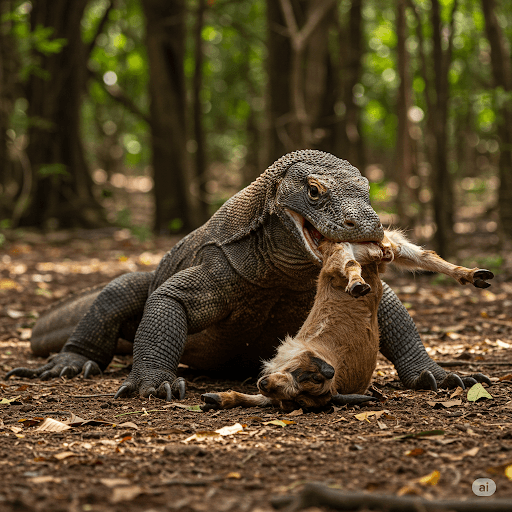
Komodo Dragon and Its Prey (Generated by Artificial Intelligence)
In Komodo dragons, mating typically occurs at the beginning of the dry season, and females lay their eggs toward the end of the year in soil depressions or abandoned bird nests. The incubation period lasts approximately 7–9 months. Females can lay an average of 15 to 30 eggs per year. After hatching, juveniles often spend time in trees to avoid predators and feed on small invertebrates.
Komodo dragons possess a scientifically verified ability for parthenogenesis. Female individuals can produce offspring from unfertilized eggs without the presence of a male. This reproductive strategy is a significant adaptive feature in terms of population sustainability. However, all offspring produced through this method are male, resulting in limited genetic diversity.
The International Union for Conservation of Nature (IUCN) classifies the Komodo dragon as "Vulnerable." Major threats to the species include habitat loss, tourism pressure, illegal hunting, and climate change. Conservation efforts focus on monitoring natural populations and ensuring the sustainable management of habitats. Regulations implemented within Komodo National Park and surrounding areas contribute significantly to the protection of the species.

Komodo Dragon Egg (Generated by Artificial Intelligence)
Fry, B. G., Wroe, S., Teeuwisse, W., Van Osch, M. J. P., Moreno, K., Ingle, J., McHenry, C., Ferrara, T., Clausen, P., Scheib, H., Winter, K. L., Greisman, L., Roelants, K., Van Der Weerd, L., Clemente, C. J., Giannakis, E., Hodgson, W. C., Luz, S., Martelli, P., . . . Norman, J. A. (2009). A central role for venom in predation by Varanus komodoensis (Komodo Dragon) and the extinct giant Varanus ( Megalania ) priscus. Proceedings of the National Academy of Sciences, 106(22), 8969–8974. https://doi.org/10.1073/pnas.0810883106
Iannucci, A., Benazzo, A., Natali, C., Arida, E. A., Zein, M. S. A., Jessop, T. S., Bertorelle, G., & Ciofi, C. (2021). Population structure, genomic diversity and demographic history of Komodo dragons inferred from whole‐genome sequencing. Molecular Ecology, 30(23), 6309–6324. https://doi.org/10.1111/mec.16121
Purwandana, D., Ariefiandy, A., Imansyah, M. J., Ciofi, C., Forsyth, D. M., Gormley, A. M., Rudiharto, H., Seno, A., Fordham, D. A., & Jessop, G. G. a. T. S. (2015). Evaluating environmental, demographic and genetic effects on population-level survival in an island endemic. Ecography, 38(10), 1060–1070. https://www.jstor.org/stable/ecography.38.10.1060

No Discussion Added Yet
Start discussion for "Komodo Dragon (Varanus komodoensis)" article
Morphology and Physiological Characteristics
Body Structure
Sensory Organs and Thermoregulation
Toxin Production and Predatory Mechanism
Habitat, Distribution, and Ecology
Geographical Distribution
Ecological Niche and Predatory Role
Habitat Preferences and Human Interaction
Reproduction, Behavior, and Conservation Status
Reproductive Biology
Parthenogenesis (Asexual Reproduction)
Conservation Status and Threats
This article was created with the support of artificial intelligence.