


This article was automatically translated from the original Turkish version.
+2 More
Konya Archaeological Museum
Foundation | 1901 (first opening), 1962 (current building) | ||||||||
|---|---|---|---|---|---|---|---|---|---|
Location | Meram Konya Sahibata Mah. Sahibata Cad. No:91 | ||||||||
Important Excavations | Çatalhöyük, Erbaba, Süberde, Sızma, Karahöyük, Kıcıkışla, Sille, Çumra, Alibeyhöyük, Alaeddin Tepesi, Beyşehir Gölü | ||||||||
Major Works | Fired clay vessels, obsidian and flint arrow/spearheads, bronze rings, cylinder seals, sarcophagi, bronze statues, mosaics, gold jewelry | ||||||||
Visiting Hour(s) | 09:00 - 17:00 (closed on Mondays) | ||||||||
Konya Archaeological Museum is located in the city of Konya, Türkiye. It was first established in 1901 in a building at the southwest corner of the Karma Middle School. In 1927, the collections were moved to the Mevlana Museum, and in 1953 they were transferred to the İplikçi Camii. The museum’s current building opened in 1962 in the Meram district.

Konya Archaeological Museum (Ministry of Culture and Tourism of Türkiye)
The Konya Archaeological Museum displays a large number of archaeological artifacts spanning from the Neolithic period through the Early Bronze Age, Middle Bronze Age (Assyrian Trade Colonies), Iron Age (Phrygian, Urartian), Classical, Hellenistic, Roman and Byzantine periods. Most of these artifacts were excavated from important archaeological sites such as Çatalhöyük, Erbaba, Süberde, Sızma, Karahöyük, Kıcıkışla, Sille, Çumra, Alibeyhöyük, Alaeddin Tepesi and the vicinity of Beyşehir Lake.

Konya Archaeological Museum (Ministry of Culture and Tourism of Türkiye)
Neolithic Period (c. 6500–5300 BCE): Obsidian and flint arrowheads and spear points, as well as fired clay vessels, excavated from Çatalhöyük, Erbaba and Süberde are on display.
Early Bronze Age (c. 3000–1950 BCE): Fired clay vessels from the excavations at Sızma and Karahöyük, along with ribbed vessels characteristic of the Beyşehir Lake region, are exhibited.
Middle Bronze Age (c. 1950–1750 BCE): Fired clay vessels made on a potter’s wheel, bronze rings, cylinder seals and candleholders shaped like grape clusters, found at Karahöyük, are displayed.
Iron Age (8th–6th centuries BCE): Phrygian vessel fragments from Alaeddin Tepesi in Konya, Phrygian and Lydian pottery from the Kıcıkışla region, and Urartian bronze fibulae are housed in the museum.
Classical Period (480–330 BCE): Imported kylixes, lekythoi and oinokhoes decorated using the black-figure technique, excavated from Kıcıkışla, are exhibited.
Hellenistic Period (330–30 BCE): Polished plates, bowls and deep carved vessel molds are on display.
Roman Period (30 BCE–395 CE): Among the bronze statuettes are figures of Hermes, Eros and a bull.
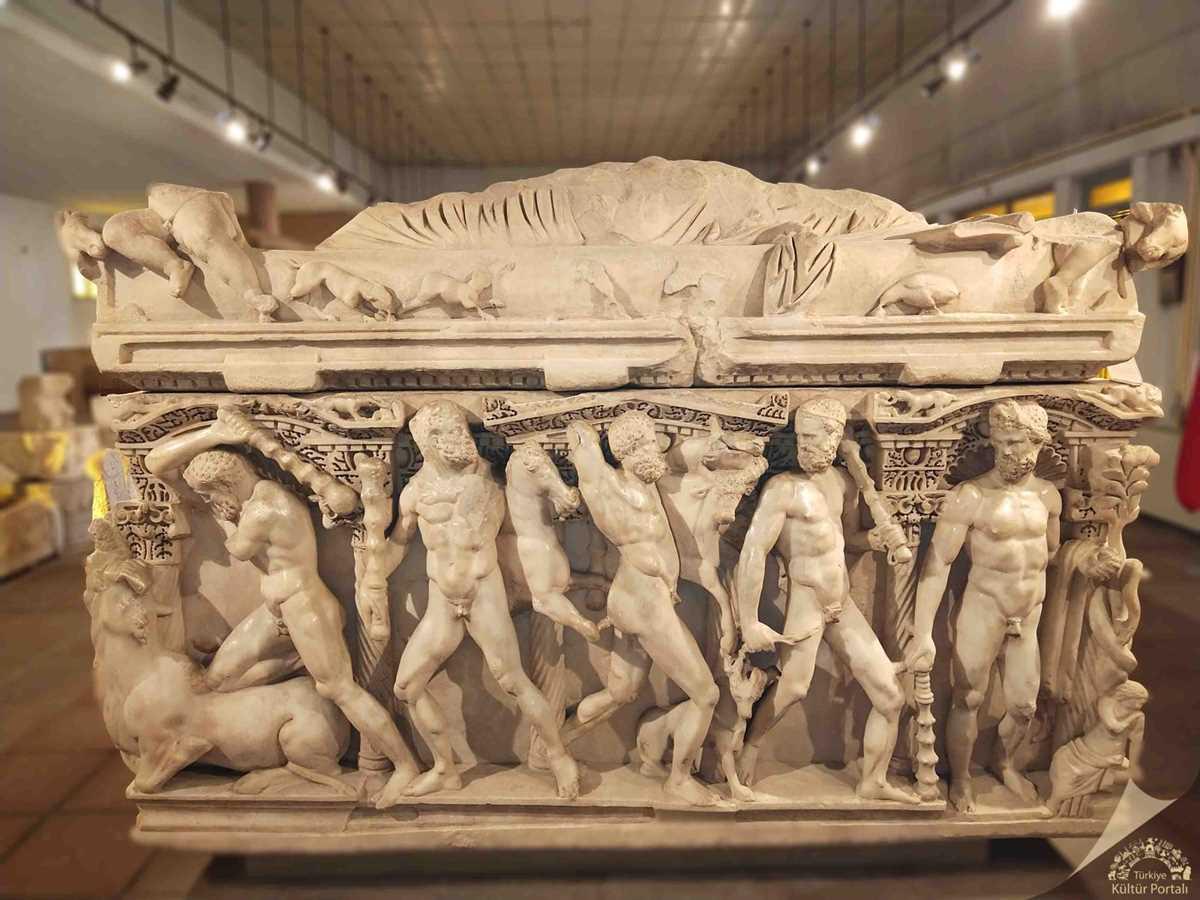
A significant artifact is the Sidemara-type columned marble sarcophagus (250–260 CE) from Yunuslar Village in Beyşehir district.
From the Iconium necropolis, columned Sidemara-type and garlanded Pamphylia-type sarcophagi, a statue of Poseidon, fired clay sarcophagi, incense vessels, glass tear bottles, gold jewelry, ivory combs and manicure tools are exhibited.
A large-scale floor mosaic dated to the 6th century CE, discovered during excavations in Sille Tatköy in 1990, is on display.
Floor mosaics and bronze door knockers, crosses and reliquaries excavated from Çumra, Alibeyhöyük and Kilise Mevkii are also part of the collection.
In the portico at the museum entrance, architectural fragments in stone and marble from the Byzantine period, tombstones and Roman funerary stelae are exhibited.
In the front garden, Roman marble statues, sarcophagi, burial chests, lion-shaped tomb guardians, column capitals and inscriptions are displayed. Among the inscriptions are texts referring to the cities of Iconium, Derbe and Lystra, which were visited by Saint Paul.

Konya Archaeological Museum (Konya Governorate)
The majority of the artifacts were obtained from excavations in and around Konya, including Çatalhöyük, Erbaba, Süberde, Sızma, Karahöyük, Kıcıkışla, Sille, Çumra, Alibeyhöyük, Alaeddin Tepesi and the vicinity of Beyşehir Lake.
The museum is located at Sahibata Mahallesi, Sahibata Caddesi No:91, in the Meram district of Konya. Opening hours are from 09:00 to 17:00 daily, with ticket sales closing at 16:40. The museum is closed on Mondays.
Accessed November 26, 2025.
Accessed November 26, 2025.
Accessed November 26, 2025.
Kültür Portalı. "Konya Arkeoloji Müzesi." T.C. Kültür ve Turizm Bakanlığı. Accessed 2025.
Müzeler Genel Müdürlüğü. "Konya Arkeoloji Müzesi." T.C. Kültür ve Turizm Bakanlığı. Accessed 2025.
T.C. Konya Valiliği. "Konya Arkeoloji Müzesi." Konya Valiliği Resmi Sitesi. Accessed 2025.

Konya Archaeological Museum
Foundation | 1901 (first opening), 1962 (current building) | ||||||||
|---|---|---|---|---|---|---|---|---|---|
Location | Meram Konya Sahibata Mah. Sahibata Cad. No:91 | ||||||||
Important Excavations | Çatalhöyük, Erbaba, Süberde, Sızma, Karahöyük, Kıcıkışla, Sille, Çumra, Alibeyhöyük, Alaeddin Tepesi, Beyşehir Gölü | ||||||||
Major Works | Fired clay vessels, obsidian and flint arrow/spearheads, bronze rings, cylinder seals, sarcophagi, bronze statues, mosaics, gold jewelry | ||||||||
Visiting Hour(s) | 09:00 - 17:00 (closed on Mondays) | ||||||||
No Discussion Added Yet
Start discussion for "Konya Archaeological Museum" article
Exhibited Artifacts and Periods
Prehistoric Artifacts Hall
Iron Age Artifacts Hall
Roman Period Hall
Byzantine Artifacts
Garden and Outdoor Artifacts
Important Excavation Sites
Location and Visit Information