This article was automatically translated from the original Turkish version.
+2 More
Name(s) | Korean War (한국전쟁) | ||||||||
|---|---|---|---|---|---|---|---|---|---|
Date(s) | 25 June 1950 – 27 July 1953 | ||||||||
Place | Korean Peninsula | ||||||||
South Korea Side | United Nations Forces | ||||||||
North Korea Side | People's Republic of China Soviet Union | ||||||||
Cause of Start | North Korea's Attack | ||||||||
Course of the War | Panmunjom Armistice Panmunjom armistice negotiations static trench warfare China's entry into the war UN intervention fall of Seoul North Korea's attack | ||||||||
The Korean War is an armed conflict that occurred in the second half of the 20th century and affected not only the Korean Peninsula but also global politics. The war began on 25 June 1950 with an invasion by North Korean forces into South Korean territory. It quickly transcended being merely a conflict between the two Koreas; a multinational intervention force was formed at the call of the United Nations, and with the subsequent entry of the People’s Republic of China into the conflict, it evolved into a global proxy war. In this regard, the Korean War is regarded as the first hot conflict of the Cold War era and is assessed as a direct manifestation of the ideological and military rivalry between the United States and the Soviet Union.【1】

A Cartoon on the Korean War (Oylum Bülbül Beşler)
Over the course of more than three years of war, the Korean Peninsula changed hands multiple times, resulting in millions of deaths and displacements. The military, political and humanitarian consequences affected not only the Korean people but also the domestic and foreign policies of the states involved in the conflict. Türkiye Cumhuriyeti was among the first countries to send troops to Korea at the call of the United Nations; it participated in the war with four different brigade-level units. This decision marked a turning point that accelerated Türkiye’s shift toward the Western Bloc in its foreign policy.
The Second World War ended in 1945, giving rise to a new world order that triggered profound changes in global politics. The surrender of Germany and Japan solidified the defeat of the Axis powers; Europe was largely devastated, while political vacuums emerged in regions previously occupied by Japan in Asia. Under these conditions, the victorious powers, the United States and the Soviet Union, emerged as the dominant actors of the postwar era, and their ideological, political and military rivalry formed the core dynamic of the Cold War.
The United States aimed to establish a world order based on capitalist free-market economics and liberal democracy; to this end, it implemented economic aid programs such as the Marshall Plan for Western European countries. On the other hand, the Soviet Union sought to expand its influence by supporting communist regimes in Eastern European territories it had occupied during the war, leading to a bipolar world order. The declaration of the Truman Doctrine in 1947 and the establishment of NATO in 1949 demonstrated the institutionalization of competition between the blocs.

A Cartoon Depicting the Soviet Union’s Perspective of the Era (Oylum Bülbül Beşler)
This militarization and diplomatic polarization did not remain confined to Europe but extended to Asia.【2】 The Communist Party’s seizure of power in China under the leadership of Mao Zedong in 1949 strengthened the socialist bloc’s presence in Asia and reinforced U.S. influence over allied countries such as Japan and the Philippines. Thus, the Asia-Pacific region became a new front of the Cold War, and the Korean Peninsula became the site of its first hot conflict.
During this period, international relations were shaped by military alliances, ideological orientations and spheres of influence. The temporary solidarity among the victorious powers after the Second World War gave way to a systematic atmosphere of mistrust; global politics was restructured according to the principle of “bipolarity.” In this context, the geopolitical and strategic importance of the Korean Peninsula inevitably became part of a global struggle.
The Korean Peninsula had been annexed by Japan since 1910 and remained a direct colony of the Japanese Empire until the end of the Second World War. However, Japan’s unconditional surrender on 15 August 1945 ended its authority over Korea, prompting the need for a new international arrangement regarding Korea’s future. The idea of temporarily dividing Korea into two separate occupation zones was accepted at the Yalta Conference; the area north of the 38th parallel was placed under Soviet control, while the south was placed under the control of the United States of America.

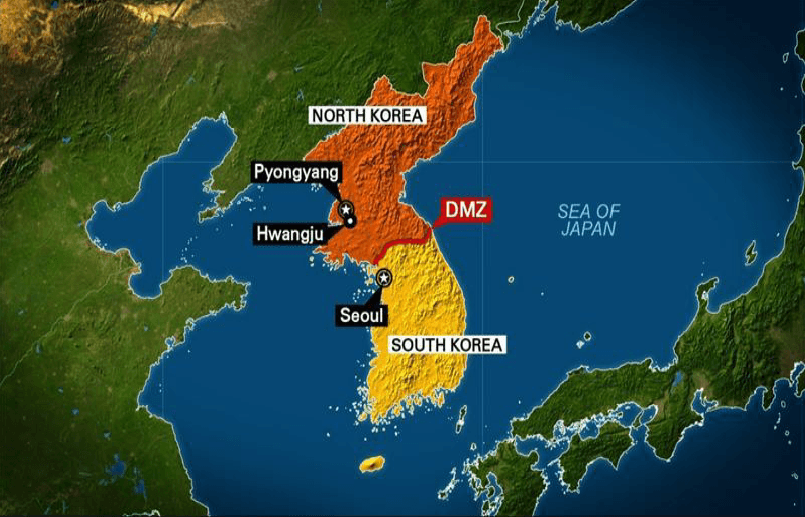
A Map Showing the Divided Structure of Korea (Ulviye Ulviya Mammadova)
Although this division was initially intended to be temporary and it was expected that the Korean people would establish a unified state in accordance with their right to self-determination, the ideological and strategic interests of the two major powers rendered this process unworkable.【3】 While the Soviet Union established an administration in the north, the United States supported efforts to establish an independent government in the south. In 1947, the Soviet Union and North Korean authorities refused to allow general elections planned under United Nations supervision; this led to Korea’s de facto division into two separate political structures.
On 15 August 1948, an anti-communist government under Syngman Rhee was established in the south as the “Republic of Korea.” In response, on 9 September 1948, a socialist regime under Kim Il Sung was proclaimed in the north as the “Democratic People’s Republic of Korea.” Both administrations claimed legitimacy over the entire Korean Peninsula, creating a foundation for not only factual but also constitutional and ideological conflict.

A Map Showing the Situation in Korea (Seher Kömürcü)
These two newly established Korean states rapidly developed their own political, military and economic structures and strengthened their international positions by aligning with different blocs.【4】 South Korea was supported by the United States and the Western Bloc; North Korea developed close relations with the Soviet Union and the People’s Republic of China. This division meant not only a territorial split for the Korean people but also a division of identity; brotherly communities were positioned on opposing sides of rival regimes.
This political fragmentation was reinforced over time by increasing clashes along the military boundary. Frequent border violations, mutual propaganda campaigns and small-scale armed confrontations became significant developments that prepared the ground for war. During this period, the Korean Peninsula became one of the focal points of the conflicting interests of global powers; by 1950, the region had reached the brink of military escalation.
The political polarization on the Korean Peninsula between 1948 and 1950 quickly led to military tensions; small-scale clashes along the border escalated. Both Korean governments remained committed to the goal of a unified Korea and developed plans to eliminate the opposing side by military means. On 25 June 1950, this tension erupted into open war, and the Korean War officially began.

News on the Outbreak of War (Fatih Set)
The war erupted when the North Korean People’s Army launched a comprehensive offensive across the 38th parallel in the early morning.【5】 Equipped with Soviet-made heavy weapons and numerically superior, North Korean units rapidly reached Seoul and captured the capital. The South Korean army, lacking adequate training, equipment and discipline, could not withstand the offensive and was forced to retreat southward to the Busan region.

Changes in the Map of Korea During the War (Shi Woon Choi)
North Korea’s attack met with a strong international response; the United Nations Security Council convened urgently on 26 June 1950.【6】 The Security Council determined that the attack threatened international peace and security and adopted Resolution 82, demanding that North Korea immediately cease its offensive and withdraw its forces behind the 38th parallel. However, as the attack continued, Resolution 83, issued on 27 June, called upon United Nations member states to assist South Korea.
In response to this call, the United States immediately mobilized and directed its naval and air forces in the Far East toward Korea. While these decisions were being made, the Soviet representative Andrey Vyshinsky was boycotting Security Council meetings due to the issue of China’s representation rights. Consequently, resolutions were adopted without a Soviet veto, facilitating the United Nations’ direct involvement in the conflict.
With the outbreak of war, Korea ceased to be merely an internal matter of two states; it transformed into an international armed conflict. Alongside the United States, countries such as the United Kingdom, Canada, Australia, France, the Netherlands and Türkiye began participating with land, air and naval forces; the People’s Republic of China also joined the conflict in the following months, altering the balance of power. These developments turned the Korean War into the first hot conflict of the Cold War and heralded the era of proxy wars.
The Korean War is regarded not merely as an internal conflict between two separate governments on the Korean Peninsula but as the first open military manifestation of the ideological and geopolitical polarization of the Cold War era. The war was the first large-scale proxy conflict conducted without direct armed confrontation between the United States, leader of the Western Bloc, and the Soviet Union, the dominant power of the Eastern Bloc. In this respect, the Korean War reshaped the political, diplomatic and military positions of not only the Korean people but also all states involved in or indirectly affected by the conflict.
The deployment of a multinational military force under U.S. leadership within the framework of the United Nations demonstrated that the war was conducted on the basis of international legitimacy. Simultaneously, this marked the first time the United Nations effectively utilized its collective security mechanism. The absence of the Soviet Union from the Security Council meetings at the war’s outset enabled resolutions to be adopted without veto, providing a significant diplomatic advantage to the Western Bloc. As the war progressed, the intervention of the People’s Republic of China on the side of North Korea transformed the regional conflict into a global struggle and fundamentally altered strategic balances in Asia.
The Korean War also clarified the ideological fronts of the Cold War. The United States, through its strong support for South Korea, aimed to contain the spread of communism in Asia; this was viewed as one of the early examples of the “domino theory.” Conversely, although the Soviet Union did not directly participate on the battlefield, it provided weapons and logistical support to North Korea and intervened indirectly through China. This situation strengthened the proxy war nature of the conflict.
The Korean War also forced countries such as Türkiye, which had sought to remain outside the conflict, to take sides; it served as a turning point that solidified Türkiye’s political alignment with the Western Bloc at a military level. By deciding to send troops to Korea as part of its goal to join NATO, Türkiye established itself as a reliable partner within the Western Alliance. Similarly, after the war, NATO expanded, military expenditures increased, and neutrality policies declined globally.
At the end of the war in 1953, the parties signed not a peace treaty but merely an armistice agreement. Therefore, legally, the state of war continues to exist on the Korean Peninsula. The Demilitarized Zone (DMZ), established after the Panmunjom Armistice, remains the most sensitive border line between the two Koreas to this day. This situation demonstrates that the Korean War was not merely a conflict specific to the Cold War era but also lies at the foundation of today’s geopolitical issues.
On the morning of 25 June 1950, the North Korean People’s Army crossed the 38th parallel and launched a sudden and comprehensive attack on South Korean territory. The offensive was carried out during a period when the South Korean army was unprepared; frontline defenses quickly collapsed and North Korean units rapidly advanced into the interior of South Korea. The South Korean capital, Seoul, fell to North Korean forces just three days after the attack began, on 28 June 1950.
North Korea’s attack was not confined to Korea’s internal affairs; it was evaluated as a direct violation of international law and the United Nations Charter. The United Nations Security Council defined the attack on Korea as a threat to international peace and security and, on 26 June, adopted Resolution 82, demanding that North Korea cease its offensive and withdraw its forces behind the 38th parallel. When this demand went unheeded, Resolution 83, issued on 27 June, called upon United Nations member states to provide military assistance to South Korea. The United States assumed leadership in response to this call and redirected its naval and air forces in the Asia-Pacific region toward Korea.

Just Before the Fall of Seoul in Korea (Şehlem Kaçar)
The Republic of Korea Armed Forces suffered heavy losses in the first days of the war; due to deficiencies in military organization, inadequate equipment and weak logistical infrastructure, they were forced to retreat.【7】 At the time of the attack, the Republic of Korea army consisted of approximately 95,000 soldiers; the majority of these units were organized as local security forces and lacked tanks, artillery and air support. In contrast, North Korean units were equipped with heavy armored units, tanks and modern weapons with Soviet support. Moreover, during the initial phase of the war, strategic initiative was entirely in North Korea’s hands.
The fall of Seoul was not only a major setback for South Korea but also a significant blow to Western public opinion, particularly in the United States. This development threatened the legitimacy of the South Korean regime and raised fears that U.S. influence in East Asia could be undermined. In response, U.S. President Harry S. Truman assessed the Korean War as the first major step in communist expansion and integrated this intervention into a global containment strategy. Following the United States, the United Kingdom, Canada, Australia and other allied nations pledged military support to South Korea.
At this stage, the South Korean army and American units had been pushed back to the Busan area, becoming confined to a narrow zone in the southeastern part of the Korean Peninsula known as the Pusan Perimeter. The defensive line established there would later serve as the foundation for the United Nations forces’ counteroffensive. However, the rapid developments in the first weeks of the war marked a period of absolute North Korean superiority.
The invasion launched by North Korea on 25 June 1950 created a profound crisis not only on the Korean Peninsula but also on a global scale. This attack was assessed as an “open threat to peace” under the founding principles of the United Nations, prompting the Security Council to convene urgently to address the crisis. Resolution 82, adopted on 26 June, called for the cessation of North Korea’s offensive and the withdrawal of its forces behind the 38th parallel; when this appeal proved ineffective, Resolution 83, issued on 27 June, called upon United Nations members to provide military assistance. Resolution 84, issued on 7 July 1950, determined that the command of the military intervention in South Korea would be assumed by the United States.
These developments demonstrated the first practical application of the United Nations’ collective security mechanism in response to an attack on a member state. An important detail was that the absence of the Soviet Union’s representative from Security Council meetings enabled the resolutions to be adopted without veto. The Soviet representative was boycotting the meetings in protest against the lack of representation for the People’s Republic of China. This diplomatic vacuum allowed Western states to gain dominance in the decision-making process.

A Cartoon on the United Nations’ Intervention (Oylum Bülbül Beşler)
Under the framework of United Nations intervention, 16 countries sent military forces—land, air and naval—to Korea.【8】 These countries included the United States, the United Kingdom, France, Canada, Australia, Türkiye, Belgium, the Netherlands, Greece and the Philippines. Additionally, more than 40 countries provided indirect support through logistical, medical and humanitarian aid. The operational command of this multinational force was conducted by the U.S. Joint Chiefs of Staff, and the command of ground forces was entrusted to General Douglas MacArthur.
The formation of the United Nations force demonstrated that the Korean War was not merely an internal matter concerning the Korean people but a crisis concerning international peace and security. Moreover, its multinational structure strengthened the legal and political legitimacy of the war and reinforced the Western Bloc’s collective capacity to act against communist expansion. This development also directly contributed to the institutionalization of new military alliances such as NATO.
On 25 July 1950, Türkiye officially announced its decision to send a brigade-sized military unit to Korea; this decision became one of the complementary elements of the multinational structure in the Korean War. Thus, the Korean War became not only a battlefield for participating states but also the first laboratory for the international alliances that would shape the Cold War.
In the early months of the Korean War, the rapid advance of North Korean forces was halted by the United Nations forces’ counteroffensive and South Korea’s successful defense in the Busan region. Under the command of General Douglas MacArthur, the United Nations Army fundamentally altered the course of the war with the Inchon Landing in September 1950. Through this amphibious operation, UN forces recaptured Seoul, pushed North Korean units beyond the 38th parallel, and rapidly advanced into northern Korea, reaching the Chinese border. These developments raised the prospect that the war would extend beyond merely defending South Korea and that the North Korean regime could be completely eliminated.
The approach of United Nations forces to the Yalu River, i.e., the Chinese border, was perceived by the People’s Republic of China as a direct security threat. The Chinese leadership argued that allowing a regime change in Korea would jeopardize its own border security and therefore decided to intervene. Approximately 300,000 military personnel, organized under the name of the Chinese People’s Volunteers (CPV), secretly entered Korea at the end of October 1950.
China’s entry into the war constituted one of the most critical turning points of the Korean War. Particularly following the Chinese offensive that began in late November, United Nations forces suffered heavy losses, and Seoul fell once again into the hands of North Korean and Chinese units. During this period, harsh winter conditions and logistical difficulties forced UN forces to retreat, restoring the balance of the war.
China’s entry into the war eliminated the regional nature of the conflict and reinforced the image of a direct international proxy war. For the United States, this situation necessitated a reevaluation of the limits of its military engagement in Asia. General MacArthur’s proposal for direct attacks on Chinese territory was rejected by President Truman, leading to MacArthur’s dismissal. This crisis created a significant turning point in U.S. civil-military relations.
China’s intervention in the war prevented the collapse of the North Korean regime and led to a more balanced stalemate between the two sides. Following this period, the war took on a more defensive and positional warfare character; large-scale front-line changes gave way to a static front.
These developments demonstrated that China’s intervention not only saved the North Korean regime but also laid the groundwork for China’s emergence as a visible global power during the Cold War. From this war onward, China was identified as an independent pole in Asia opposing the Western Bloc and began developing a diplomatic line independent of the Soviet Union.
From the beginning of 1951, large-scale front-line movements in the Korean War gave way to a static, positional warfare phase. The reshaped front-line balance following the entry of the Chinese People’s Volunteers led both sides to entrench themselves and establish new defensive lines. Although the United Nations forces recaptured Seoul for the second time in February 1951, indicating a temporary shift in initiative, neither the Chinese and North Korean forces nor the UN forces were in a position to achieve lasting superiority through large-scale offensives.
During this period, the military nature of the war changed; instead of aiming for deep advances, intense positional battles around specific hills and defensive points became prominent. From mid-1951 onward, the front line stabilized around the 38th parallel and showed minimal change throughout the war. This period was characterized by low-intensity but continuous combat involving artillery fire, limited infantry raids, reciprocal trench warfare and reconnaissance activities.
The static war period also brought about a political stalemate. Since no clear victory or defeat emerged from the fighting, a balance of power developed that prolonged the war. This situation became exhausting for both the soldiers on the front lines and the participating countries. Particularly, harsh weather conditions, high-altitude positions, logistical difficulties and human losses intensified the social and psychological impacts of the war.
During this period, South Korea, with support from UN forces, improved its defensive capacity, while North Korean and Chinese forces attempted to offset their loss of initiative by leveraging terrain advantages. However, the inability to achieve superiority and the continued engagement of both sides despite dwindling resources led inevitably to negotiations.
Ultimately, this static and exhausting war environment laid the groundwork for the initiation of peace talks in July 1951. The village of Panmunjom was designated as the neutral site for these negotiations; thus, the diplomatic process that would shape the final phase of the war began. However, the negotiations themselves were as long and arduous as the war; for over two years, talks remained inconclusive, during which static fighting on the front lines continued uninterrupted.
As the Korean War transformed into a static front-line conflict in mid-1951, the warring parties acknowledged the impossibility of a military solution and turned to diplomatic channels. In July 1951, armistice talks began between representatives of North Korea and the People’s Republic of China and the United Nations forces in the village of Panmunjom. The location of the talks, situated on the front line but designated as neutral, symbolically represented both the military and political dimensions of the war.
The Panmunjom Talks constituted a multilateral and highly challenging diplomatic process involving all parties to the conflict. Initially, the negotiations aimed at a comprehensive peace treaty to end the war entirely; however, this goal gradually narrowed to focus solely on an armistice, with the parties concentrating only on ending hostilities. The main reasons for the slow progress of the talks included the fate of prisoners of war, the determination of the new border, monitoring mechanisms and political representation issues.
The most contentious issue was the fate of prisoners of war. The Chinese and North Korean side advocated for the forced repatriation of prisoners; however, the United Nations side, shaped largely by diplomatic initiatives from India, proposed the voluntary release of prisoners based on their own wishes. This fundamental disagreement caused months of deadlock; the processes of prisoner exchange and the establishment of neutral monitoring commissions took considerable time.
Despite all these obstacles, the exhausting impact of the nearly three-year-long war on the parties ultimately compelled them to seek a diplomatic solution. On 27 July 1953, an “armistice agreement” was signed in Panmunjom, bringing an end to active combat in the Korean War. The agreement established a Demilitarized Zone (DMZ), approximately 240 kilometers long and 4 kilometers wide, based on the actual front line; this line remains the de facto border between North and South Korea today.
However, this armistice does not mean that the war officially ended. No peace treaty was signed between the parties; therefore, the state of war on the Korean Peninsula has not legally ceased. This situation has led to the persistence of tension and military preparedness in the region to this day.
The Panmunjom Armistice is also the first major military intervention in United Nations history in which a lasting peace was not established. After the armistice, the U.S. military presence in South Korea became permanent, while North Korea deepened its military and political relations with China and the Soviet Union. Thus, the Korean War is remembered in history as one of the most critical turning points that defined the Cold War equation, affecting not only the Korean Peninsula but also the broader global order.
After the Second World War, Türkiye entered a significant process of change in its foreign policy, gradually abandoning its principle of neutrality and seeking closer relations with the Western Bloc. This transformation was primarily driven by increasing Soviet pressure on Türkiye in the postwar period, particularly renewed demands regarding the Straits and territorial claims over Kars and Ardahan. In response to this threat, Türkiye felt the need to secure its security through a collective security system and began taking concrete steps toward joining the North Atlantic Treaty Organization (NATO).
The outbreak of the Korean War was viewed by Türkiye as a significant opportunity to achieve this goal. The newly elected Democratic Party administration, which came to power in 1950, believed that integration with the Western alliance needed to be reinforced not only through political rhetoric but also through concrete contributions. Government officials, led by Foreign Minister Fuat Köprülü, interpreted the United Nations’ call not merely as a peaceful initiative but as a test of Türkiye’s position within the Western Bloc.

A Cartoon on Türkiye’s Participation in the War (Muhammed Cihad Kubat)
On 25 July 1950, the Council of Ministers decided that Türkiye would send a brigade-sized military unit to Korea.【9】 This decision was neither discussed in the Grand National Assembly of Türkiye nor consulted with the opposition. Consequently, the decision to send troops to Korea became a major point of domestic political debate; opposition parties criticized the decision as being taken outside parliamentary oversight, violating constitutional norms and democratic procedures. However, the government justified its decision by linking it to national interests, emphasizing its necessity for NATO membership and integration with the Western world.
At the time the decision was made, Türkiye had not yet been officially accepted into NATO. Türkiye’s application for NATO membership, which was not among the founding members established in 1949, had previously been negatively received by some European countries, particularly due to reasons related to geographical location and political stability. The decision to send troops to Korea was interpreted as a strategic demonstration of Türkiye’s commitment to NATO membership; it was hoped that Türkiye’s military contribution would demonstrate its military capacity and loyalty to the West.
In the realm of foreign policy, Türkiye’s participation in the Korean War was not limited to providing military support; it was also an initiative to redefine Türkiye’s position in the international system. This move marked a critical turning point in Türkiye’s transition from a “neutral country” to becoming part of the Western defense system. Indeed, shortly after this decision, Türkiye’s path to NATO membership accelerated; in February 1952, Türkiye, along with Greece, was officially admitted into the Alliance.
Türkiye’s decision to send troops to the Korean War was announced on 25 July 1950 through a decision of the Council of Ministers; however, this decision was implemented without being debated in the Grand National Assembly of Türkiye or submitted to a vote. Taken during the first three months of the Democratic Party’s tenure, this decision sparked serious debates regarding the functioning of the political system, decision-making processes and democratic norms. Opposition parties, especially the Republican People’s Party, criticized the government for bypassing the Assembly on a vital issue such as foreign policy.
Opposition parties, led by the Republican People’s Party, accused the government of exceeding its constitutional authority and argued that unilaterally committing Türkiye to a high-risk conflict like war contradicted the principle of the rule of law. Criticisms were not limited to the procedure of the decision but also extended to its substance. It was frequently argued that there was no direct connection between Korea and Türkiye, that the war did not threaten Türkiye’s national security and that sending Turkish soldiers to fight in a foreign conflict with no direct relevance to Türkiye lacked legitimate public support.
In contrast, the Democratic Party government defended its decision to join the Korean War on strategic grounds, asserting that security against the Soviet threat could only be guaranteed through participation in collective security mechanisms and that sending troops to Korea would open the path to full integration with the West. Moreover, Democratic Party leaders emphasized in their public statements that the decision was based on a sense of international responsibility, contribution to peace and commitment to United Nations principles.
The Istanbul press devoted extensive coverage to these debates. While some newspapers viewed the government’s initiative as a positive development and argued that Türkiye was striving to gain a respected position in the Western world, others criticized the exclusion of the Assembly as a violation of constitutional balance. Newspaper commentaries also discussed the social and economic costs of sending Turkish soldiers to another war. In particular, the emotional scenes during troop deployments, especially at railway stations, evoked both a sense of national unity and anxiety and sorrow among the public.
The decision to participate in the Korean War demonstrated the extent to which the Democratic Party prioritized its goal of integration with the Western Bloc in foreign policy; however, it also revealed certain institutional and legal shortcomings in legitimizing this goal domestically. This decision laid the groundwork for more systematic discussions in later years regarding the limits of democratic oversight in Türkiye, the effectiveness of parliamentary governance and the unilateral influence of the executive on foreign policy.
Türkiye’s decision to send troops to the Korean War generated widespread reactions not only among political circles but also in public opinion and the press. Examination of news reports, commentaries and opinion columns in newspapers of the period reveals that different segments of society responded to this decision with various emotions and assessments. In particular, the Istanbul press interpreted the decision to send troops to Korea as both a foreign policy initiative and a test of national responsibility; it thoroughly analyzed the motivations behind the decision, its potential consequences and its reflections in public conscience.

Young People Supporting Turkish Troops in Korea with Flags Drawn in Blood (Şehlem Kaçar)
Following the announcement of the decision, some newspapers described the government’s initiative as a positive step and argued that Türkiye was striving to join the collective security system to counter Soviet pressure on Türkiye. It was emphasized that Türkiye’s positive response to the United Nations’ call would strengthen its image as a state fulfilling its international obligations.
However, more critical articles were also published in the press. Some newspapers, in particular, criticized the government for making the decision without consulting the Grand National Assembly or adequately informing the public, arguing that this undermined democratic governance. They contended that the legal and moral legitimacy of sending Turkish soldiers to fight in a war thousands of kilometers away, with no direct connection to Türkiye’s security, needed to be questioned. The phrase “Where is Korea? Where is Türkiye?” became a symbolic expression reflecting public skepticism and questioning of the troop deployment decision.
Public opinion, however, presented a more complex picture. On one hand, there was a desire for Türkiye to gain a stronger position internationally; on the other, families of conscripts sent to war expressed anxiety and sorrow. Ceremonies held during troop deployments, especially the farewell scenes at railway stations, visibly revealed public emotions; these scenes were frequently photographed and published in newspapers of the period.

Senator Cain with Fuat Köprülü (Burcu Yener)
Moreover, the arrival of Turkish soldiers in the theater of operations and their battlefield successes were met with pride and national enthusiasm, especially in major cities such as Istanbul.【11】 These successes were frequently highlighted in the press; newspaper headlines emphasized the bravery, discipline and heroism of Turkish soldiers. These positive portrayals served as a tool to bolster domestic support for the government’s foreign policy initiative, providing short-term political advantages.
However, as the war progressed, casualties, prisoner reports and the hardships experienced on the front lines fostered a more cautious and critical public attitude. The initial enthusiasm gradually gave way to fatigue, questioning and social trauma; especially the accounts of returning soldiers led the public to confront the true face of the war.
Immediately after deciding to participate in the Korean War, Türkiye launched a military preparation process and rapidly organized a brigade suitable for combat conditions. This brigade, known as the “Turkish Brigade” (officially the Turkish Combat Brigade), was organized to be sent to Korea under United Nations command. The brigade’s formation, training, deployment and equipment were carried out at a rapid pace despite the limited resources of the period.
The core of the Turkish Brigade consisted of professional officers and non-commissioned officers; enlisted soldiers were primarily selected from reserve officer candidates, active-duty soldiers and volunteers. The brigade’s strength was set at approximately 5,000 soldiers; it included infantry battalions, artillery units, reconnaissance elements, medical, communications and logistical support units. The brigade was initially gathered for collective training at the Artillery and Infantry Schools in Polatlı, Ankara, and completed its pre-deployment training in Kayseri and İskenderun.
The training program was structured to suit the combat environment in Korea; special emphasis was placed on night combat, hand grenade usage, machine gun training and close-quarters combat. The disciplined nature, resilience and morale of Turkish soldiers ensured the successful completion of the training program in a short time. The brigade’s command cadre was composed of officers proficient in English to ensure compatibility with United Nations forces. General Tahsin Yazıcı was appointed as the brigade’s first commander, a choice valued for both experience and discipline.
As part of deployment preparations, soldiers’ equipment was reviewed; under American assistance, the brigade was provided with rifles, machine guns, mortars and anti-tank weapons. However, some deficiencies and shortages had to be addressed using domestic resources. Soldiers’ uniforms and provisions were revised to suit the Korean climate. Additionally, the brigade was deployed with its own medical and supply units, enabling independent operations upon arrival in Korea.
The deployment of the Turkish Brigade to Korea began on 17 September 1950; soldiers departed from İskenderun Port aboard American transport ships and arrived in Korea on 17 October 1950 after a month-long sea voyage. The arrival point was Busan Port in South Korea, from where they traveled by land to the front line. The brigade’s first garrison area was Taegu. After a brief adaptation training period, the units were directly directed to the front line.
The deployment of the Turkish Brigade to Korea marked the first overseas military deployment in the history of the Republic of Türkiye; this situation also created a significant logistical and institutional experience for the Turkish Armed Forces. The brigade, during the later stages of the war, attracted attention not only through its frontline duties but also through humanitarian aid activities and symbolic functions.
The first frontline mission of the Turkish Brigade began immediately after its arrival on the Korean Peninsula in October 1950. The First Turkish Brigade, under the command of General Tahsin Yazıcı, was stationed under the United States Eighth Army and experienced its first major battle in November 1950 in the Kunuri region. During this period, the Chinese People’s Volunteers significantly increased their presence on the battlefield, dramatically altering the balance of power. The Turkish Brigade’s participation in the conflict played a critical role in the United Nations forces’ defensive and withdrawal maneuvers during this new phase.
The Battle of Kunuri was the first major test for the Turkish Brigade in the Korean War. Between 25 and 27 November 1950, Turkish units were assigned to protect the right flank of the American 2nd Division and resisted Chinese attempts to encircle and annihilate them. Despite the enemy’s numerical and firepower superiority, the Turkish Brigade held its position, preserving the frontline at great cost and facilitating the withdrawal of allied units. This battle served as a remarkable example of Turkish soldiers’ resistance, close-combat capability and morale, earning widespread international acclaim.

Situation of the 2nd Infantry Division at Kunuri (Muhammed Cihat Kubat)
After Kunuri, the Turkish Brigade demonstrated similar resilience in the Battle of Wawon.【12】 Beginning on 27 November, this engagement focused on Turkish units being surrounded by a large-scale Chinese offensive. Despite intense pressure, the brigade successfully broke out of the encirclement and largely rescued its forces.
"[Kore Ayla] Ayla Finally Met Her Father Suleyman." YouTube video, Accessed August 6, 2025. https://www.youtube.com/watch?v=v4XRcBtdds0.
Bülbül Beşler, Oylum. *La Guerre de Corée et la militarisation de l’opinion publique turque*. Master's thesis, Université Galatasaray, Institut des Sciences Sociales, Département des Sciences Politiques, 2025. Accessed August 6, 2025. https://tez.yok.gov.tr/UlusalTezMerkezi/TezGoster?key=P3dtmmHrq-mzEcmCLi1CqbT1D8jNP-n6KNv-34tCs9-O_kEN4fTdvmqoacmLceZn.
Choi, Shi Woon. "İzzet Keribar’s Documentary Photographs After the Korean War." Master's thesis, Mimar Sinan Fine Arts University, Institute of Fine Arts, Department of Photography, 2021. Accessed August 6, 2025. https://tez.yok.gov.tr/UlusalTezMerkezi/TezGoster?key=8tbPippmWV_b-Irrn9YEAm4_gvjJdfKKAL699MzcRv0cbVDltGqgG-YVIY70ki7x.
Demir, Meltem. *İstanbul’da Yaşayan Kore Savaşı Gazileri Üzerine Sözlü Tarih Çalışması*. Master's thesis, Marmara University, Institute of Turkic Studies, Department of Turkish History, Department of Republican History, 2018. Accessed August 6, 2025. https://tez.yok.gov.tr/UlusalTezMerkezi/TezGoster?key=MzP7PYssFqdb3WIjlroAkWfvSTwxyy6gYxR8O36RYb_rX00FBuMMzVpIz3a8B-ns.
Erdem, Nihat. *Kore Savaşı’nda Türklerin Açtığı Bir Okul: Ankara Okulu ve Yetimhanesi*. Master's thesis, Necmettin Erbakan Üniversitesi, Sosyal Bilimler Enstitüsü, Tarih Anabilim Dalı, 2022. Accessed August 6, 2025. https://tez.yok.gov.tr/UlusalTezMerkezi/TezGoster?key=kScA8XnrRb0WogX-qPGFkkmy9LEsykPkvDya4S8HH0peAGewW39PBla8bjwNGR6Z.
Erlevent, Burçin. *1950-1953 Kore Savaşında Esir Kamplarındaki Türkler*. Master's thesis, İstanbul University, Atatürk's Principles and History of Revolution Institute, Atatürk's Principles and History of Revolution Department, 2014. Accessed August 6, 2025. https://tez.yok.gov.tr/UlusalTezMerkezi/TezGoster?key=48XPj7KKQhKUgntkUiKO3EwIOpLM_N08DPS8gfndqm5r70mFB1fYeLKhMbhKjP61.
Girginer, Mahmut. *Kore Savaşı ve Türkiye'nin Kuzey Atlantik Antlaşması'na Kabulündeki Etkisi*. Master's thesis, İstanbul Gedik Üniversitesi, Lisansüstü Eğitim Enstitüsü, Siyaset Bilimi ve Kamu Yönetimi Tezli Yüksek Lisans Programı, 2024. Accessed August 6, 2025. https://tez.yok.gov.tr/UlusalTezMerkezi/TezGoster?key=usXiZIM9Lp0wk-YzRoaT-11mATXMFEDnFpmPHQc58GnI68NGowMqRSjQ_kDpokjc.
Gül, Emre. *Periyodik İstihbarat Raporları Çerçevesinde Kore Savaşı’nda Türk Silahlı Kuvvetleri*. Master's thesis, Tokat Gaziosmanpaşa Üniversitesi, Lisansüstü Eğitim Enstitüsü, Tarih Anabilim Dalı, 2024. Accessed August 6, 2025. https://tez.yok.gov.tr/UlusalTezMerkezi/TezGoster?key=UjlM15wKZGQW6TLC0pvCt6a7wosvd9tmkHy0BBn5hs2gKuMFRzWSyWJZlb1RrqjF.
Karacaova, Tuncay. *İstanbul Basınında Kore Savaşı*. Master's thesis, Balıkesir University, Institute of Social Sciences, Department of History, 2010. Accessed August 6, 2025. https://tez.yok.gov.tr/UlusalTezMerkezi/TezGoster?key=veR1mHu9yoWjwcVUjCEoPLa10PqKGX10N3vXvAr8yqWpaBRqSQblhtWgYv7FH6NJ.
Kaçar, Şehlem. *Reading the Korean War through the Photographs of Semiha Es*. PhD thesis, İstanbul Bilgi Üniversitesi, Sosyal Bilimler Enstitüsü, İletişim Doktora Programı, 2022. Accessed August 6, 2025. https://tez.yok.gov.tr/UlusalTezMerkezi/TezGoster?key=CG8WvdvvxJP04Unr7Yecf_xQtB_L6aeYAAxR9_nLCqSDSTASPjd4gt-3UyyMB7FI.
Kubat, Muhammed Cihad. *A Godly Progressive Nation: The Korean War and Turkey’s Cold War Reordering*. PhD thesis, İhsan Doğramacı Bilkent University, Institute of Economics and Social Sciences, Department of History, 2024. Accessed August 6, 2025. https://tez.yok.gov.tr/UlusalTezMerkezi/TezGoster?key=KMB79M3N7zK1UR2WYeRgQkucNreqCeUYF4MqbLPxxatR9hDuern0GTVzw4U3svtP.
Kubat, Muhammed Cihad. *Ambassador at War: John J. Muccio and the Korean War (1948–1952)*. Master's thesis, İhsan Doğramacı Bilkent University, Institute of Economics and Social Sciences, Department of History, 2019. Accessed August 6, 2025. https://tez.yok.gov.tr/UlusalTezMerkezi/TezGoster?key=npGs9H39x7G6401x51yqpIVLfrdOrtGyQ1Tnf1e9HrG1-hhTHKydu44R3H8iRQR9.
Kömürcü, Seher. *Ulus ve Zafer Gazetelerinde Kore Savaşı*. Master's thesis, Yeditepe University, Atatürk's Principles and History of Revolution Institute, 2024. Accessed August 6, 2025. https://tez.yok.gov.tr/UlusalTezMerkezi/TezGoster?key=1pwTzRXnomYf6jwqVORfUdlyOVhl6Y6qwLF996ZHagRrPuFXXifEL7AqGBwMOcyu.
Mammadova, Ulviye Ulviya. *Kore Kollektif Bellek İnşasında Kore Savaşı ve Savaşın Ulus Kimlik Oluşumundaki Yeri*. Master's thesis, İstanbul University, Institute of Social Sciences, Eurasia Studies Department, 2023. Accessed August 6, 2025. https://tez.yok.gov.tr/UlusalTezMerkezi/TezGoster?key=G_oJ1rKE4SgJUkomyAKpR3-sltVibkSPPrpMLZncThQOhB7tL8Z5AOd5Y7dWHDdg.
Pala, Medine. *Kore Savaşı'nın Dönemin Kore Edebiyat Eserlerine Etkisi*. Master's thesis, Ankara University, Institute of Social Sciences, Department of Eastern Languages and Literatures, Department of Korean Language and Literature, 2017. Accessed August 6, 2025. https://tez.yok.gov.tr/UlusalTezMerkezi/TezGoster?key=7lOJX8w_8PRQU1mSHU6-jgA6bkU_c_t000z_AWO-3BqcgZ82tjE7l1BB7pO1E_q2.
Savcı, Mehmet. *Kore Savaşına Katılan Türk Birlikleri*. PhD thesis, İstanbul University, Institute of Atatürk's Principles and History of Revolution, Department of Atatürk's Principles and History of Revolution, 2018. Accessed August 6, 2025. https://tez.yok.gov.tr/UlusalTezMerkezi/TezGoster?key=MzP7PYssFqdb3WIjlroAkYGjb0aqtXxax8QM0d5oUTqW6LEktJ07S0pa3AKKGkrO.
Set, Fatih. *Sinema-Savaş İlişkisi ve Türk Sineması’nda Kore Savaşı*. Master's thesis, Selçuk University, Institute of Social Sciences, Department of Radio, Television, and Cinema, 2019. Accessed August 6, 2025. https://tez.yok.gov.tr/UlusalTezMerkezi/TezGoster?key=Mir2lXQK1dkmQ9Ige3PZbsNhH61TZLI4ZePxCifz-Vo3y3BGEvqeH-wr6jmWqkdr.
Temur, Nur Seda. *The Korean War and Turkish-American Relations*. Master's thesis, Middle East Technical University, Graduate School of Social Sciences, Department of International Relations, 2019. Accessed August 6, 2025. https://tez.yok.gov.tr/UlusalTezMerkezi/TezGoster?key=npGs9H39x7G6401x51yqpAEN0RFhtLHfEwgETiP70ldWQQRvepADEnqJxN0YdG_6.
Tunç, İrfan. *Kore Savaşı’nda Kunuri Muharebelerinin Askerî Harekât Prensipleri Açısından Değerlendirilmesi*. Master's thesis, National Defense University, Alparslan Defense Sciences Institute, Department of Military History, 2019. Accessed August 6, 2025. https://tez.yok.gov.tr/UlusalTezMerkezi/TezGoster?key=T1mWGp9MngYYkCSgiJvtVj5yu2aKbUPRC1ipVuLYivG7shQb5BvvjT7SOaFdUvMv.
Yener, Burcu. *Türk Basınında Kore Savaşı ve Türkiye*. Master's thesis, Hatay Mustafa Kemal University, Institute of Social Sciences, Department of History, 2019. Accessed August 6, 2025. https://tez.yok.gov.tr/UlusalTezMerkezi/TezGoster?key=Mir2lXQK1dkmQ9Ige3PZbmaaUXXQ99LTkbJmH5WMMnCd_dG2ekik4tVUwNhp28lo.
Öztürk, Sevde. *Kore Savaşı ve Sonrası Süreçte (1950-1958) Türk Tugayı ve Tabur İmamlarının Korelilerin İslam Anlayışına Etkisi*. Master's thesis, İbn Haldun Üniversitesi, Lisansüstü Eğitim Enstitüsü, Din Bilimleri Anabilim Dalı, 2021. Accessed August 6, 2025. https://tez.yok.gov.tr/UlusalTezMerkezi/TezGoster?key=CG8WvdvvxJP04Unr7Yecf6zoCNJjG9jLLfuCARB1NCEMSyFIh_0QEk6rW72zRMKS.
İşçimen, Alper. *Kore Savaşı’na Gönderilen İlk Birliklerin Türkiye’deki Lojistik Tertiplenmeleri*. Master's thesis, National Defense University, Alparslan Sciences of Defense Institute, Department of Military History, 2021. Accessed August 6, 2025. https://tez.yok.gov.tr/UlusalTezMerkezi/TezGoster?key=fl0Kw4p1rmMDotyKRdYv1LgHOqAjzzZ-sF-L8OFHIQEuHbXFNJDgYUpA4QfWpDyh.
[1]
Oylum Bülbül Beşler, La Guerre de Corée et la militarisation de l’opinion publique turque (Master’s Thesis, Université Galatasaray, Institut des Sciences Sociales, Département des Sciences Politiques, 2025), p. 189.
[2]
Oylum Bülbül Beşler. (a.g.e), p. 191.
[3]
Ulviye Ulviya Mammadova, Kore Kollektif Bellek İnşasında Kore Savaşı ve Savaşın Ulus Kimlik Oluşumundaki Yeri (Master’s Thesis, Istanbul University, Institute of Social Sciences, Eurasian Studies Department, 2023), p. 111.
[4]
Seher Kömürcü, Ulus ve Zafer Gazetelerinde Kore Savaşı (Master’s Thesis, Yeditepe University, Atatürk’s Principles and History of the Revolution Institute, 2024), p. 220.
[5]
Fatih Set, Sinema-Savaş İlişkisi ve Türk Sineması’nda Kore Savaşı (Master’s Thesis, Selçuk University, Institute of Social Sciences, Radio Television and Cinema Department, 2019), p. 37.
[6]
Shi Woon Choi, İzzet Keribar’ın Kore Savaşı Sonrası Belgesel Fotoğrafları (Master’s Thesis, Mimar Sinan Fine Arts University, Institute of Fine Arts, Photography Major, 2021), p. 20.
[7]
Şehlem Kaçar, Reading the Korean War through the Photographs of Semiha Es (PhD Thesis, Istanbul Bilgi University, Institute of Social Sciences, Communication Doctoral Program, 2022), p. 45.
[8]
Oylum Bülbül Beşler. (a.g.e), p. 190.
[9]
Muhammed Cihad Kubat, A Godly Progressive Nation: The Korean War and Turkey’s Cold War Reordering (PhD Thesis, İhsan Doğramacı Bilkent University, Institute of Economics and Social Sciences, Department of History, 2024), p. 181.
[11]
Burcu Yener, Türk Basınında Kore Savaşı ve Türkiye (Master’s Thesis, Hatay Mustafa Kemal University, Institute of Social Sciences, Department of History, 2019), p. 48.
[12]
Muhammed Cihad Kubat.A Godly Progressive Nation, p. 83.


Name(s) | Korean War (한국전쟁) | ||||||||
|---|---|---|---|---|---|---|---|---|---|
Date(s) | 25 June 1950 – 27 July 1953 | ||||||||
Place | Korean Peninsula | ||||||||
South Korea Side | United Nations Forces | ||||||||
North Korea Side | People's Republic of China Soviet Union | ||||||||
Cause of Start | North Korea's Attack | ||||||||
Course of the War | Panmunjom Armistice Panmunjom armistice negotiations static trench warfare China's entry into the war UN intervention fall of Seoul North Korea's attack | ||||||||
The International Background of the Korean War
Global Power Balance After the Second World War
Division and Political Structuring of the Korean Peninsula
Outbreak of War: 25 June 1950
The Significance of the Korean War in the Context of the Cold War
The Outbreak and Development of the War (1950–1953)
North Korea’s Invasion of the South and the Fall of Seoul
The United Nations’ Intervention Decision
China’s Entry into the War and Turning Points
Front Line Before Panmunjom and the Static War Period
Panmunjom Talks and the Armistice Agreement (27 July 1953)
Türkiye’s Participation in the Korean War
Türkiye’s Decision-Making Process in the Context of Foreign Policy
The Government’s Decision and Domestic Political Implications
Reactions of Turkish Public Opinion and the Press
Establishment, Training and Deployment Preparations of the Turkish Brigade
Battles and Missions of the Turkish Brigades
First Turkish Brigade: Battles of Kunuri, Wawon and Kumyangjang-Ni