

This article was automatically translated from the original Turkish version.
+1 More
Körteke Kalesi is a historical fortress and settlement located on a high hill known as “Kale Tepe,” northeast of Körteke Village in the Bozdoğan district of Aydın Province, Türkiye. The structure is regarded as one of the Lycian-type hilltop settlements in the Inner Caria region, notable for its acropolis situated on a rocky outcrop, along with towers and a cistern that form a defensive settlement. The area where the structure stands is believed to be associated with the ancient city of XYATİS.
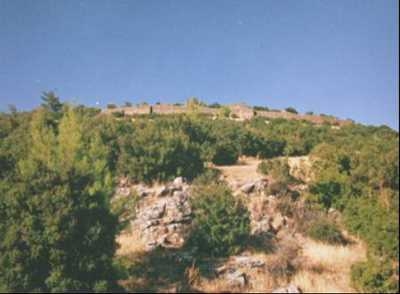
Körteke Kalesi is situated on a high hill known as “Kale Tepe,” northeast of Körteke Village in the Bozdoğan district of Aydın Province, Türkiye. The fortress occupies a commanding position on a rocky and strategic elevation chosen specifically for defensive purposes.
On the rocky hilltop lies an acropolis forming the core of the settlement. Towers are positioned at the eastern and western ends of the settlement, with a cistern constructed between them to meet the water needs of the inhabitants. The southern section of the acropolis is enclosed by a triple-towered inner wall system, dated to the 5th century BCE.
The settlement, located in the Inner Caria region, is classified as one of the Lycian-type hilltop settlements. Such settlements are typically built on high, defensible hills and are distinguished by their strategic positions that allow control over surrounding areas.

Körteke Kalesi(Kültür Portalı)
The settlement area of Körteke Kalesi is considered among the Lycian-type hilltop settlements of Inner Caria, constructed on elevated terrain for defensive purposes. Such settlements were typically built on steep and inaccessible hills to enable surveillance and control of the surrounding landscape. Körteke Kalesi is noted to occupy such a strategically positioned hill.
The remains of the fortress and surrounding settlement are said to hold a significant position within the network of ancient settlements in the region. Research suggests that the site may be linked to the ancient city of XYATİS, mentioned in classical sources and believed to have been located in Inner Caria. This association indicates that the settlement may have functioned as a regional center or defensive outpost during antiquity.
The presence of architectural traces from different periods within the fortress walls and settlement area suggests that the site was used over an extended time span. In particular, the inner wall system surrounding the southern part of the acropolis has been dated to the 5th century BCE. This wall system and the associated towers indicate that the settlement was organized for defensive purposes during the Classical Period.
The historical development of Körteke Kalesi exhibits similarities with other hilltop settlements in Inner Caria. These settlements were generally regarded as strategic centers used both for defense and for controlling nearby routes and inhabited areas. Körteke Kalesi occupies a position from which it could oversee the valleys and transit routes in its vicinity.
Körteke Kalesi is built on a rocky hill that provides natural defensive advantages and exhibits the characteristic layout of a hilltop settlement. The highest point of the site is occupied by the acropolis, which forms the main defensive and residential section of the fortress and is enclosed by a system of walls.
Towers are located at the eastern and western ends of the acropolis. These towers are key components of the fortress’s defensive system, used for surveillance and defense. Between the towers lies a cistern constructed to supply water to the settlement. The cistern is regarded as one of the fundamental architectural elements enabling the long-term occupation of the fortress.
The southern section of the acropolis is surrounded by a triple-towered inner wall system. This wall system has been dated to the 5th century BCE and forms a defensive line that protects the acropolis area, constituting one of the most important architectural components of the fortress.
The architectural layout of Körteke Kalesi shares similarities with other hilltop settlements in Inner Caria. The wall and tower structures are built upon the natural rocky terrain, taking advantage of the topography. This demonstrates that the settlement was planned with a clear defensive orientation.
Körteke Kalesi is located within the boundaries of Bozdoğan district in Aydın Province, near Körteke Village. The fortress is approximately 40 kilometers from the Bozdoğan district center. Due to its elevated position on a hill compared to surrounding settlements, access is possible by road up to a certain point, after which paths leading up the hill must be used.
Access to Körteke Kalesi is achieved by following the road from Bozdoğan district center toward Çamlıdere. After reaching Körteke Village, the fortress is located on Kale Tepe, to the northeast of the village. Due to the high and rocky topography of the area, access to the fortress is made via local paths connecting nearby settlements.

Location and General Features
Historical Features
Architectural Features
Access