


This article was automatically translated from the original Turkish version.

Kotlin is a statically typed programming language developed by JetBrains modern. It was announced on 19 July 2011 and its first stable version was released on 15 February 2016. On 17 May 2017, Google declared Kotlin the official language for Android application development. Kotlin aims to provide versatile usage by supporting not only the Java Virtual Machine (JVM) but also JavaScript and native platforms.
Kotlin stands out particularly for its seamless interoperability with Java. It enables developers to use Kotlin within existing Java projects and combine Java and Kotlin code within the same codebase. This allows leveraging the Java ecosystem while also benefiting from Kotlin’s programming features. As an open source project, Kotlin is continuously developed with support from community.
Kotlin aims to offer a more readable and understandable syntax. Through features such as null safety, data classes, extension functions, coroutines and multi-platform support, it enables the development of mobile, web, desktop and server-side applications to develop.
Type Safety: Kotlin minimizes NullPointerException errors by ensuring null safety. This structure distinguishes between nullable and non-nullable types, allowing deeper analysis of whether a variable can be null. This mechanism includes safe call operator (?.), elvis operator (?:) and the !! operator like.

(Example of safe call operator usage)
Structures That Reduce Code Volume: Kotlin reduces repetitive code by using modern programming techniques such as data classes, lambda expressions and the when expression. Data classes automatically provide methods like toString(), equals() and hashCode(), enabling more readable and efficient code.
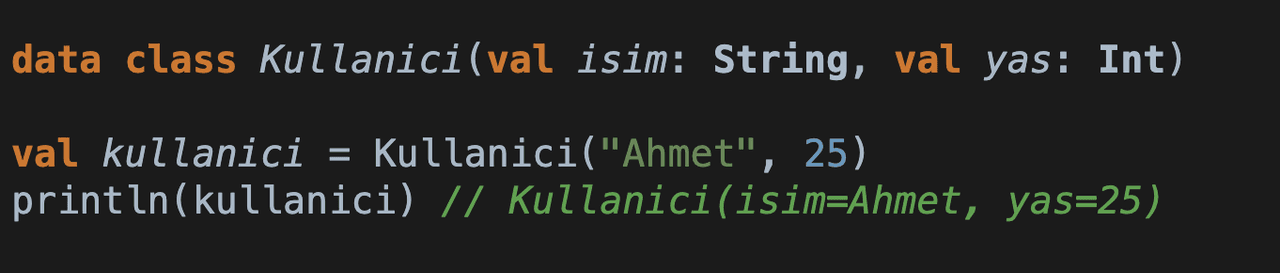
(Example scenario demonstrating improved readability with data class usage)
Interoperability: Kotlin is 100% compatible with Java and both languages can be used together in the same project. Accessing Java classes from Kotlin code or vice versa is possible. This allows projects transitioning to Kotlin to continue using their existing Java codebase without modification.
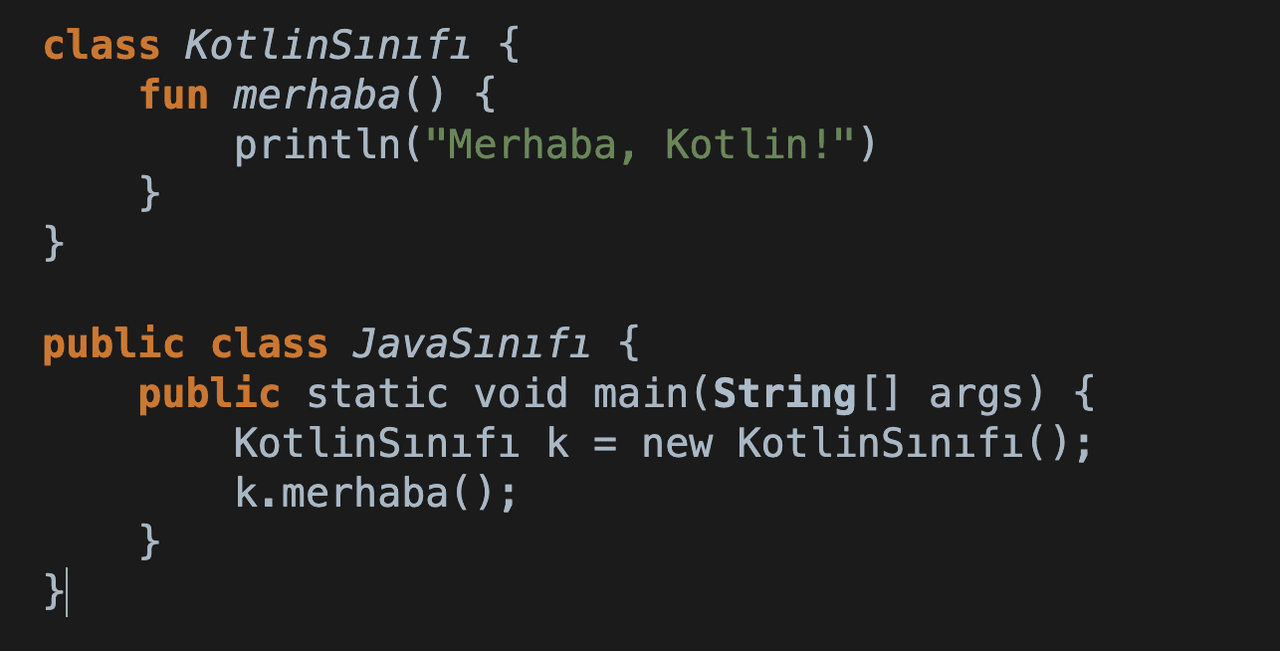
(Example scenario of Kotlin and Java working together)
Extension Functions: Kotlin allows adding new functionality to existing classes without modifying their source code. It is possible to add new methods without access to the original class implementation, thereby reducing code duplication and increasing flexibility opportunity.
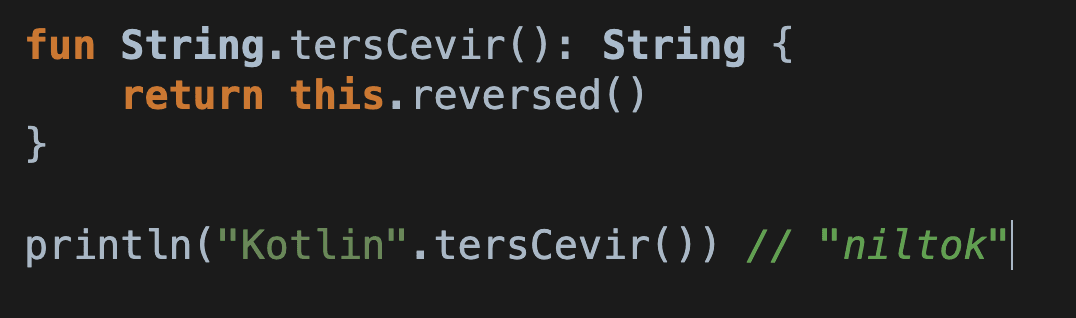
(Example scenario of extension function usage)
Coroutines: Kotlin provides the Coroutines structure for asynchronous programming. Coroutines enable efficient management of threads by executing long-running operations without blocking the main thread. They are especially used for network requests, database operations and delayed tasks main.
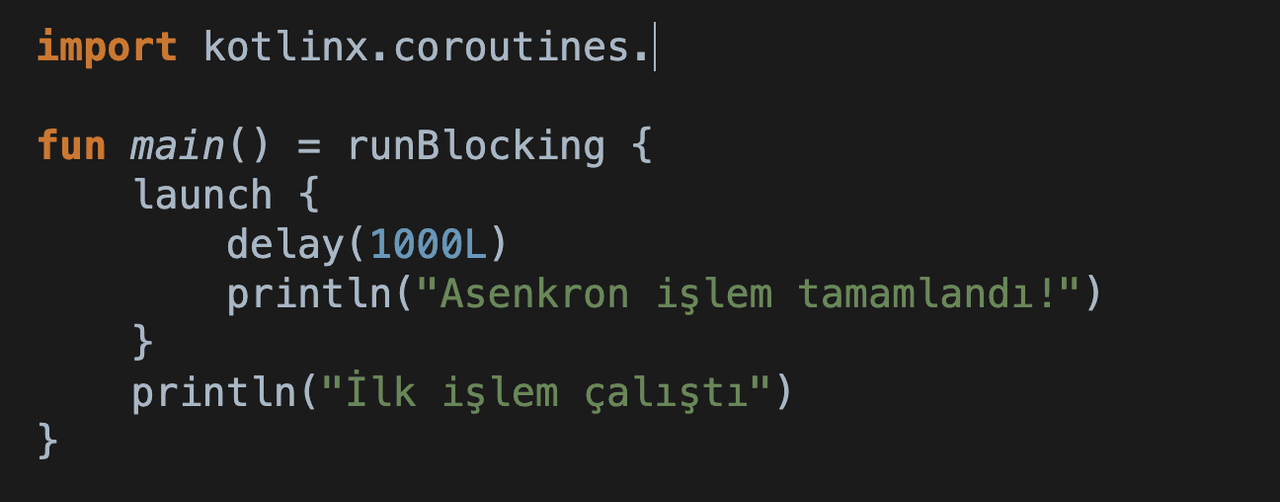
(Example scenario of an asynchronous operation via Coroutines)
Multi-platform Support: As a language capable of running on different platforms, Kotlin enables the development of iOS, web and desktop applications. With Kotlin Multi-platform (KMP), code can be written once and compiled for multiple platforms. This reduces code duplication across operating systems common.
Smart Casts and Type Inference: Kotlin can automatically determine variable types and perform type conversions when appropriate checks are made. For example, after verifying that a variable is of a specific type, it can be used directly as that type without requiring an explicit cast transformation.

(Example scenario eliminating the need for explicit type casting with Smart Casts)
Android Application Development: In 2017, Google announced Kotlin as the official language for Android development. Kotlin includes the Coroutines structure for managing asynchronous operations in Android apps and supports modern UI development through Jetpack Compose. A rich ecosystem exists for Android development library.
Backend Development: Kotlin is used in backend development with frameworks such as Spring Boot and Ktor. Java-based services can be written in Kotlin. Ktor offers a lightweight and flexible framework for microservices, while Spring Boot is a popular choice for large-scale applications. Additionally, it is possible to develop GraphQL APIs and RESTful services using Kotlin.
Web Development: Kotlin can be compiled to JavaScript and used in web development processes. Web applications can be created using Kotlin/JS. Frontend development can be performed alongside frameworks such as Kotlin/React.
Desktop Application Development: Kotlin enables the development of desktop applications using technologies such as JavaFX and TornadoFX. Since it runs on the JVM, cross-platform desktop software development is possible independent.
Multi-platform Development: Kotlin Multi-platform (KMP) allows sharing common business logic between iOS and Android, enabling application development with a single codebase.
Data Science and Machine Learning: Kotlin is used in data science projects with support for Jupyter Notebook and various libraries. The KotlinDL library provides a framework for machine learning applications. Kotlin can be preferred for data processing, big data analysis and artificial intelligence models.
Kotlin is a programming language used across various domains. It has diverse use cases ranging from Android development to backend services, web applications and data science. Its full compatibility with Java makes it possible to integrate into existing projects.
Google. "Kotlin for Android Developers." Accessed January 27, 2025. https://developer.android.com/kotlin
JetBrains. "Kotlin Documentation." Accessed January 27, 2025. https://kotlinlang.org/docs/home.html
JetBrains. "Kotlin Multi-platform Mobile." Accessed January 27, 2025. https://lp.jetbrains.com/kmm-for-crossplatform-developers/
JetBrains. "Kotlin Multi-platform." Accessed January 27, 2025. https://kotlinlang.org/docs/multiplatform.html
JetBrains. "Kotlin Programming Language." Accessed January 27, 2025. https://kotlinlang.org/
JetBrains. "Kotlin/JS Overview." Accessed January 27, 2025. https://kotlinlang.org/docs/js-overview.html
KotlinDL. "KotlinDL Library." Accessed January 27, 2025. https://github.com/Kotlin/kotlindl
Spring. "Spring Boot with Kotlin." Accessed January 27, 2025. https://spring.io/guides/tutorials/spring-boot-kotlin/

No Discussion Added Yet
Start discussion for "Kotlin Programming Language" article
Key Features of Kotlin
Use Cases of Kotlin