

This article is not approved yet.
Krüper's Nuthatch (Sitta krueperi) is a songbird species belonging to the family Sittidae, found only in Türkiye, the southern Caucasus, southwestern Russia, and the Greek island of Lesvos. It is recognized for its medium size, short bill, and strong climbing ability.
Its distribution is mostly restricted to forests of Turkish pine (Pinus brutia) and other conifers. Its diet varies seasonally, feeding on insects, spiders, and conifer seeds. It is a resident species, although altitudinal movements occur depending on the season. The International Union for Conservation of Nature (IUCN) has classified it as a species of Least Concern.

Krüper's Nuthatch (pixabay)
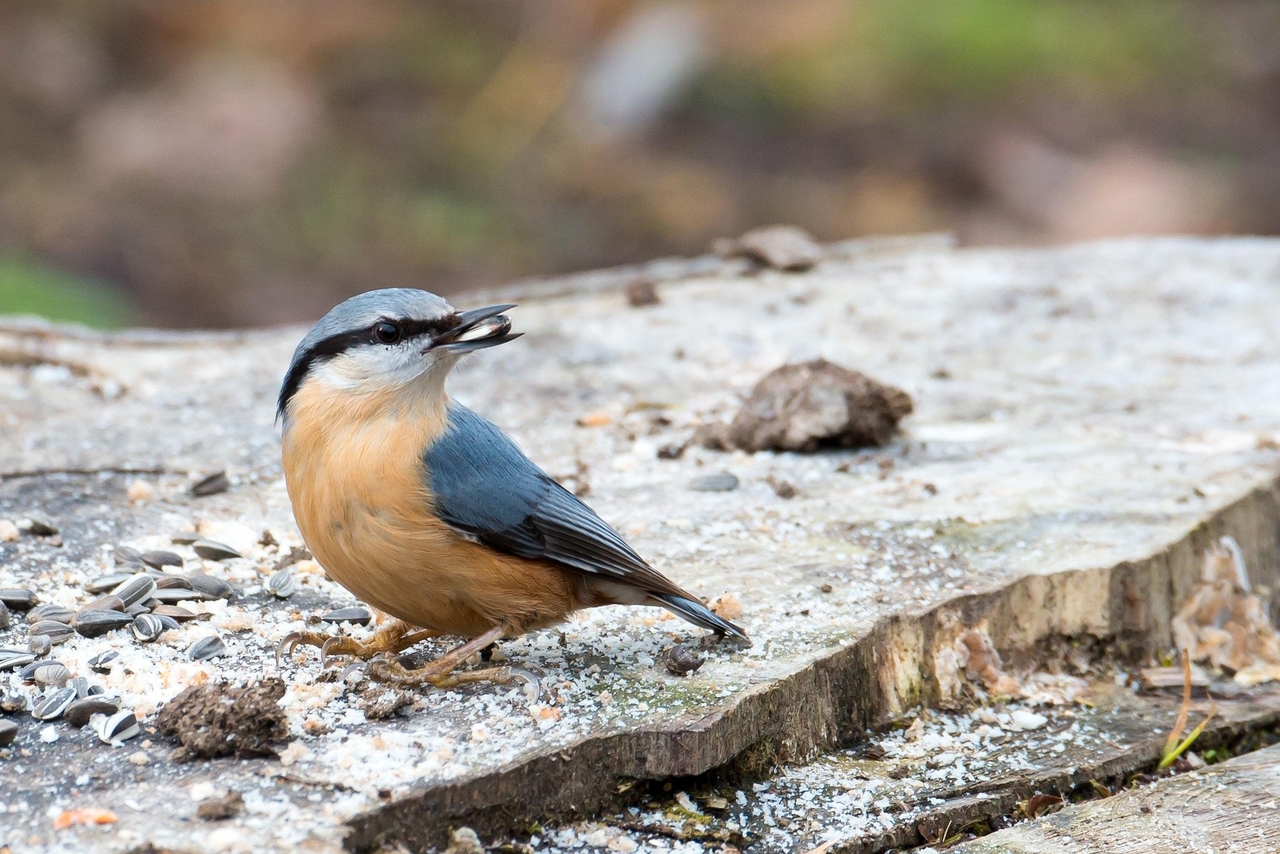
Krüper's Nuthatch is about 12–13 cm long, weighing 10–14 g, and is a medium-sized nuthatch. In males, the forehead is glossy black with a bluish sheen; from this area, a white supercilium extends toward the nape. A distinct black line runs across the eye. The back, wing coverts, and tail feathers are bluish-grey; wing flight feathers are darker, edged with paler bluish-grey.
The outer tail feathers show bluish-grey and white areas near the tips. The cheeks, throat, and sides of the neck are white. In the middle of the breast is the species’ distinctive feature: a reddish-chestnut patch. The sides of the breast and belly are grey, fading to dirty white or brownish tones on the lower belly and undertail coverts. The undertail coverts are chestnut with whitish tips. The bill is dark horn-colored with a grey-blue base; the eyes are dark chestnut or brown, surrounded by a fine white eye-ring. Legs are dark grey or brownish.
Females resemble males but the black on the forehead is duller and less distinct toward the rear; the breast patch is paler and more orange-rufous. Juveniles lack the black forehead, have duller upperparts, and a faint, pale breast patch. The bill is dark horn-colored, with a pinkish base to the lower mandible and yellowish gape.
Krüper’s Nuthatch is a regionally endemic species with a restricted geographical range. It occurs across much of Türkiye, particularly in the western, southern, and northern mountain belts; on the island of Lesvos in Greece; in southwestern Russia (Krasnodar region, northwestern Caucasus); and in northern Georgia.
Its habitat is primarily limited to coniferous forests. In Türkiye, it inhabits Turkish pine (Pinus brutia) forests at lower elevations; and at higher altitudes, fir (Abies), spruce (Picea), black pine (Pinus nigra), cedar (Cedrus libani), and occasionally juniper (Juniperus) stands. On Lesvos, it is closely associated with Turkish pine, but may also nest in nearby broad-leaved trees if available. In the Caucasus, it is most abundant in fir and spruce forests, mixed beech–fir (Fagus–Abies) stands, and, though less frequently, in maple (Acer) groves.
Altitudinal distribution varies across its range. In Türkiye, it is found mostly between 500–1000 m, occasionally near sea level, up to 1700 m in Uludağ, and as high as 2500 m in the Taurus Mountains. On Lesvos, it occurs between 200–700 m, descending to sea level in winter. In the Caucasus, it generally inhabits 1000–2000 m, but has been recorded as low as 150 m along the Black Sea coast.

Distribution Map (IUCN Red List)
The diet of Krüper’s Nuthatch varies seasonally. During the breeding season, it feeds mainly on insects, larvae, and spiders; nestlings are raised exclusively on animal matter. In autumn and winter, the primary food source shifts to conifer seeds, particularly those of Turkish pine (Pinus brutia) as well as other pine, fir, and spruce species.

Krüper's Nuthatch (pixabay)
Foraging usually takes place among fine branches, cones, and tree trunks. The bird inserts its bill tip between cone scales to extract seeds, which it often stores by wedging them into bark crevices or hidden cracks. These food caches become especially important during wet and cold periods when cones remain closed. Occasionally, it forages on the ground and rarely catches flying insects. Outside the breeding season, individuals feed alone or in small groups, and in winter they may join mixed-species flocks.

Krüper's Nuthatch (pixabay)
The breeding season of Krüper’s Nuthatch begins between mid-April and mid-May, depending on region and elevation. The species is monogamous, and pairs defend their nesting territory vigorously. Nest sites are usually tree cavities in the trunks or thick branches of conifers; sometimes the female cleans out or enlarges an existing cavity, and only rarely excavates a new one. The nest foundation is built with coarse bark flakes, cone scales, and decayed wood, lined with moss, plant fibers, feathers, and hair.
The clutch consists of 5–7 eggs, dirty white with reddish or purplish markings. Only the female incubates, for about 14–17 days, while the male occasionally feeds her. Chicks are initially fed by the female, and later by both parents with insects and spiders. The fledging period ranges from 16–22 days.
Nest-site selection is strongly tied to mature coniferous trees. The removal of dead trees or the loss of cavity-bearing trees has a direct negative impact on the species’ breeding success.
Krüper’s Nuthatch is a notably vocal species. In alarm or agitation, it utters sharp, hissing-like notes such as a short “cha” or “sharr”; as excitement increases, these calls accelerate into a harsh, rasping series. In flight, a nasal, short “tsek” call is typical. Softer contact calls include a “pwit” and a finch-like “dui” or “doid.”
Although vocalizations are heard year-round, singing is most frequent in spring. The typical song is a sharp, wavering trill lasting 4–8 seconds, repeated at a rate of about eight notes per second, often perceived as “pip-pip-pip…” or “vit-vit-vit…”. In a more complex form, the song consists of repeated paired syllables, high-pitched and resonant, such as “yu-di, yu-di…” or “vika-vika…”. Songs are primarily used in territorial defense or mate communication.
Song Call (xeno-cento)
Krüper’s Nuthatch (Sitta krueperi) is globally classified as Least Concern by the International Union for Conservation of Nature (IUCN). The total population is estimated at 120,000–450,000 pairs, the majority of which are found in Türkiye. A small but stable colony persists on the island of Lesvos in Greece, while populations in the Caucasus and Russia are more limited and irregular.
Between 1990 and 2000, declines exceeding 20% were reported in the largest populations in Türkiye and Russia, with the decrease in Türkiye continuing between 2000 and 2012. By contrast, the population on Lesvos has remained relatively stable. The main threats to the species include increasing tourism and holiday housing developments in coastal areas, destruction of mature coniferous forests, logging of large trees for resin extraction, and forest fires. In the Caucasus, the felling of old fir and spruce forests directly affects breeding habitats.
The species is listed in Annex I of the EU Birds Directive and Appendix II of the Bern Convention. It is also recognized as threatened in the Red Data Books of both Türkiye and Greece. Key conservation measures include safeguarding the continuity of mature coniferous forests, preserving dead trees in forest management, and limiting habitat loss caused by tourism.

Morphological Characteristics
Distribution and Habitat
Feeding
Breeding
Voice and Song
Conservation Status
This article was created with the support of artificial intelligence.