


This article was automatically translated from the original Turkish version.
+1 More
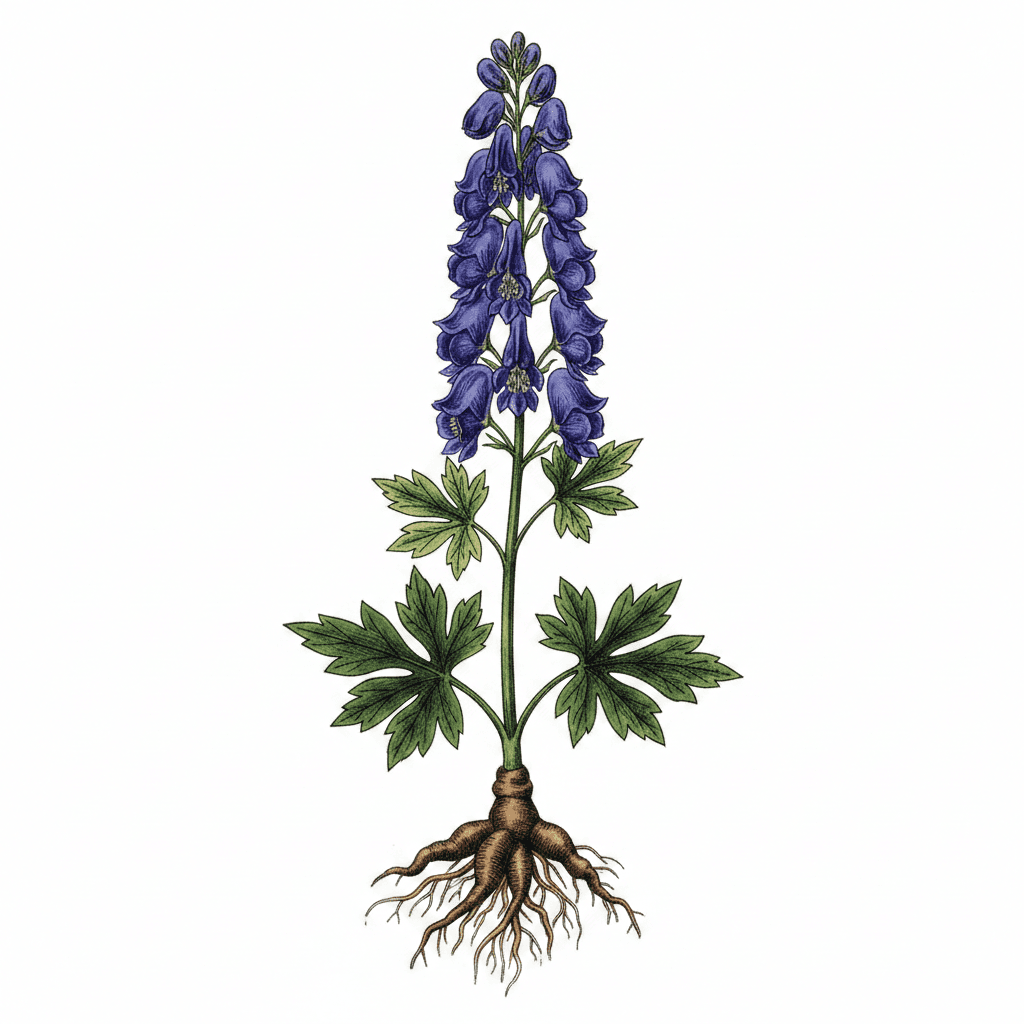
Kurtboğan
(Yapay Zekayla Oluşturulan Görsel)
Kurtboğan (Aconitum napellus), Ranunculaceae (Buttercup family) is a perennial plant species known in folk tradition as “kurtboğan,” “miğfer otu,” or “queen of poisons.” In botanical literature, the genus Aconitum is divided into three subgenera: Gymnaconitum, Lycoctonum, and Aconitum. A. napellus belongs to the subgenus Aconitum, which is characterized by biennial paired tuberous roots, unlike Lycoctonum, which has perennial rhizomes. This genus comprises approximately 324 accepted species worldwide, primarily distributed in the cool regions of the Northern Hemisphere, especially in mountainous areas of Europe, Asia, and North America. Historically, the plant has been cultivated as an ornamental and also used as an arrow poison in hunting due to its high toxicity.【1】

Kurtboğan (Aconitum napellus) Stem and Flower
Examination of the plant’s external structure reveals a tall, upright, and smooth stem that can reach up to two meters in height. The leaves are alternately arranged along the stem and typically consist of three or five lobed segments. Flowering occurs between May and July; the flowers are blue or purple, bilaterally symmetrical, and arranged in a raceme.
The most distinctive feature of the flowers is the upper sepal, which forms a helmet or hood-like structure. The underground tuberous roots are 4–10 cm long and obconic (inverted cone-shaped); a star-shaped tissue region (cambium) is clearly visible in cross-section. Ecologically, A. napellus prefers moist, nutrient-rich, and slightly acidic soils at elevations ranging from sea level to 3,000 meters.
Aconitum napellus’s pharmacological and toxicological effects are determined by secondary metabolites known as diterpenoid alkaloids. All parts of the plant are toxic, but the toxic compounds accumulate most densely in the roots and seeds.
The primary toxic component is aconitine, isolated in 1833. Other major toxic constituents include mesaconitine and hypaconitine, which are diester diterpenoid alkaloids (DDAs). These alkaloids exhibit high biological activity due to ester linkages in their chemical structure. In addition, flavonoid glycosides such as quercetin and kaempferol derivatives, which show antioxidant properties, as well as aconitic acid, an organic acid, have been identified in the floral parts.
The plant’s poisoning mechanism is explained by the direct effect of its alkaloids on voltage-gated sodium channels in cell membranes. Aconitine binds to the alpha subunit of sodium channels, causing them to remain persistently open and preventing inactivation. This results in excessive intracellular sodium accumulation and permanent depolarization of the cell. In cardiac muscle cells, this ion imbalance triggers calcium overload, leading to fatal cardiac arrhythmias. The lethal dose in humans is estimated to be between 1 and 6 mg. Symptoms of poisoning begin immediately after ingestion with a burning or tingling sensation in the mouth, tongue, and throat, followed by nausea, severe pain, muscle paralysis, respiratory distress, and ultimately cardiac arrest.
In traditional systems such as Chinese medicine and Ayurveda, Aconitum species have been used for thousands of years to treat rheumatism, joint pain, and certain infections. However, for medical use, the plant must undergo special detoxification procedures known as Paozhi. These processes involve prolonged boiling, steaming, or treatment with salt water or milk. Thermal processing hydrolyzes the highly toxic diester alkaloids into less toxic monoester alkaloids, such as benzoylaconine.
There is no specific antidote for aconitine poisoning in clinical practice; therefore, treatment is largely supportive. Primary interventions include gastric lavage, administration of activated charcoal, and electrolyte monitoring. For control of cardiac arrhythmias, antiarrhythmic drugs such as amiodarone or hemoperfusion may be employed.【2】
Warning: The content presented here is for general encyclopedic information only. These details must not be used for diagnosis, treatment, or medical advice. Always consult a physician or qualified healthcare professional before making any health-related decisions. The author and KÜRE Encyclopedia assume no responsibility for any consequences arising from the use of this information for diagnostic or therapeutic purposes.
Been, Anita. “Aconitum: Genus of Powerful and Sensational Plants.” *Pharmacy in History* 34, no. 1 (1992): 35–39. Accessed February 11, 2026. http://www.jstor.org/stable/41111425
Chan, Y. T., N. Wang, and Y. Feng. “The Toxicology and Detoxification of Aconitum: Traditional and Modern Views.” *Chinese Medicine* 16, no. 1 (2021): 61. Accessed February 11, 2026. https://doi.org/10.1186/s13020-021-00472-9
Gruendercoach. “Çiçek, düğün çiçeği, Aconitum napellus.” Photograph. Pixabay, September 23, 2024. Accessed February 11, 2026. https://pixabay.com/tr/photos/%c3%a7i%c3%a7ek-d%c3%bc%c4%9f%c3%bcn-%c3%a7i%c3%a7e%c4%9fi-aconitum-napellus-9062141/
Hans. “Mavi demir şapka, Akonitum napellus, Doğa görseli.” Photograph. Pixabay. Accessed February 11, 2026. https://pixabay.com/tr/photos/mavi-demir-%c5%9fapka-akonitum-napellus-8798/
Laínz, Manuel. “Aconitum Napellus.” *Taxon* 20, no. 4 (1971): 651–651. Accessed February 11, 2026. https://doi.org/10.2307/1218292
Ward, T. Ogier. “Cases Of Poisoning By Monkshood (Aconitum Napellus).” *The British Medical Journal* 2, no. 205 (1860): 939–40. Accessed February 11, 2026. http://www.jstor.org/stable/25196583
Yeshi, Karma, and Phurpa Wangchuk. “Aconitum napellus (Monkshood).” In *Exploring Poisonous Plants*, 101–112. Boca Raton, FL: CRC Press, 2023. Accessed February 11, 2026. https://doi.org/10.1201/b23017-8
[1]
Yeshi, Karma ve Phurpa Wangchuk. “Aconitum napellus (Monkshood).” In Exploring Poisonous Plants, 101–112. Boca Raton, FL: CRC Press, 2023, erişim 11 Şubat 2026, https://doi.org/10.1201/b23017-8
[2]
Chan, Y. T., N. Wang ve Y. Feng. “The Toxicology and Detoxification of Aconitum: Traditional and Modern Views.” Chinese Medicine 16, no. 1 (2021): 61, erişim 11 Şubat 2026, https://doi.org/10.1186/s13020-021-00472-9

Kurtboğan
(Yapay Zekayla Oluşturulan Görsel)
No Discussion Added Yet
Start discussion for "Kurtboğan (Aconitum napellus)" article
Morphological Structure and Ecological Distribution
Phytochemical Composition and Alkaloid Profile
Toxicological Mechanism and Symptoms
Traditional Use, Detoxification, and Clinical Management