

This article was automatically translated from the original Turkish version.
+2 More
Status(es) | UNESCO World Heritage Site (1993) | ||||||||
|---|---|---|---|---|---|---|---|---|---|
Developer(s) | Shamsuddin Iltutmish | ||||||||
Founder(s) | Qutbuddin Aibak | ||||||||
Legal Protection | Ancient Monuments and Archaeological Sites and Remains Act | ||||||||
Protective Institution | Archaeological Survey of India | ||||||||
Restoration and Additions | Firuz Shah Tughluq | ||||||||
Construction Start | 1193 | ||||||||
Purpose of Construction | Victory Tower / Symbol of Muslim dominance | ||||||||
Architectural Period | Indo-Islamic Architecture (Early Period) | ||||||||
Material(s) | Red Sandstone White Marble | ||||||||
Location | New Delhi Türkiye Mehrauli | ||||||||
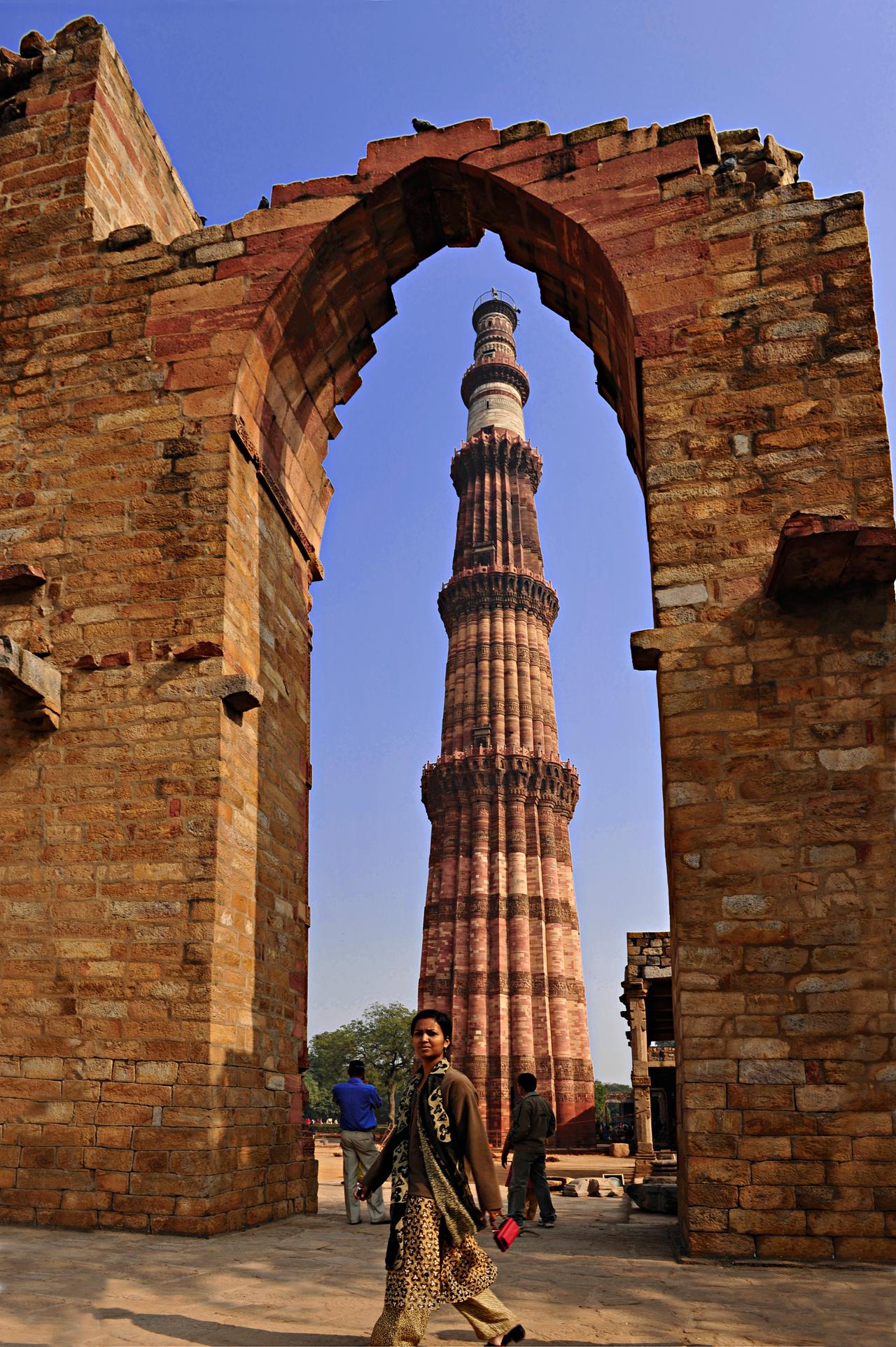
Rising at the heart of the ensemble of monuments representing the origins and development of Indo-Islamic architecture, this minaret is a victory tower from the early period of the Delhi Sultanate. Together with the surrounding structures, the area is known as the “Qutub Minar and Monuments.” The minaret itself holds the distinction of being the tallest stone tower in both Delhi and India, standing at a height of 72.59 meters.
Construction of the minaret began in 1193 under the orders of Qutbuddin Aibak, the Ghurid ruler who conquered Delhi and founded the Delhi Sultanate, as a symbol of the Muslim victory in India. The construction process, marked by contributions and repairs by successive sultans, spanned approximately 200 years before reaching its current five-story form.【1】 Initially, the minaret had no specific name; it came to be known by this name following the death of the Chishti Sufi saint Kutbuddin Bakhtiyar Kaki.【2】 Unlike square-plan minarets in the West, the structure is regarded as an advanced example of the circular-plan, thick, and tall victory minaret tradition developed in Central Asia by the Karakhanids, Ghaznavids, and Ghurids.

Qutub Minar behind the Alai Darwaza (Flickr)
The construction and evolution of the Qutub Minar were shaped by the contributions of four significant rulers of the Delhi Sultanate:
Aibak, the founder of the minaret, initiated construction in 1192 and completed only the ground floor.【3】 Its location immediately south of the Quwwat-ul-Islam Mosque, whose foundations he laid, demonstrates that the structure served not only as a call to prayer for the mosque’s muezzin but also as a political and symbolic monument of victory.
Iltutmish, Aibak’s successor and son-in-law, added three more stories to complete the minaret as a four-story structure.【4】 With these additions, the minaret remained positioned in the southwest corner of the southern outer courtyard of the mosque. The stories added during his reign exhibit characteristics of early Indo-Islamic architecture.
Khalji initiated construction of a second minaret, the Alai Minar, intended to surpass the Qutub Minar in size. He also commissioned the construction of the Alai Darwaza within the complex.【5】
In 1369, lightning struck the minaret and damaged the fourth story, necessitating repairs under Tughluq’s rule.【6】 During restoration, the damaged fourth story was repaired and an additional story was added, bringing the total to five. The stories added by Tughluq were constructed largely with white marble, differing from the earlier levels.
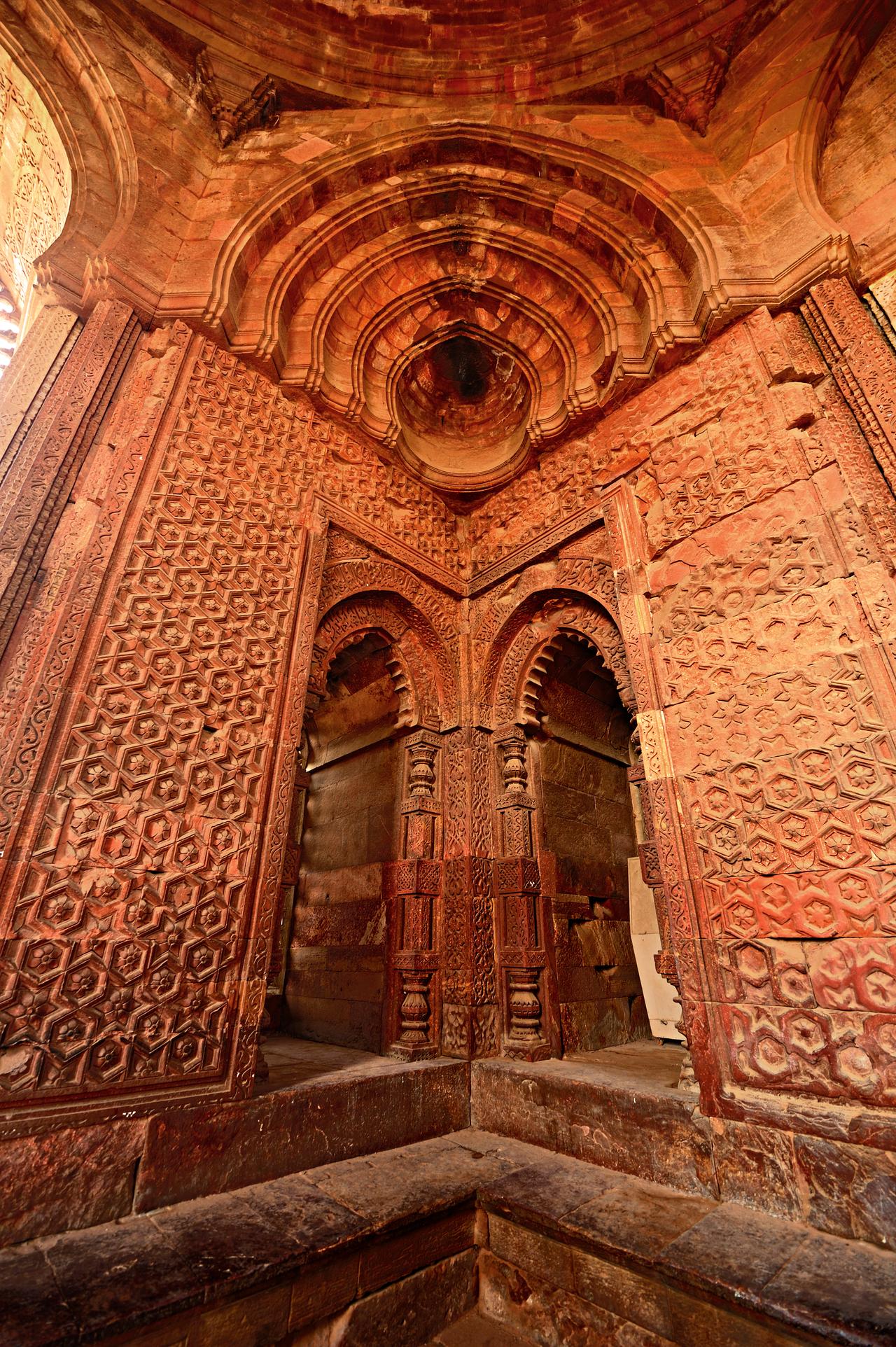
Red Carved Sandstone Built by Turkish Artisans (Flickr)
The Qutub Minar is a freestanding, five-story structure that tapers gradually from a base diameter of 14.42 meters to a top diameter of 2 meters. Its current total height is 72.59 meters. Between each story are projecting balconies adorned with muqarnas and inscribed bands.【7】
The first three stories, constructed in the early period, are built of red sandstone. During the restoration and additions under Firuz Shah Tughluq, the fourth and fifth stories incorporated more white marble alongside sandstone to enhance the architectural aesthetics.
The shaft is encircled by geometric and floral ornamentation, along with inscriptive bands written in Arabic and Nagari scripts.【8】 These inscriptions include verses from the Qur’an and serve as important historical records detailing the construction and restoration history of the minaret, naming its builders such as Aibak, Iltutmish, Tughluq, and Ibrahim Lodi.
The Qutub Minar has a circular shaft, but its exterior is animated by vertical flutes and ridges that vary in design on each level. Particularly on the first story, angular and rounded flutes alternate, reflecting the experimental approaches of early Indo-Islamic architecture.
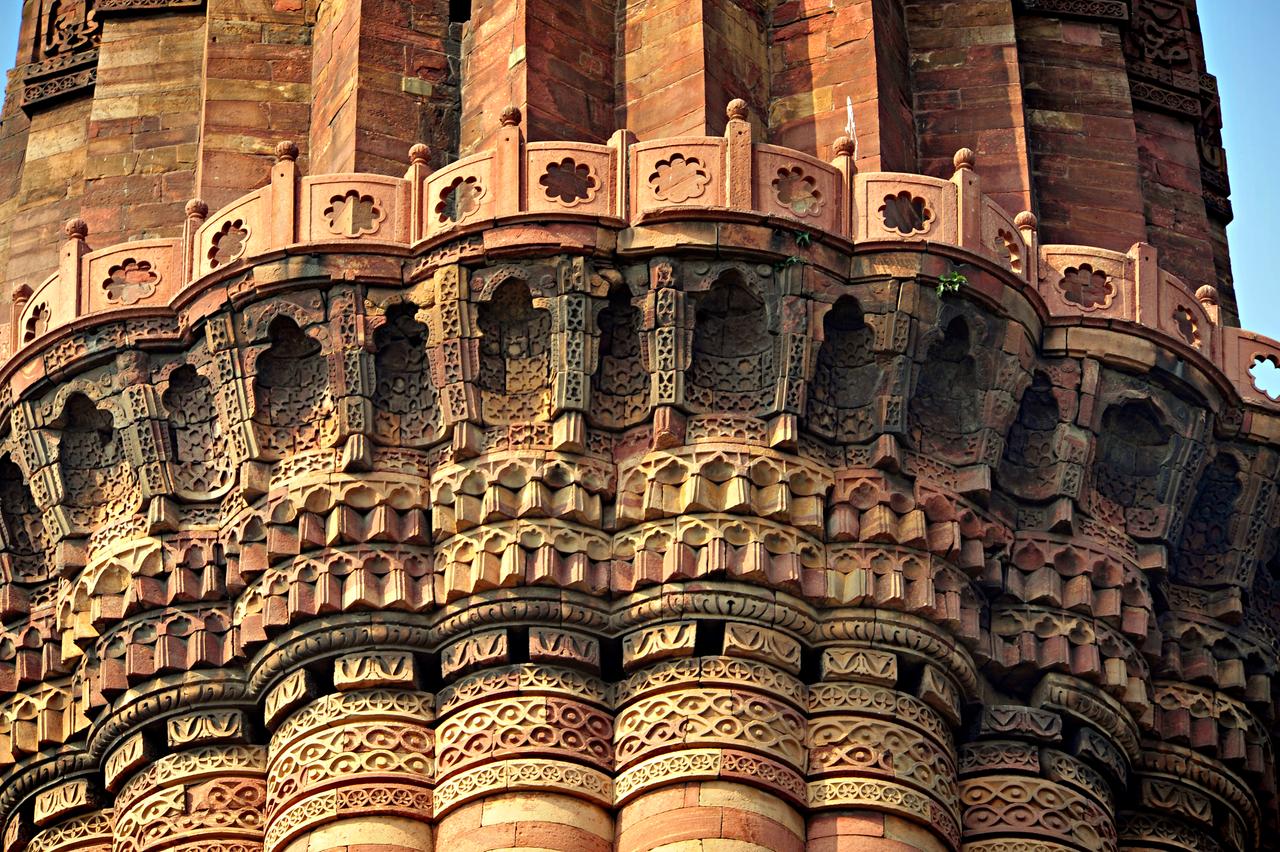
Muqarnas or Corbel Bracket Between the First and Second Stories of Qutub Minar in New Delhi (Flickr)
The Qutub Minar is situated within a vast archaeological area surrounded by significant structures from the earliest Muslim settlement in India:
The first large mosque built in India and the earliest example of Indo-Islamic architecture, it was commissioned by Qutbuddin Aibak in 1198. The mosque’s construction reused columns and architectural elements from 27 demolished Hindu and Jain temples.【9】
Constructed in 1235 for Sultan Shamsuddin Iltutmish, this tomb marks the beginning of the tradition of royal mausoleums in India. A simple square chamber built of red sandstone, its interior is entirely carved with geometric and arabesque inscriptions associated with the Saracen tradition.
Another tomb within the Qutub complex, the Tomb of Imam Zamin is a small structure from the Mughal period, built in the 16th century for Imam Zamin, a prominent religious figure of the era.
Constructed in 1311 by Alaeddin Khalji as the southern gateway to the Quwwat-ul-Islam Mosque, this structure is recognized as the first Indo-Islamic building to fully employ Islamic architectural and decorative principles.【10】
A partially completed minaret initiated by Alaeddin Khalji with the intention of doubling the height of the Qutub Minar. Only the first story, reaching a height of 25 meters, was finished.
Located in the mosque courtyard, this pillar dates to the 4th century and bears an inscription in Sanskrit written in the Brahmi script.

Jain Temple Architrave on Columns of the Quwwat-ul-Islam Mosque (Flickr)
The Qutub Minar and Monuments Complex was inscribed on the UNESCO World Heritage List in 1993.
It was listed under the criterion of being “an outstanding example of a type of building, architectural or technological ensemble or landscape which illustrates a significant stage in human history.”【11】 The religious and funerary structures here represent an exceptional example of the architectural and artistic achievements of early Islamic India. The site’s state of conservation is stable. The structure, its location, forms, designs, materials, and essence remain essentially authentic. All restoration work has respected the original architectural and decorative systems, ensuring the preservation of its “Outstanding Universal Value.”

Current Condition of the Qutub Minar (Flickr)
The minaret has suffered various natural disasters throughout its history. The most significant was the 1369 lightning strike that damaged the fourth story. In response, Firuz Shah Tughluq undertook repairs in 1368, restoring the damaged fourth story and adding an additional story to make the minaret five stories tall.【12】 Its dome was later destroyed by an earthquake, yet the minaret survived two major earthquakes. Major R. Smith restored the minaret in 1829.【13】 Today, the Qutub Minar and Monuments Complex is owned by the Government of India and managed by the Archaeological Survey of India (ASI). The structure is protected under the Ancient Monuments and Archaeological Sites and Remains Act (1958), with annual funding allocated for its general preservation, maintenance, and management.【14】
Anadolu Ajansı. "Hindistan'da kutlu bir minare: Kutub Minar." Accessed December 5, 2025. https://www.aa.com.tr/tr/kultur-sanat/hindistanda-kutlu-bir-minare-kutub-minar/2081065
Archaeological Survey of India. "Qutb Minar." *Archaeological Survey of India*. Accessed December 5, 2025. https://asi.nic.in/pages/WorldHeritageQutbMinar
BBC. "Kutub Minar: Hindistan'ın en yüksek minaresi neden mahkemeye düştü?." BBC. Accessed December 5, 2025. https://www.bbc.com/news/world-asia-india-61509282
Islam Encyclopedia. "KUTUB MİNÂR." Islam Encyclopedia. Accessed December 5, 2025. https://islamansiklopedisi.org.tr/kutub-minar
TRT Haber. "Hindistan'da Müslümanlığın sembolü: Kutub Minar." Accessed December 5, 2025. https://www.trthaber.com/haber/kultur-sanat/hindistanda-muslumanligin-sembolu-kutub-minar-374275.html
UNESCO. "Qutb Minar and its Monuments." *UNESCO World Heritage Centre*. Accessed December 5, 2025. https://whc.unesco.org/en/list/233/
gençrobv. "Hindistan Yeni Delhi DSC_5822." *Flickr*. Accessed December 5, 2025. https://www.flickr.com/photos/youngrobv/3330149847/in/photostream/
gençrobv. "Hindistan Yeni Delhi _D7C1994" Flickr. Accessed December 5, 2025. https://www.flickr.com/photos/youngrobv/3331064136/in/photostream/
gençrobv. "Hindistan Yeni Delhi _D7C2008." Flickr. Accessed December 5, 2025. https://www.flickr.com/photos/youngrobv/3330999718/in/photostream/
gençrobv. "Hindistan Yeni Delhi _D7C2032." Flickr. Accessed December 5, 2025. https://www.flickr.com/photos/youngrobv/3330154869/in/photostream/
gençrobv. "Hindistan Yeni Delhi _D7C2034" Flickr. Accessed December 5, 2025. https://www.flickr.com/photos/youngrobv/3331019986/in/photostream/
gençrobv. "Hindistan Yeni Delhi _D7C2036" Flickr. Accessed December 5, 2025. https://www.flickr.com/photos/youngrobv/3330175931/in/photostream/
[1]
Anadolu Ajansı, "Hindistan'da kutlu bir minare: Kutub Minar," Anadolu Ajansı, erişim 5 Aralık 2025, https://www.aa.com.tr/tr/kultur-sanat/hindistanda-kutlu-bir-minare-kutub-minar/2081065
[2]
İslam Ansiklopedisi, "KUTUB MİNÂR," İslam Ansiklopedisi, erişim 5 Aralık 2025, https://islamansiklopedisi.org.tr/kutub-minar
[3]
İslam Ansiklopedisi, "KUTUB MİNÂR," İslam Ansiklopedisi, erişim 5 Aralık 2025
[4]
Archaeological Survey of India, "Qutb Minar," Archaeological Survey of India, erişim tarihi: 5 Aralık 2025, https://asi.nic.in/pages/WorldHeritageQutbMinar
[5]
İslam Ansiklopedisi, "KUTUB MİNÂR," İslam Ansiklopedisi, erişim 5 Aralık 2025
[6]
İslam Ansiklopedisi, "KUTUB MİNÂR," İslam Ansiklopedisi, erişim 5 Aralık 2025
[7]
İslam Ansiklopedisi, "KUTUB MİNÂR," İslam Ansiklopedisi, erişim 5 Aralık 2025
[8]
Archaeological Survey of India, "Qutb Minar," Archaeological Survey of India, erişim tarihi: 5 Aralık 2025
[9]
Archaeological Survey of India, "Qutb Minar," Archaeological Survey of India, erişim tarihi: 5 Aralık 2025
[10]
UNESCO, "Qutb Minar and its Monuments," UNESCO World Heritage Centre, erişim tarihi: 5 Aralık 2025, https://whc.unesco.org/en/list/233/
[11]
UNESCO, "Qutb Minar and its Monuments," UNESCO World Heritage Centre, erişim tarihi: 5 Aralık 2025
[12]
İslam Ansiklopedisi, "KUTUB MİNÂR," İslam Ansiklopedisi, erişim 5 Aralık 2025
[13]
Archaeological Survey of India, "Qutb Minar," Archaeological Survey of India, erişim tarihi: 5 Aralık 2025
[14]
UNESCO, "Qutb Minar and its Monuments," UNESCO World Heritage Centre, erişim tarihi: 5 Aralık 2025


Status(es) | UNESCO World Heritage Site (1993) | ||||||||
|---|---|---|---|---|---|---|---|---|---|
Developer(s) | Shamsuddin Iltutmish | ||||||||
Founder(s) | Qutbuddin Aibak | ||||||||
Legal Protection | Ancient Monuments and Archaeological Sites and Remains Act | ||||||||
Protective Institution | Archaeological Survey of India | ||||||||
Restoration and Additions | Firuz Shah Tughluq | ||||||||
Construction Start | 1193 | ||||||||
Purpose of Construction | Victory Tower / Symbol of Muslim dominance | ||||||||
Architectural Period | Indo-Islamic Architecture (Early Period) | ||||||||
Material(s) | Red Sandstone White Marble | ||||||||
Location | New Delhi Türkiye Mehrauli | ||||||||
History and Construction Process
Builders and Ruling Periods
Qutbuddin Aibak
Shamsuddin Iltutmish
Alaeddin Khalji
Firuz Shah Tughluq
Architectural Features
Qutub Minar Complex and Surrounding Structures
Quwwat-ul-Islam Mosque
Tomb of Iltutmish
Tomb of Imam Zamin
Alai Darwaza
Alai Minar
Iron Pillar
UNESCO World Heritage Status
Damage, Restorations, and Conservation Efforts