


This article was automatically translated from the original Turkish version.
+1 More
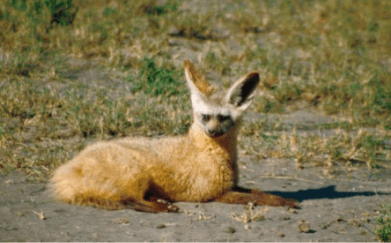
İri Kulaklı Tilki
Large-eared Fox (Otocyon megalotis) is a small canid species native to eastern and southern Africa, known for its exceptionally large ears that can exceed 13 centimeters in length. These striking ears enhance its acute hearing to detect underground insects and play a vital role in thermoregulation. Adapted to arid and semi-arid savanna ecosystems, this species is distinctly different from other fox species in both feeding behavior and morphology (e.g. Vulpes chama, Vulpes rueppellii).

Large-eared Fox (Otocyon megalotis)(ResearchGate)
Large-eared foxes have a sandy gray coat; the underparts are lighter, while the areas around the eyes, muzzle, backs of the ears, feet, and the tip of the long, bushy tail are darker. Body length ranges from 46 to 66 centimeters, and weight varies between 3 and 5.4 kilograms.
The most distinctive feature of the species is its large ears, which aid in heat dissipation to keep the animal cool and provide exceptional hearing sensitivity. Unlike other mammals and fox species, it possesses over 50 high-crowned teeth. A specialized projection on the lower jaw provides attachment points for powerful muscles used to rapidly crush insects.

Geographic Distribution of Subspecies of the Large-eared Fox(ResearchGate)
It occurs in two distinct populations: one in eastern Africa (from Ethiopia and Sudan to Tanzania) and another in southern Africa (from Angola to South Africa). It prefers short-grass savannas, scrublands, and dry grasslands. It inhabits complex, multi-entrance burrows that it digs itself or takes over from other animals such as aardvarks.
Its diet consists of 70 to 80 percent harvester termites. It also feeds on dung beetles, grasshoppers, scorpions, spiders, small rodents, lizards, fruits, and eggs. It locates prey by lowering its nose to the ground and erecting its ears to listen for insect movements beneath the soil. It is often found near large mammal herds, as their dung attracts the dung beetles that form its primary food source.
It typically lives in family groups of two to five individuals. It shows tolerance for overlapping territories and can occur at high densities in certain areas. It communicates using ear and tail movements along with various soft whistling sounds. Its activity patterns vary according to termite activity and temperature; in southern Africa, it may be nocturnal in summer and diurnal in winter.

Large-eared Fox (Otocyon megalotis)(Generated by Artificial Intelligence)
It generally leads a monogamous life. Gestation lasts 60 to 75 days, and a litter may contain up to six pups. The male fox (father) plays an active role in pup care, guarding them, playing with them, grooming them, and teaching them to hunt. Pups emerge from the den at 8 to 12 days old and are fully grown by approximately six months of age.
The large-eared fox is listed as Least Concern on the IUCN Red List. Although it is sometimes hunted for its fur or killed due to the mistaken belief that it harms domestic animals, it remains widespread across southern and eastern Africa. In captivity, it can live up to 13 to 14 years.

İri Kulaklı Tilki
No Discussion Added Yet
Start discussion for "Large-eared Fox (Otocyon megalotis)" article
Physical Characteristics
Habitat and Distribution
Feeding Habits
Social Behavior and Life Cycle
Reproduction and Pup Care
Conservation Status