

This article was automatically translated from the original Turkish version.
Lazarus reflex, is a rare, complex spinal reflex movement observed in patients diagnosed with brain death. This phenomenon is characterized by motor movements in which the patient raises their arms and crosses them over the chest. It occurs due to the persistence of neural activity in the spinal cord despite irreversible loss of brainstem function.
The Lazarus reflex was first described in the medical literature in 1984 by Ropper. The term is derived from the biblical figure Lazarus, whom Jesus raised from the dead, reflecting the resemblance of this movement to a body previously deemed dead exhibiting motion. Medically, this condition is an automatic spinal response occurring in cases of brain death, where brainstem reflexes and spontaneous respiration have completely ceased, yet spinal cord neurons remain functional.【1】

Visual representation of the Lazarus reflex (generated by artificial intelligence)
The underlying mechanism of this reflex is associated with the disruption of neural connections between the brain and spinal cord. It is believed to occur due to conditions such as hypoxia (oxygen deficiency) and hypotension (low blood pressure), which sever supraspinal inhibition. Under normal conditions, spinal reflex arcs are suppressed by the brain; when this inhibition is removed (disinhibition), these reflexes may become active. This occurs during a window in which brainstem functions have ceased but spinal neurons remain active.
The Lazarus reflex presents as a dramatic and complex sequence of movements when observed externally. Its typical features include:【2】
Movement Pattern: The patient raises their arms upward, may straighten their shoulders and head from the bed (by approximately 20 cm), and crosses their arms over the chest.
Duration: Following the movement, the arms and trunk relax and return to the bed. In one documented case, the movement lasted approximately 8 to 10 seconds before the patient returned to their original position.
Timing: This reflex can be triggered during the apnea test, after discontinuation of mechanical ventilation, or during organ retrieval surgery.

Visual representation of the Lazarus reflex (generated by artificial intelligence)
The occurrence of the Lazarus reflex does not exclude or invalidate the diagnosis of brain death. The three essential criteria for diagnosing brain death are deep coma, absence of brainstem reflexes, and lack of spontaneous respiration. The Lazarus reflex originates below the level of the foramen magnum and is therefore classified as a spinal reflex, not a brainstem activity. Like deep tendon reflexes, the Babinski sign, and other spinal automatisms, the Lazarus reflex is included among the motor responses that may occur in patients with confirmed brain death.【3】
The emergence of this reflex can be highly traumatic for family members and healthcare personnel unfamiliar with the phenomenon.
Risk of Misinterpretation: The nature of the movement—resembling lifting and hugging—may be mistakenly interpreted as signs of life or pain, potentially leading to mistrust between families and the medical team and resulting in social complications.
Impact on Healthcare Teams: For surgical and anesthesia teams, its sudden occurrence can cause shock and stress.【4】
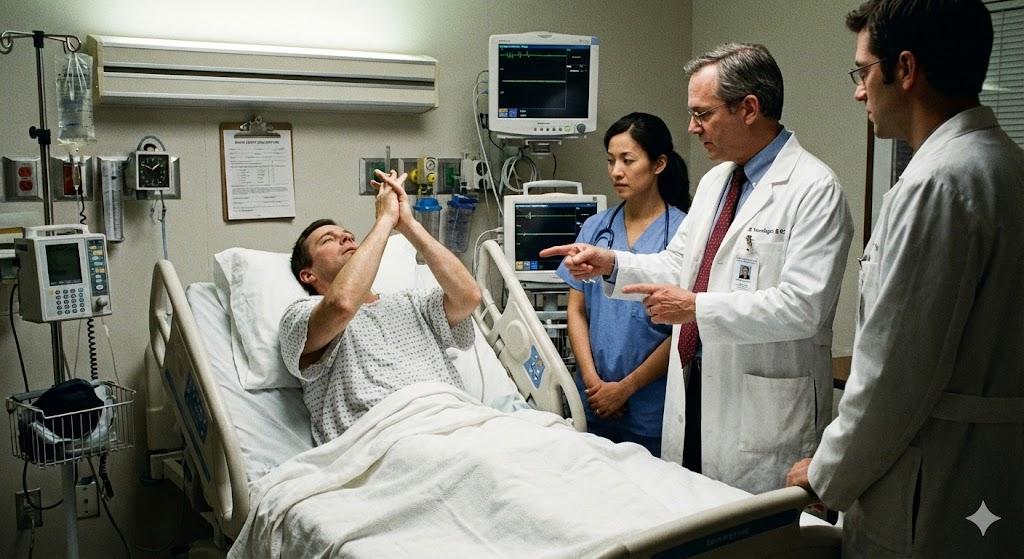
Visual representation of the Lazarus reflex (generated by artificial intelligence)
Preventing the occurrence of the Lazarus reflex and similar spinal reflexes during organ donation procedures or patient transfer is medically important.
Pharmacological Intervention: To prevent unwanted reflex movements, neuromuscular blocking agents (muscle relaxants) are recommended during patient transfer and organ retrieval surgery.
Dose Adjustment: In prolonged organ transplantation surgeries, repeated dosing should be considered based on the drug’s half-life.【5】
Warning: The content in this article is provided solely for general encyclopedic information. The information here should not be used for diagnosis, treatment, or medical advice. Always consult a physician or qualified healthcare professional before making any health-related decisions. The author and KÜRE Encyclopedia assume no responsibility for any consequences arising from the use of this information for diagnostic or therapeutic purposes.
[1]
Uyar, Emel and Ayşegül Ceylan. “Brain Death.” Guven Medical and Health Sciences. Accessed 17 January 2026. https://www.gms.org.tr/storage/app/uploads/public/665/851/480/66585148002b0943292550.pdf
[2]
Şahinkaya, Halide Hande and Mine Parlak. “Unexpected Event During Organ Retrieval: Lazarus Sign.” Turkish Society of Thoracic Cardiovascular Anesthesia and Intensive Care. Accessed 17 January 2026. https://gkda.org.tr/congress/26/bildiriler26/s26.pdf
[3]
Uyar, Emel and Ayşegül Ceylan. “Brain Death.” Guven Medical and Health Sciences. Accessed 17 January 2026. https://www.gms.org.tr/storage/app/uploads/public/665/851/480/66585148002b0943292550.pdf
[4]
Şahinkaya, Halide Hande and Mine Parlak. “Unexpected Event During Organ Retrieval: Lazarus Sign.” Turkish Society of Thoracic Cardiovascular Anesthesia and Intensive Care. Accessed 17 January 2026. https://gkda.org.tr/congress/26/bildiriler26/s26.pdf
[5]
Şahinkaya, Halide Hande and Mine Parlak. “Unexpected Event During Organ Retrieval: Lazarus Sign.” Turkish Society of Thoracic Cardiovascular Anesthesia and Intensive Care. Accessed 17 January 2026. https://gkda.org.tr/congress/26/bildiriler26/s26.pdf

History and Definition
Pathophysiology
Clinical Features and Signs
Role in the Diagnosis of Brain Death
Medical and Psychosocial Implications
Management and Prevention