


This article was automatically translated from the original Turkish version.
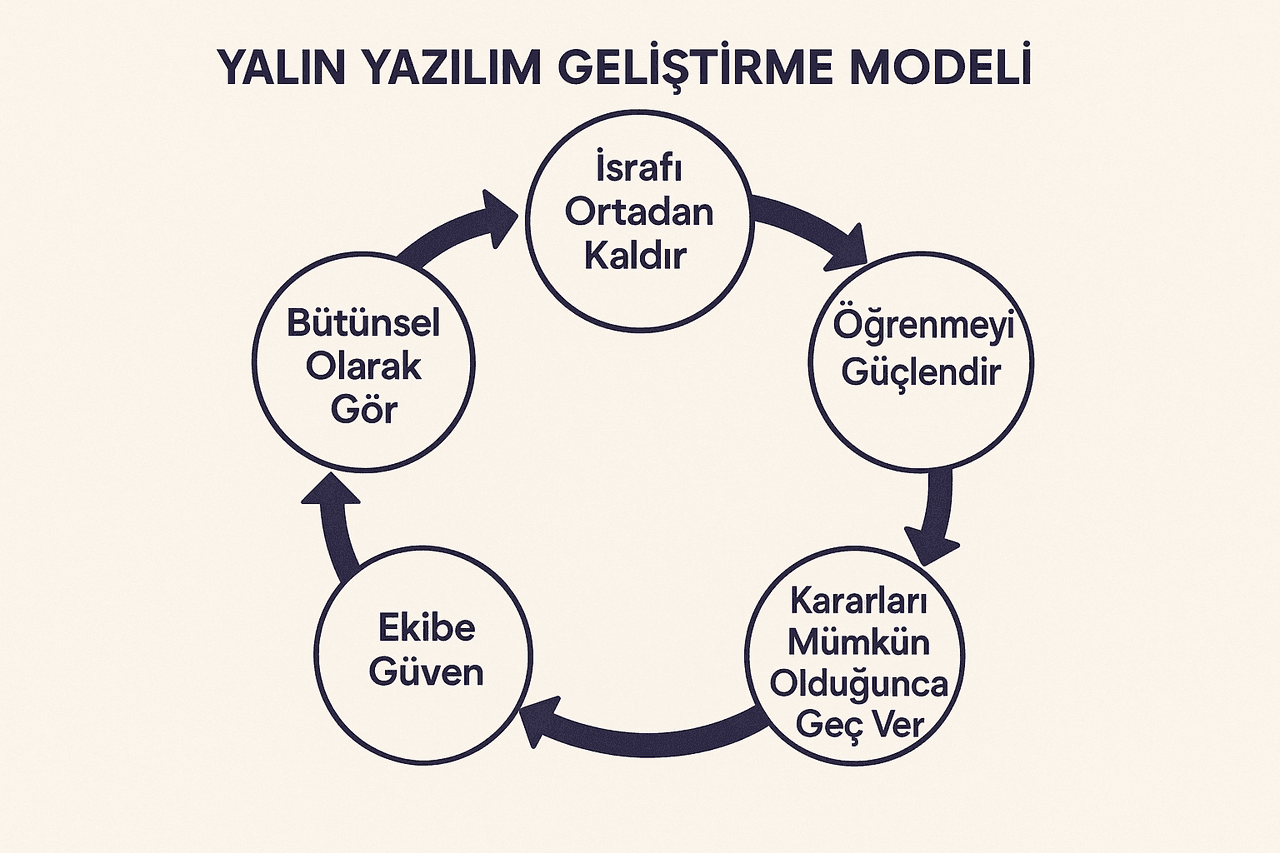
Generated with artificial intelligence.
Lean Software Development
Definition(s) | Lean Software Development is an approach adapted from the Toyota Production System (TPS) and Just-in-Time (JIT) principles and maximizing customer value in the software development process. increasing efficiency aimed at reducing waste | ||||||||
|---|---|---|---|---|---|---|---|---|---|
Seven Fundamental Principles | Optimize the Whole System Build Quality In Respect People and Strengthen Teams Deliver Quickly Delay Decisions Increase Learning Eliminate Waste | ||||||||
The Lean Software Development model, can be defined as an approach that adapts the core principles of lean manufacturing to software engineering, focusing on reducing waste, increasing efficiency, and maximizing customer value. Its origins lie in the Just-in-Time (JIT) production logic developed within the Toyota Production System (TPS) in the mid-20th century in the Japanese automotive industry. This philosophy was first applied in production management and later systematically conceptualized in the 1980s through research conducted at MIT.
Lean Software Development, inspired by lean manufacturing, aims to make the software development process more flexible, faster, open to learning, and responsive to customer feedback. This approach is not merely a set of specific practices but also encompasses a value system, a management philosophy, and a commitment to continuous improvement.
The history of lean philosophy extends back to Toyota’s development of a production system after World War II to achieve efficient production with limited resources. The Toyota Production System centered on the concept of waste, reducing inventory costs and increasing production efficiency by enabling workers to operate multiple machines and take responsibility for quality control on the production line. During this process, the flow of information was reversed through the use of Kanban cards, eliminating unnecessary intermediate stock.
In the mid-1980s, under the leadership of James Womack at MIT, the International Motor Vehicle Program (IMVP) saw John Krafcik conduct a detailed analysis of the production efficiency of Toyota and other Japanese automotive companies, introducing the term “lean” into the literature for the first time. The findings of these studies reached a broad audience with the 1990 publication of The Machine That Changed the World, and lean thinking began to be applied across various disciplines, starting with production management worldwide.
In the context of software development, practices such as Microsoft’s daily build approach in the 1990s exhibited similarities with Toyota’s JIT production philosophy. Microsoft’s daily build and synch and stabilize approach implemented the principle of building quality in by preventing the accumulation of defective products.
The 2003 book Lean Software Development: An Agile Toolkit 【1】 by Mary and Tom Poppendieck stands out as one of the first systematic efforts to adapt the fundamental principles of lean manufacturing to software engineering. The Poppendiecks transformed the five core lean principles previously used in manufacturing (value definition, value stream mapping, flow creation, pull system establishment, and pursuit of perfection) into seven core principles for software development.
These seven principles are:
In the lean approach, waste is defined as any activity that does not directly add value to the customer. Examples of waste in software development include unnecessary code and features, incomplete work, complex approval mechanisms, excessive bureaucracy, delayed feedback, buggy code, and repeated fixes. The Poppendiecks note that value stream mapping can be used in software development processes to make sources of waste visible.
Management and teams identify and plan to eliminate unnecessary tasks by discussing bottlenecks in each development iteration. This approach distributes the responsibility for continuously tracking and preventing waste across the entire team.
Unlike manufacturing, software development is an activity of discovery. Uncertainties arise throughout the process, and teams revise their understanding of how the software should function as they acquire new information. Therefore, continuous learning in lean software development is supported by techniques such as code reviews, knowledge sharing, and pair programming.
The Poppendiecks emphasize the “learn first” approach: critical decisions are delayed to maximize the accumulation of knowledge. Additionally, a minimum viable skill set is developed, and customer feedback is rapidly collected to prevent the software from becoming bloated with unnecessary features.
In traditional project management, decisions are made early; however, market volatility and technological uncertainties can quickly invalidate these decisions. Lean software development advocates postponing irreversible decisions and incorporating new information into the process. This approach necessitates building code in a flexible and modifiable manner.
In the lean approach, speed means both reducing time-to-market and accelerating feedback cycles. Early versions (Minimum Viable Product – MVP) are released to the market to learn from real user experiences. This allows errors to be detected early and corrected at low cost.
Fast delivery also requires viewing software development not as a project but as a continuous flow. Continuous Integration and Continuous Delivery are key practices in this context.
A key principle of lean philosophy is respect for people. Development teams are not merely executors of orders but are seen as knowledge workers who guide the process. Delegating decision-making authority to the team as much as possible enhances collaboration, creativity, and a sense of responsibility within the team.
Lean software development proposes that quality should be built into every step of the process, not just at the final testing stage. This understanding is supported by techniques such as Test-Driven Development (TDD), automated test suites, continuous integration, and code reviews.
Early examples of this principle include Harlan Mills’ top-down programming approach from IBM and Microsoft’s synch and stabilize philosophy. The goal is to detect and fix errors as early as possible to prevent costly problems from arising later.
In lean software development, optimizing the whole means avoiding behaviors that improve individual subsystems at the expense of the overall system. This phenomenon, known as suboptimization, can occur, for example, when developers write code rapidly but testing teams cannot keep up, leading to compromises in quality.
Therefore, the value stream is evaluated as a whole, bottlenecks are identified, and the entire process is ensured to flow smoothly. Visual management techniques such as Kanban contribute to holistic optimization by making every step of the process visible.
Lean software development is often regarded as a framework within the broader Agile approach due to many shared principles. Both approaches embrace incremental delivery, customer focus, and responsiveness to change. However, there are fundamental differences between them.
Agile is primarily product-oriented and aims to respond rapidly to customer requirements, while lean software development also emphasizes process optimization. In this context, Agile methods such as Scrum and Kanban can be viewed as tools for applying lean principles.
Lean software development is not merely a theoretical approach; it is supported in practice by various tools and techniques:
Kumar, Dasari Ravi. "Lean software development." The project perfect white paper collection (2005). Accessed Adresi.
Kupiainen, Eetu, Mika V. Mäntylä, and Juha Itkonen. "Using metrics in Agile and Lean Software Development–A systematic literature review of industrial studies." Information and software technology 62 (2015): 143-163. Accessed Adresi.
Poppendieck, Mary, and Michael A. Cusumano. "Lean software development: A tutorial." IEEE Software 29, no. 5 (2012): 26-32. Accessed Adresi.
Raman, Sowmyan. "Lean software development: is it feasible?" In *17th dasc. aiaa/ieee/sae. digital avionics systems conference. proceedings (cat. no. 98ch36267)*, vol. 1, pp. C13-1. IEEE, 1998.
Scrum Alliance. "What is Lean Software Development?" Accessed July 7, 2025. Accessed Adresi.
[1]
Poppendieck, Mary, and Tom Poppendieck. Lean software development: An agile toolkit: An agile toolkit. Addison-Wesley, 2003. Erişim Adresi.

Generated with artificial intelligence.
Lean Software Development
Definition(s) | Lean Software Development is an approach adapted from the Toyota Production System (TPS) and Just-in-Time (JIT) principles and maximizing customer value in the software development process. increasing efficiency aimed at reducing waste | ||||||||
|---|---|---|---|---|---|---|---|---|---|
Seven Fundamental Principles | Optimize the Whole System Build Quality In Respect People and Strengthen Teams Deliver Quickly Delay Decisions Increase Learning Eliminate Waste | ||||||||
No Discussion Added Yet
Start discussion for "Lean Software Development Model" article
Historical Background
Emergence of the Lean Software Development Model
Seven Core Principles
Eliminate Waste
Amplify Learning
Delay Commitment
Deliver Fast
Respect People
Build Quality In
Optimize the Whole
Relationship Between Lean Software Development and Agile Approaches
Application Practices